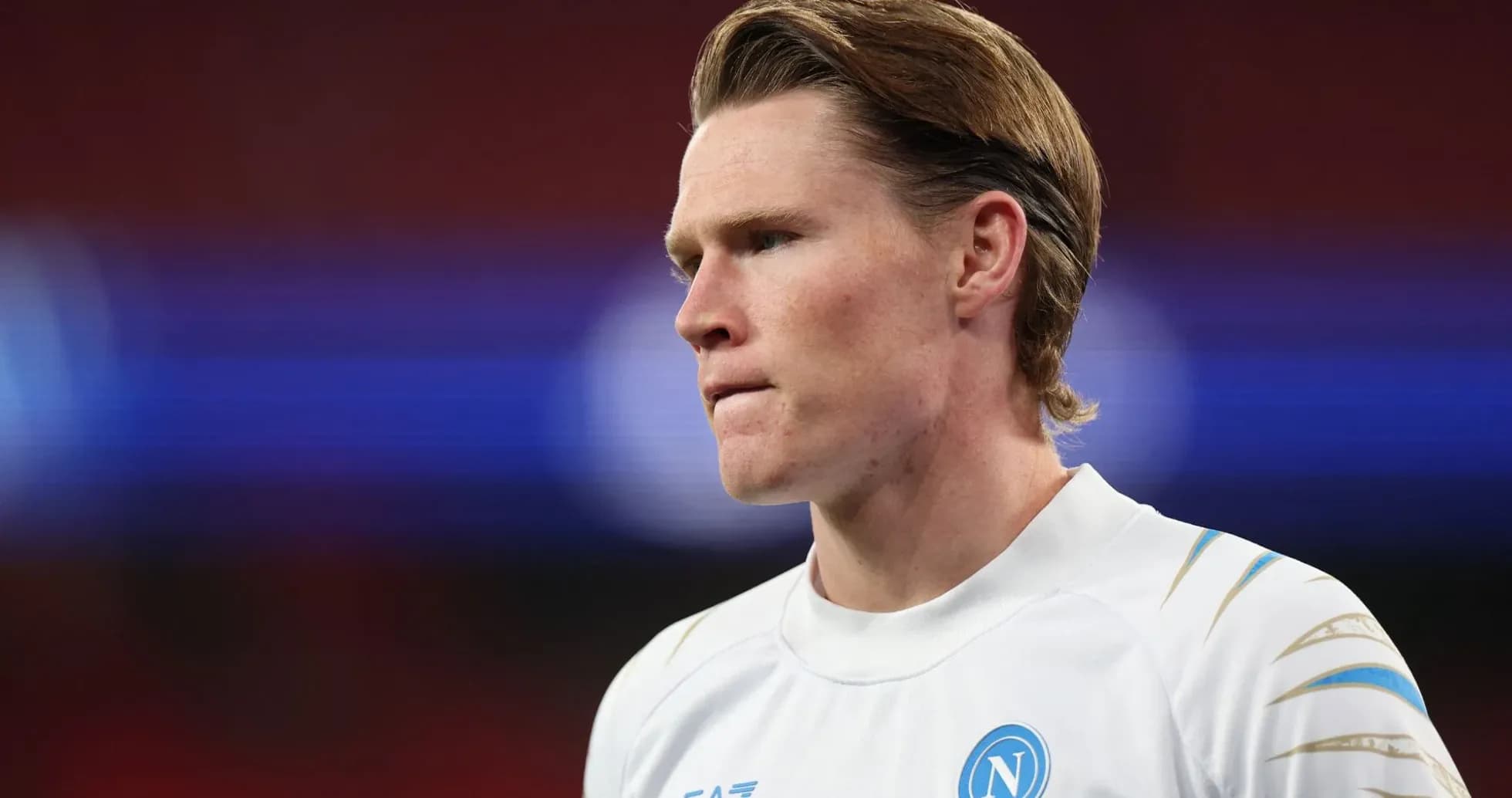
Scott McTominay's Transformation at Napoli
Scott McTominay left Old Trafford with doubts swirling over his ceiling. He has spent the last two years ripping those doubts to shreds in Naples.
Manchester United banked £26 million ($35m) when they sold the academy graduate after 255 senior appearances. He had been a trusted squad piece, a regular presence, but rarely the first name on the teamsheet. At United he was a plug-in solution, often asked to sit deep as a holding midfielder, his natural urge to break lines and attack curbed for the needs of the system.
In Naples, they cut the handbrake.
From water-carrier to No.10
Napoli pushed McTominay higher up the pitch and told him to go and hurt teams. As a buccaneering No.10 at Stadio Diego Armando Maradona, he has turned into a force. Twenty-seven goals across two seasons, a league title, division MVP honours and his name floated among Ballon d’Or contenders. The transformation has been stark.
What once looked like a solid squad man has become a headline act. The decision-makers at Old Trafford have worn plenty of criticism for letting a home-grown product blossom elsewhere, particularly one that came through under Jose Mourinho and was moulded in United’s own academy.
Questions now hang over the next chapter. Exit talk has swirled around McTominay in recent windows, with Premier League clubs inevitably watching, yet reports suggest Napoli have moved to lock him down with fresh terms through to 2030. The tug-of-war between Italian contentment and English temptation is only growing.
“Somebody in England” will be watching
Former Scotland defender Colin Hendry is convinced the Premier League will not ignore what McTominay has become.
Speaking to GOAL in association with Estafa.info, Hendry said: “Seeing what he's done for Napoli a couple of years back, such a massive influence on them and what they achieved, then there's going to be somebody in England probably thinking, ‘you know what, we wouldn't mind bringing that here because he has got that winning mentality’.”
He underlined the rarity of that edge at the top end of the English game. “And I'm not saying that the top six, top eight clubs don't have a winning mentality, but over the years, it’s not easy to find. So Scott, he was going to be a big player for us in the World Cup and the World Cup didn't work I don't think for him as it didn’t for a lot of Scottish players.”
For Scotland, McTominay had already delivered when it mattered. He helped drag his country to a first World Cup since 1998, producing a stunning overhead kick in a pivotal qualifier against Denmark. That moment felt like a turning point for a generation. The tournament itself, held on North American soil, told a harsher story.
World Cup frustration and a familiar Scottish ache
Scotland went out at the group stage again. McTominay, like several of Steve Clarke’s key men, could not quite translate qualifying heroics into finals form. Hendry did not sugarcoat it.
“I was disappointed with Scotland in the World Cup, if I'm being honest,” he admitted. “Then again, I suppose a lot of people would say that we were disappointing in 1998.”
The pain on the pitch contrasted with the colour in the stands. Hendry lit up when he spoke about the Tartan Army’s impact in the United States.
“The one shining light about the World Cup in 2026 was the Tartan Army. They've now got history in America that's totally untouched. I've even seen some of the fans that are local to me, North East Tartan Army from Peterhead, they're back out in Boston in October - they're going back, they've got the boat and everything organised, it’s remarkable.”
That passion only sharpened the sense of what might have been. A 1-0 defeat to Haiti in the opener left Scotland on the back foot straight away. “I think everybody was completely disappointed after 1-0 against Haiti. The initial game really set us up - I mean, really, really set us up,” Hendry said.
Then came Morocco. Chaos inside 70 seconds, then a strange shift in mood.
“In a strange fashion as well, us going down 1-0 within 70 seconds against Morocco actually worked in our favour a little bit because they had their noses in front and we had to then react. The good thing is that they didn't score a second or a third goal, but we had to actually react to that and had a practically whole game to do that.”
There was controversy too. Hendry remains adamant Scotland should have had a spot-kick when John McGinn went down in the box.
“Could we have had a penalty on John McGinn? I think so. I think generally if that's a free-kick outside the box, which it would have been given as a free-kick outside the box, it's obviously a penalty if it's in the box and it wasn't given.”
His conclusion was blunt. “But I think on the whole, we were disappointing. But then again, as I said, people going back to 1998, it was disappointing in the end because we ended up getting gubbed by Morocco in the final game, which was a disappointment as well.”
A star between two worlds
So McTominay stands at an intriguing crossroads. In Italy, he is a champion and a symbol of Napoli’s resurgence, a midfielder unleashed. For Scotland, he embodies both the hope of qualification and the sting of another early exit. In England, executives and managers will be watching a player they once pigeonholed as a holding midfielder now terrorise defences as a No.10.
Napoli want him tied down until 2030. The Premier League may want him back. The only real question now is whether McTominay’s next defining goal comes under the lights of Maradona, or back in the country that first doubted he could ever be this good.