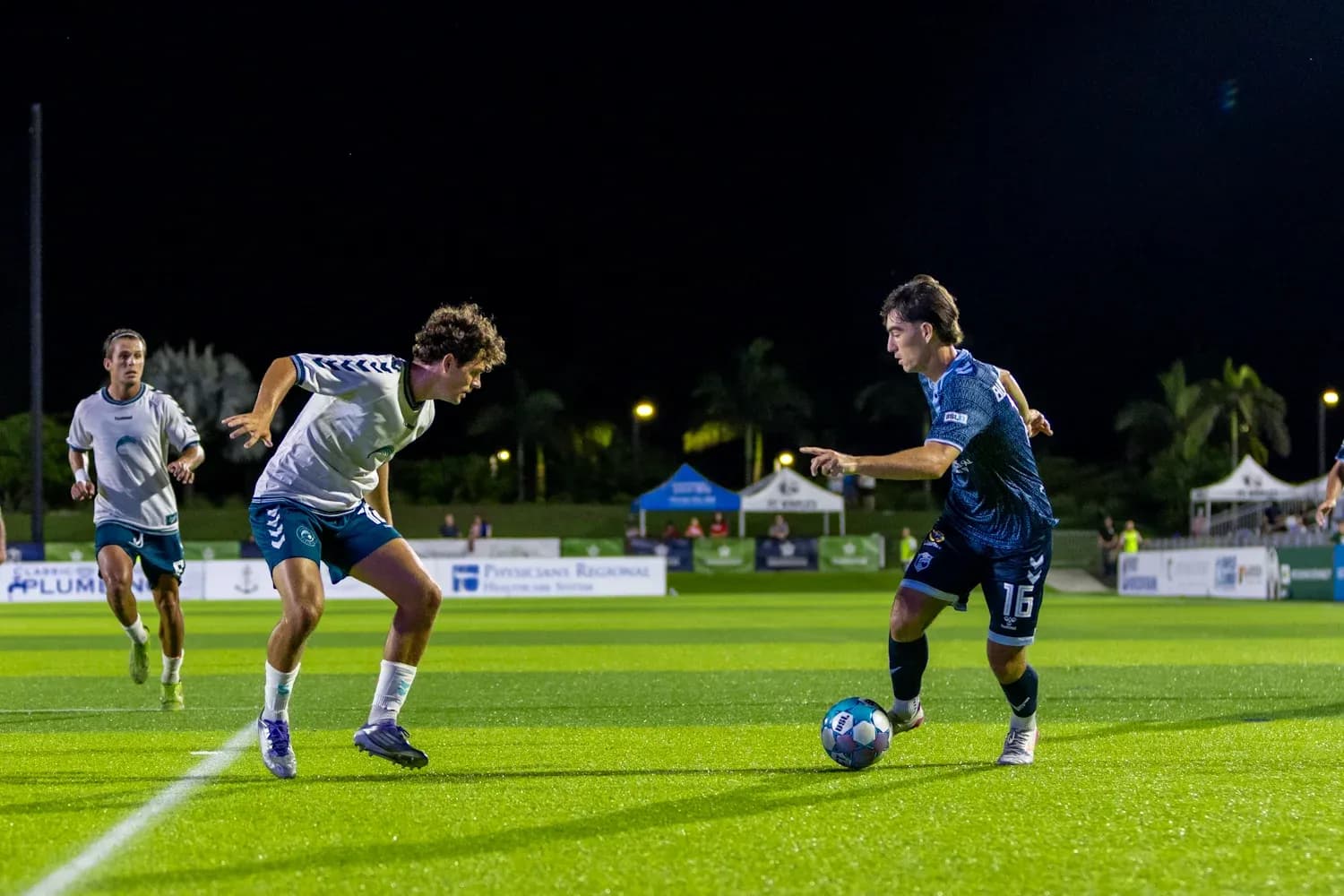
Sarasota Paradise Defeats Naples 2–0 in USL League One Cup
Under the lights of the Paradise Coast Sports Complex, this USL League One Cup Group 7 meeting ended with a clear verdict on the scoreboard: Naples 0–2 Sarasota Paradise, a result that reshapes the narrative of both squads in this early-stage competition.
I. The Big Picture – Group 7 tension on Florida turf
Heading into this game, both sides were already living on fine margins in Group 7. Naples arrived with a fragile campaign identity: in total this season they had played 3 fixtures, winning 1 and losing 2, with 3 goals scored and 7 conceded. Their overall goal difference of -4 (3 scored, 7 against) mirrored the table’s warning sign, where they sat 5th with 2 points and a goal difference of -3 over the wider group phase.
At home, Naples had been slightly more competitive. In total this campaign at home they had played 2 matches, winning 1 and losing 1, scoring 2 and conceding 3. An average of 1.0 home goal for and 1.5 home goals against underlined a team that can land punches but struggles to keep the door shut.
Sarasota Paradise, by contrast, came in as a side still trying to define themselves. Overall they had played 3 games, with 1 win and 2 defeats, scoring 2 and conceding 4. Their total goal difference of -2 (2 for, 4 against) matched their 4th place in the group with 3 points. On their travels, though, Sarasota had shown a sharper edge: away they had played 2, winning 1 and losing 1, scoring 2 and conceding 2, with an away scoring average of 1.0 and away defensive average of 1.0.
This fixture, then, was a clash between Naples’ uneven home resilience and Sarasota’s balanced away profile. The 0–2 full-time scoreline confirmed Sarasota’s travelling pedigree and deepened Naples’ identity as a side that bleeds too many goals for its modest attacking return.
II. Tactical Voids and Discipline – Edges in the margins
The lineups told their own story. For Naples, coach Matthew Poland leaned on a core of hard-working, multi-role players. J. Grant (99) and G. Miglietti (9) led a flexible front line, supported by the energy of J. Osorio (8) and the width of C. Garcia (11). At the back, the likes of J. Cisneros (3) and M. Torrellas (21) were tasked with stabilising a defence that, heading into this game, had conceded 7 in total.
On the bench, Poland had different profiles to change the rhythm: the creative spark of A. Ferrin (10), the physical presence of K. O’Connor (14), and the fresh wide legs of T. Gray (7) and W. Arevalo (19). But Naples’ season-long numbers hinted at a structural issue rather than a simple personnel tweak. They had yet to keep a single clean sheet, either at home or away, and had already failed to score once overall – a warning that if the first wave of pressure didn’t bring a breakthrough, they could run out of ideas.
Discipline has also been a quiet underminer for Naples. Their yellow card distribution shows a clear spike after the interval: 40.00% of their cautions come between 46–60 minutes, with further pockets at 31–45 (20.00%) and 76–90 (20.00%). There is also a red card on their ledger in the 46–60 window. That profile suggests a team that comes out of half-time over-aggressive, perhaps chasing games, and paying the price.
Sarasota’s coach, Mika Elovaara, named a side built around technical control and vertical threat. The spine of R. Burlew (2), D. Watters (4) and R. Valentine (3) gave structure at the back, while the midfield and attack carried a mix of guile and direct running: E. Bryant (7), J. Bender (9), M. Tainio (20) and S. Karani (11) forming a fluid attacking box that could overload central zones or break wide in transition. Behind them, A. Rodriguez (16) and H. Backstrand (22) offered connective tissue between lines.
Sarasota’s disciplinary map is different but equally telling. They spread their yellows across the game, but there is a pronounced late spike: 37.50% of their yellow cards arrive between 76–90 minutes, with another 25.00% in the 46–60 window. That profile points to a side that defends aggressively when protecting leads or weathering late pressure, but crucially, they have no red cards recorded. They walk the line, but they stay on the pitch.
III. Key Matchups – Hunter vs Shield, Engine Room vs Enforcer
Without individual goal or assist tallies, the “Hunter vs Shield” duel is better framed as unit vs unit.
Naples’ attacking unit of Grant, Miglietti and Garcia is tasked with lifting an overall scoring rate of 1.0 goals per game, both at home and away. Their biggest home win – 2–1 – shows they can construct multi-goal performances in this stadium, but their total output of 3 goals in 3 fixtures is too thin to offset a leaky back line.
They ran into a Sarasota defence that, heading into this game, had conceded 4 in total across 3 matches, for an overall average of 1.3 goals against, and just 1.0 away. Sarasota’s biggest away win, 0–2, underlined how comfortable they can be playing compact and striking clinically; that exact scoreline repeated itself here, reinforcing the away side’s identity as a counter-punching outfit that doesn’t need volume of chances to decide games.
In the “Engine Room” matchup, Naples’ midfield trio of Osorio, J. Yearwood (20) and I. Cerro (30) had to solve Sarasota’s central block marshalled by players like Rodriguez and Tainio. Naples’ season-long pattern – conceding 2.3 goals per game overall – hints that their midfield screen has not been sufficiently protective, exposing a back line already under strain. Sarasota, by contrast, operate with a more balanced profile: 0.7 goals scored overall, 1.3 conceded, but with a clean sheet already banked away from home. Their central players seem more comfortable controlling game tempo when ahead, even if they are not prolific going forward.
IV. Statistical Prognosis – What this result says about both squads
Following this result, the statistical currents around both teams harden rather than soften.
For Naples, the story is of a side whose defensive frailty overwhelms their attacking intentions. Conceding 7 in total before this match, and now adding two more at home without reply, extends a trend: they are consistently allowing opponents to reach or exceed their own scoring output. With no clean sheets and an average of 2.3 goals against per game heading into the fixture, their margin for error is almost non-existent. Any tactical preview of their next outings must start with structural defensive repairs and a calmer approach after half-time, where their card and red card spikes have repeatedly put them under pressure.
Sarasota Paradise, on the other hand, continue to build a quiet but clear away identity. They arrived with an away record of 1 win and 1 defeat, 2 scored and 2 conceded, and an away clean sheet already in the bank. Another 0–2 win on their travels reinforces the idea of a side that is comfortable absorbing pressure, relying on the mobility of Bryant, Karani and Bender to turn defensive stops into decisive counters.
Discipline will remain a subplot for both. Naples must find a way to avoid that combustible 46–60 period, where a red card has already cost them and 40.00% of their yellows cluster. Sarasota’s late-game aggression – 37.50% of yellows between 76–90 minutes – is a double-edged sword: it fuels their resilience but risks suspensions and momentum swings if it tips over the line.
From a pure statistical prognosis, Sarasota’s more balanced goals against profile and their proven ability to keep clean sheets away make them the more stable proposition in this group. Naples, unless they can drag their goals against average closer to Sarasota’s 1.3 overall and 1.0 away, will remain a high-variance side: capable of moments, but too porous to sustain a serious run in the USL League One Cup.
On this night in Naples, the numbers and the narrative aligned. Sarasota Paradise left with another 0–2 away win, and with it, a clearer tactical identity. Naples were left with hard questions about their structure, their discipline, and the kind of team they want to be in the crucible of Group 7.