Raphinha's Transformation: From Ballon d’Or Snub to Barcelona's Star
A year ago, Raphinha’s season was wrecked by his own body. Persistent hamstring problems stole 125 days from him, sliced his numbers in half and turned what should have been a World Cup showcase into a personal nightmare. Sixty goal contributions in 2024-25 crashed down to 29. The Ballon d’Or he had flirted with slipped away.
This year, he didn’t even make the 30-man shortlist. Hansi Flick could barely hide his disgust.
“He is far too good not to be on that list, but we can’t change it,” the Barcelona coach said, bristling with certainty after watching his Brazilian captain tear into Europe from a new, central role.
A false nine with a killer’s instinct
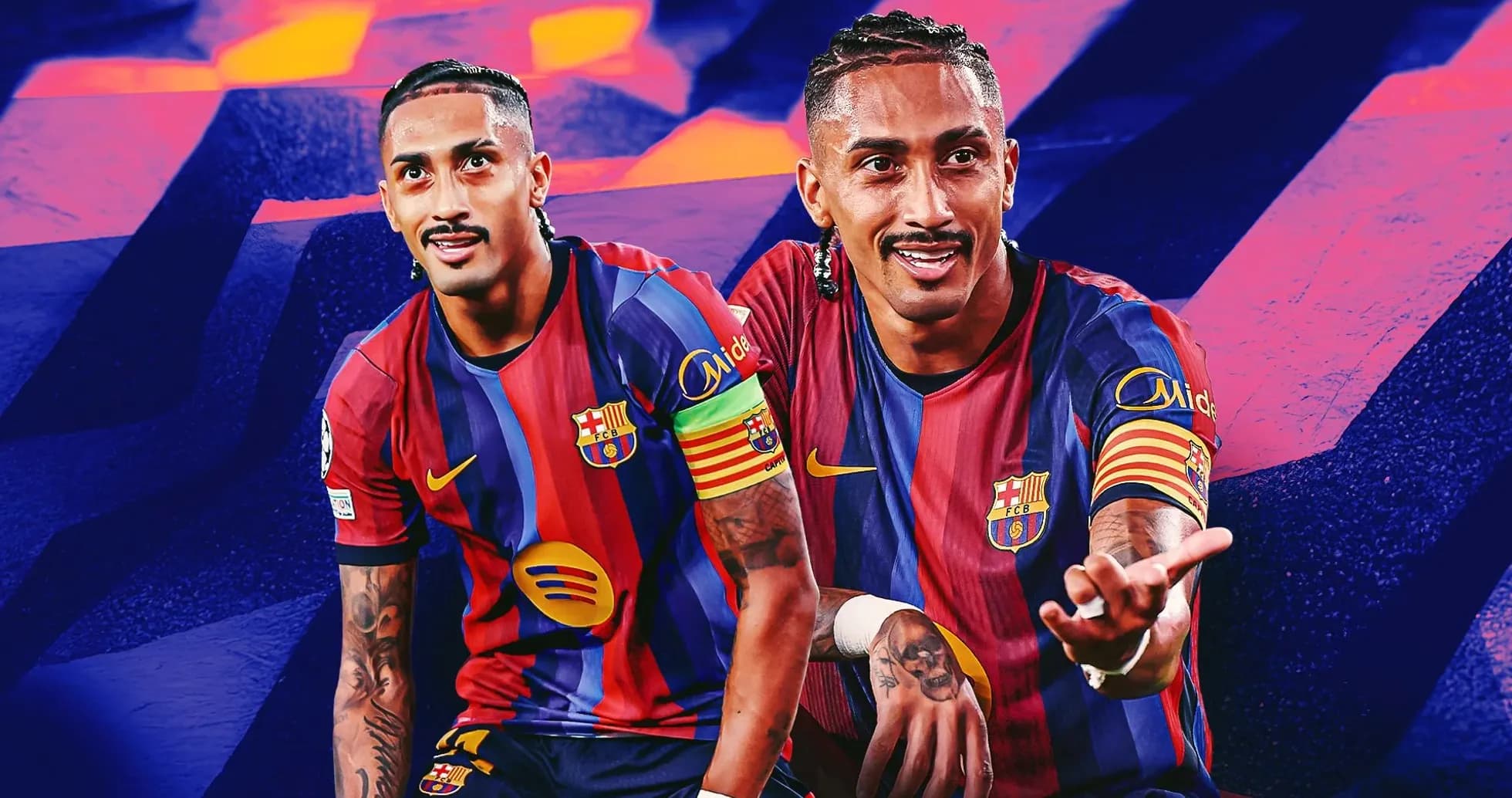
Under Flick, Raphinha has drifted away from the touchline and straight into the heart of the pitch. The switch has changed everything – for him and for Barca.
His Champions League opener against Feyenoord felt like a statement of intent. Two goals, endless menace, and a performance that looked like it had been lifted from the prime years of a Ballon d’Or winner.
The first goal was pure theatre. He took a slightly wayward pass from Lamine Yamal, slipped past one defender, glided into the box and shaped to shoot. Then came the pause. The dummy. Two Feyenoord defenders collapsed to the turf, sold completely, while Raphinha simply waited for the lane to open and rolled the ball in with icy calm.
The second was classic centre-forward craft. He initially checked towards the ball when Dani Olmo picked it up in the centre circle, then exploded in the opposite direction, leaving his marker stranded. Olmo’s pass sliced through the gap, Raphinha met it in full stride and drove his finish across a helpless goalkeeper. Textbook movement. Ruthless execution.
Barca ran out 5-1 winners. Raphinha walked away with Player of the Match and the aura of a man playing on a different plane. Right now, he carries himself like the best player in the world – and his coach is not shy about saying so.
“Rapha has played fantastic,” Flick said. “He’s on another level – he’s unbelievable.”
The numbers agree. Raphinha already has 11 goals this season, a blistering start unmatched by any Barca player in the last 60 years. Lionel Messi reached 10 in his first seven games of 2012-13 and hit nine by this stage twice more. Ronaldo hit nine in 1996-97. Raphinha has gone past them all.
Flick’s perfect frontman
This is not just about goals. It’s about how he has rewired Barca’s attack.
Robert Lewandowski was a master with his back to goal. Ferran Torres attacked space with clever, angled runs. Raphinha, at 29, is something else entirely – the ideal spearhead for Flick’s fluid, high-tempo system.
He doesn’t stay fixed between the centre-backs. He floats. He drops into pockets, then darts beyond the last man. He uses explosive acceleration and tight control to drag defenders into places they don’t want to go, stitching moves together before suddenly becoming the finisher.
His movement opens corridors for Yamal and Anthony Gordon on the flanks. It also creates chances for himself, because he reads space quicker than the defenders tracking him.
Racing Santander discovered that the hard way.
In Barca’s 7-2 La Liga demolition, Raphinha hit a hat-trick. Two from the penalty spot, one that underlined exactly why Flick trusts him as the central reference. Again, Olmo was the architect. Again, Raphinha’s timing was perfect.
He ghosted into the gap between Racing’s centre-backs, waited for the ball, then needed just a single touch before guiding a half-volley into the corner. No fuss, no panic. Just a striker who looks like he has been playing through the middle all his life.
On the ball, he makes everything look simple. Off it, he’s a machine. Barca’s high press begins with him charging down defenders, forcing rushed clearances and bad decisions. Flick demands intensity and dynamism from his forwards. Raphinha delivers both, and he does it with a clinical edge.
It’s no wonder the coach is quietly relieved the club never landed Julian Alvarez. The frontline is humming, and the money can now be used to reinforce other areas in the next transfer windows.
Chasing a Brazilian ghost: the shadow of R9
Barcelona know what it means to be lit up by a Brazilian. Romario, Rivaldo, Ronaldinho, Neymar – the lineage is rich. Yet one season still stands apart: Ronaldo’s.
In 1996, Barca paid a then-world record $19.5 million to bring a 20-year-old Ronaldo from PSV. In 49 games, he scored 47 goals. He won the Copa del Rey, the UEFA Cup Winners’ Cup and the Supercopa de España, and left defences shredded by raw power, frightening pace and laser-guided finishing.
He claimed the Pichichi with 34 league goals, took the European Golden Shoe and topped the 1997 Ballon d’Or voting. The memories from that season are burned into the club’s history: the solo slalom against SD Compostela, the hat-trick that dragged Barca to a 4-3 comeback over Atletico Madrid in the Copa del Rey.
“He is the most spectacular player I’ve ever seen,” Sir Bobby Robson said at the time.
Laurent Blanc added: “I’ve never seen anyone with that velocity and power. He was like a freight train coming at you with a ball at his feet.”
Ronaldo – R9 – was a fixed spearhead, a pure No.9. Raphinha roams more, drops deeper, interchanges. Yet the similarities are hard to ignore: the directness, the speed, the courage to attack defenders one-on-one, the instinct to kill a game in seconds.
If he sustains this level, matching Ronaldo’s output no longer sounds far-fetched. The challenge is not just goals, but trophies. Ronaldo delivered silverware in a single, incandescent year. Raphinha has the chance to turn his own peak into something even more significant – a treble-leading season that would etch his name alongside the greatest.
The captain who almost walked away
What makes this transformation even more striking is how close it came to never happening.
Raphinha’s first two years at Camp Nou under Xavi were underwhelming. Flashes of quality, yes, but no sustained run, no guaranteed starting place. By 2024, a parting of ways felt inevitable.
Then Flick arrived and saw something others were prepared to move on from. He didn’t just keep Raphinha. He handed him the keys.
With Marc-André ter Stegen sent on loan to Ajax in the summer, Flick had no doubts about the new captain. Raphinha became Barca’s permanent skipper – the first Brazilian ever to wear the armband in Catalonia.
He has responded with authority. His work rate, his willingness to press, his refusal to switch off – they set the standard for a young, ambitious squad. When games become frantic, he doesn’t wait for someone else to take control. He grabs them himself.
Off the pitch, he refuses to indulge in self-congratulation. After his hat-trick against Racing, he cut through the hype with a simple message.
“I will never say I am performing well; I always strive to improve everything I can,” he said. “I am happy with the goals, and with the win, and that is the most important thing, but we have to keep improving.”
He insists he feels “comfortable” through the middle and openly credits Flick for reshaping his game and mindset. “He is the coach who changed the way I think and how I see myself,” Raphinha said. “I am extremely grateful.”
The gratitude runs both ways.
A front line with options – and a plan to protect its star
Raphinha might be the figurehead, but Flick has built an attack that doesn’t crumble without him.
Gordon, Karim Adeyemi and Gabriel Jesus have all settled quickly since arriving in the summer. Hamza Abdelkarim, an 18-year-old Egyptian striker, has stepped up from Barca B to give Flick another profile to work with.
“Raphinha, Gabby and Hamza are three different profiles, but there are other ways we could play,” the German coach explained. “Anthony and Karim can also play in this position (as striker). Or Dani Olmo. Dani has showed us in last two years he can play there – the same with Fermin Lopez. We have a lot of options.”
Those options are not just tactical toys. They are a shield. Raphinha’s body betrayed him once; Barca cannot afford a repeat. Flick has moved decisively to protect him, substituting his captain early in the win over Feyenoord and in league victories against Athletic Club and Racing. Every minute he spends on the bench now is an investment in the months that matter most.
The same caution applies to Yamal. The teenager has become even more dangerous playing closer to Raphinha, their understanding sharpening by the week. Their link-up is brutally simple and almost impossible to defend: the instant a centre-back shifts his weight towards Yamal, the youngster slips the ball inside, trusting that Raphinha is already sprinting into the blind-side channel.
There is no battle for status between them. Yamal seems content to let Raphinha occupy the spotlight. The dressing room brims with star power, yet egos stay in check. The collective comes first, and the captain embodies that more than anyone.
From snub to legacy
Barcelona have seen Brazilian brilliance before. They have watched idols come and go, leaving behind highlight reels and broken records. Yet no Brazilian has quite managed to eclipse Ronaldo’s single-season storm.
Raphinha is not there yet. But he is leading, scoring, pressing and creating as if he intends to get there.
The Ballon d’Or panel left his name off the list. Flick didn’t. Barca didn’t. The captain’s armband didn’t.
If he keeps this up, the question will not be why he was snubbed this year. It will be where his name belongs in the club’s Hall of Fame – and whether, one day, it sits right alongside R9’s.