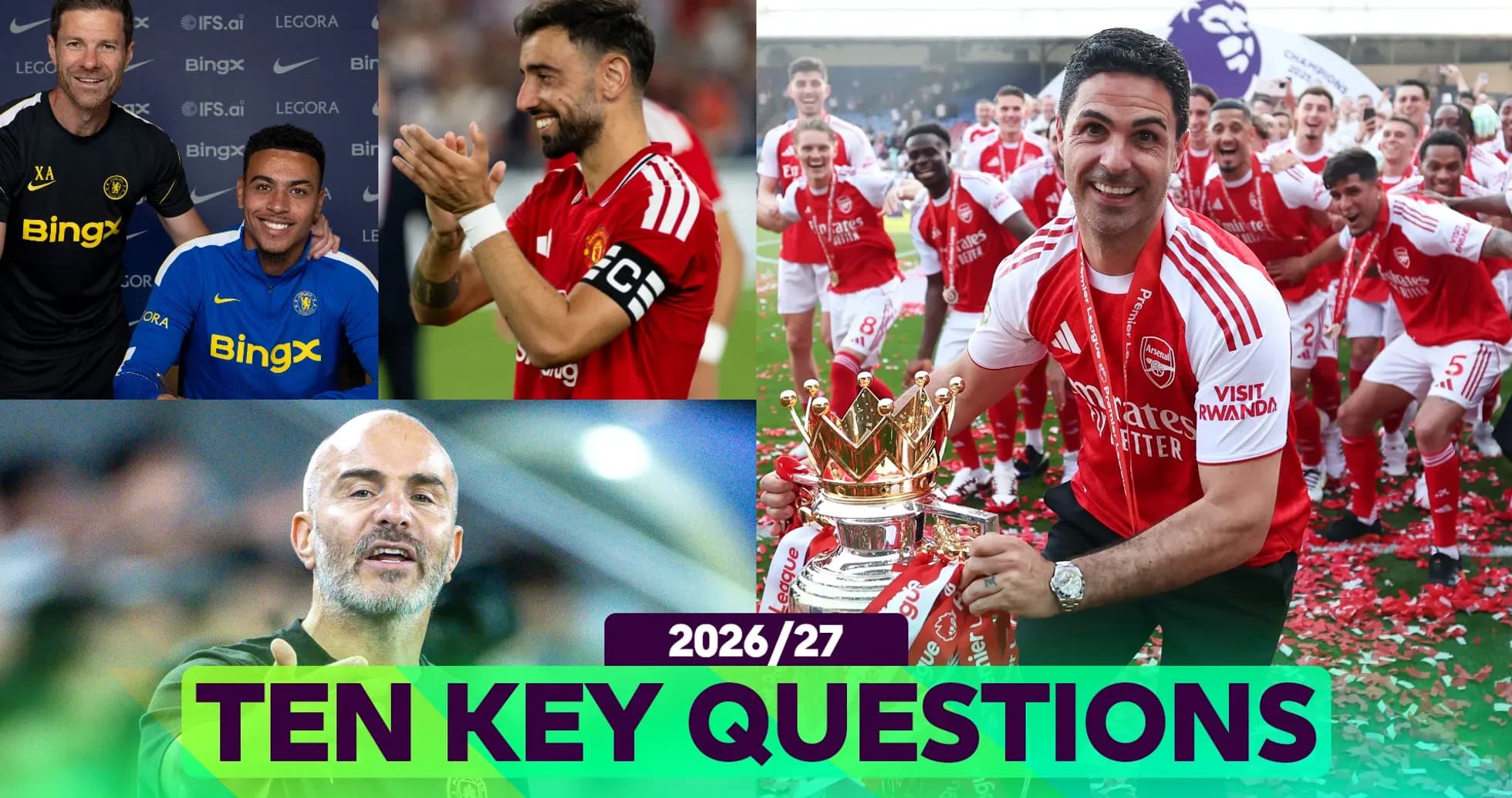
Premier League 2026/27: One Champion, Nine New Managers, and a Season of Change
The new Premier League season is almost here, and the familiar storylines have been ripped up. Five of the traditional “Big Six” are starting again with new projects. Nine clubs kick off with new managers. The Guardiola era is over. Klopp has gone. The axis of the league has shifted.
In the middle of all this turbulence stands something rare in modern English football: stability. Arsenal, champions at last under Mikel Arteta, look and feel like the grown‑ups in the room.
Arteta, experience and a rare shot at dominance
Only three managers have ever retained the Premier League title: Pep Guardiola, Sir Alex Ferguson and Jose Mourinho. Thirty‑four years of the competition, three names. It is brutally hard to go again.
Arteta might never get a better chance.
Arsenal arrive into 2026/27 with their core intact, their ideas embedded, and the weight of that long title drought finally lifted. Five years of building culminated in last season’s triumph; now they move from hunters to hunted with a group that looks comfortable with the responsibility.
Around them, the giants reset. Michael Carrick enters his first full season at Manchester United. Roberto De Zerbi starts his first from day one at Tottenham. Liverpool, Chelsea and Manchester City all begin new eras under new men. Arsenal, for once, are the ones who already know exactly who they are.
That matters most in Manchester. With Guardiola gone, the Premier League contains just one manager who has previously won the title: Arteta. The psychological shift is obvious. The coach who learned under Guardiola now stands as the division’s benchmark, just as City lose the man who defined their dynasty.
If ever there was a window for Arsenal to become the first non-Guardiola side in over a decade to truly dominate the league, this is it.
City after Pep: continuity or collapse?
Manchester City are standing at a crossroads that could define the next decade of the club.
Enzo Maresca inherits not just a team, but a monument. Guardiola’s City smashed records, bent tactics to his will and made winning look inevitable. Following that is the hardest job in English football.
History offers two templates. Arne Slot stepped into Jurgen Klopp’s shoes at Liverpool and delivered immediate continuity. Unai Emery and David Moyes walked into the shadows of Arsene Wenger and Ferguson and found only turbulence.
City have tried to tilt the odds. Instead of breaking from the Guardiola model, they have doubled down on it. Maresca is a Guardiola disciple, a possession-obsessed coach whose ideas track closely with his former boss. The club have chosen philosophy over rupture.
But the dressing room is changing. Bernardo Silva and John Stones have gone, taking with them experience, technical security and a deep understanding of Guardiola’s demands. Maresca must recreate the magic without the man who built it and without some of his most trusted lieutenants.
Does the Guardiola blueprint live on through a protégé, or does the absence of the original architect expose the fragility of an era that looked indestructible?
Alonso at Chelsea: the next great Premier League coach?
Of all the new faces on Premier League touchlines, one name crackles with intrigue: Xabi Alonso.
An invincible season with Bayer Leverkusen in 2023/24 turned him from promising young coach into one of the most coveted managers in world football. Now he lands at Chelsea at a time when Klopp and Guardiola have exited the stage. The vacuum at the top is obvious. Alonso has the pedigree to fill it.
The conditions are ripe for a fast start. Chelsea have no European football this year, a luxury that allowed Antonio Conte to drill his ideas in 2016/17 and charge to the title. Only six managers have ever won the Premier League in their debut season; three of them did it at Chelsea. Alonso joining Conte, Jose Mourinho and Carlo Ancelotti in that group is not a fantasy.
The squad is already strong and, crucially, has finally been balanced with experience. Danny Welbeck and Jordan Henderson are the first over‑30 signings of the BlueCo era, a symbolic break from the youth‑only strategy. It hints at a club that has learned from chaos and is ready to hand a serious manager a serious platform.
Give Alonso free midweeks, a receptive dressing room and the time to embed his high-level tactical ideas, and Chelsea could jump several rungs in one season.
The return of chaos football?
Last season didn’t lack goals, but it felt different. The numbers back that up. Goals per game dipped slightly from 2.40 to 2.36, yet the bigger story lay in open-play Expected Goals. After a 2023/24 campaign that produced 865.8 open-play xG (2.28 per match), that figure dropped to 692.1 (1.82 per match) in 2025/26. Attacks slowed. Set-pieces and structure took over.
The new wave of managers is poised to drag the league back into chaos.
De Zerbi arrives at Spurs preaching hard pressing and relentless attacking football, ideas he never had the time to fully implement late last season. Andoni Iraola brings his high-octane, “heavy-metal” approach from Bournemouth to Liverpool, a style many at Anfield had longed for.
Alonso’s Leverkusen and Real Madrid teams scored freely. Bournemouth’s new boss Marco Rose comes from the RB Leipzig/Borussia Dortmund school of aggressive, vertical football. At Crystal Palace, Pierre Sage is another coach who lives for fast breaks and intense pressing.
The pattern is clear: the tactical pendulum is swinging back towards risk, speed and open games. If 2023/24 was the wild high point of end-to-end football, 2026/27 is shaping up as its sequel.
Can Carrick turn a surge into a title challenge?
Manchester United’s story under Carrick has moved quickly.
Appointed caretaker on 14 January, he watched his side beat Manchester City 2-0 three days later. That result sparked a run that changed his status and, potentially, United’s trajectory.
Look at the league table from his appointment to the end of the season. Over those 17 games, almost half a campaign, United sat top:
Man Utd: P17 W12 D3 L2 – 39 points
Arsenal: P17 W11 D3 L3 – 36 points
Man City: P17 W10 D5 L2 – 35 points
Bournemouth: P17 W7 D10 L0 – 31 points
Liverpool: P17 W7 D4 L6 – 25 points
Repeat that form over 38 matches and United win their first Premier League title since 2013. Football rarely follows such neat lines, but the evidence is there: under Carrick, they have performed like champions.
His task is deceptively simple: maintain the standards of those five months while the rest of the league reshapes itself. In a season of upheaval, continuity of performance could be enough to drag United back into a race they have watched from distance for too long.
The season of the comeback?
New managers mean new hierarchies, and with them, fresh oxygen for players who drifted to the margins.
This could be the year of the comeback star.
Phil Foden and Cole Palmer both endured disappointing campaigns and missed out on England’s World Cup squad. Their talent is not in doubt; their motivation now is obvious. Marcus Rashford and Mason Mount face a fight to reclaim their status at Manchester United.
Harvey Elliott, Omar Marmoush and Andy Robertson all struggled for minutes last season. Under new regimes and with new tactical demands, they have a chance to reset their careers.
Yoane Wissa will look for a lift under a new manager. Levi Colwill and Alexander Isak, both hit by injury, return as almost forgotten figures with the ability to transform their teams’ ceilings.
Across the league, reputations are on the line. The sheer volume of change on the touchlines guarantees that some big names will rise again.
Villa and Newcastle rip it up
Twelve months ago, Aston Villa and Newcastle United were the continuity projects, tipped as Champions League contenders precisely because so little had changed.
This summer, everything has.
At Newcastle, the scale of the overhaul is stark. Eddie Howe’s resignation and the arrival of Matthias Jaissle mark a dramatic shift in direction. The new coach must do it without arguably his three best players: Bruno Guimaraes, Anthony Gordon and Sandro Tonali have all gone.
Their replacements – Lukas Hornicek, Bazoumana Toure, Aladji Bamba, Sean Steur and Ewen Jaouen – arrive for significant fees and with strong reputations. It is bold, it is risky, and it leaves Jaissle trying to build a new core from scratch.
Villa’s transition is softer but still significant. Unai Emery remains, yet there is a clear sense of one cycle ending. Youri Tielemans, Morgan Rogers and Lucas Digne have departed. In their place come Alejandro Garnacho, Johan Manzambi and Joao Gomes, signings that carry genuine excitement.
Both clubs spent last season consolidating. This time, they must prove they can evolve without losing what made them dangerous in the first place.
Europe: dream or drain?
Nine Premier League clubs qualified for Europe last season. For those new or relatively new to midweek continental football, the thrill comes with a warning label.
The recent evidence is mixed. Aston Villa lifted the UEFA Europa League and still finished fourth. Crystal Palace slipped to 15th in the league but would not trade that for their UEFA Conference League triumph.
At the other end, Nottingham Forest, Spurs and Newcastle all fell into the bottom half, seemingly weighed down by the extra fixtures.
This year brings fresh experiments. Brighton & Hove Albion enter the Conference League for the first time and only their second European campaign ever. They will look to emulate Palace’s ability to balance domestic and continental demands. Palace themselves should be better equipped now to handle a Europa League schedule.
Bournemouth and Sunderland, both in the Europa League, have more reason to worry about depth. Their squads will be stretched in ways they have never experienced. Those Thursday nights will be glorious occasions – and potentially brutal tests.
The knock-on effect could reshape the race behind the elite. Leeds United, who have recruited aggressively, may fancy their chances of a top‑nine finish simply because so many rivals must juggle Europe. Brentford, narrowly missing out last season, again have clear midweeks to absorb Keith Andrews’ detailed work.
The middle of the table is starting to look like anything but.
Mid-table muscle and a deeper league
Leeds and Brentford are not alone in thinking bigger.
Fulham have turned to former Real Madrid defender Alvaro Arbeloa as head coach, and he has already brought in two players from Real. The message is clear: the club wants to build on Marco Silva’s foundation and close the single‑point gap that kept them out of the European places last season.
Nottingham Forest now have Oliver Glasner, the coach who delivered both the Conference League and FA Cup to Crystal Palace. Even without Elliot Anderson, sold to Manchester City, Forest will believe they can reproduce something closer to their seventh-place finish of two years ago.
Everton, meanwhile, quietly look stronger. They should finally feel settled in their new stadium and, crucially, they enjoy continuity in David Moyes that few others can match this year. The arrivals of Hayden Hackney, Christian Norgaard and Brennan Johnson all raise the level of the starting XI.
Put it together and the picture is striking: weaknesses are harder to find. The Premier League’s middle class has rarely looked this well armed.
The promoted three: ready or exposed?
Coventry City, Ipswich Town and Hull City enter the division after heavy summers in the market, following the template Sunderland set a year ago. Sunderland’s ambitious spending propelled them not just to safety but into Europe, alongside Leeds, and ended a run of promoted sides bouncing straight back down.
All three newcomers have leaned towards established internationals from mainland Europe rather than stacking up on Premier League experience. Ipswich have made room for Issa Diop and Sasa Lukic, Hull for Matt Targett and Jack Butland, but the core of their business lies abroad.
Predicting how they cope is a fool’s game. Sunderland and Leeds were widely tipped to struggle in 2025/26 and instead thrived.
Coventry arrive as Championship winners by a distance, guided by the experienced Frank Lampard. Ipswich have recent top-flight experience and have hired Gary O’Neil, a coach who has already kept Bournemouth and Wolverhampton Wanderers up.
Hull look the most vulnerable. Their underlying numbers last season were alarming: in Opta’s “Expected Points” table for the Championship, their xG for and against put them 23rd out of 24. On paper, they are favourites to finish bottom.
Yet this is Hull’s first time back in the Premier League since 2017. Optimism is non‑negotiable. They, like everyone else, will start the season believing in the possibility of something better.
And that might be the defining feature of 2026/27. From champions to newcomers, from rebuilt giants to emboldened mid‑table clubs, almost every team can construct a credible case for progress. The league feels deeper, sharper, more volatile.
In a season of this much change, who dares to seize it?