Plazma Youth Sport Games: A Celebration of 30 Years
On a raised platform above the Adriatic, 20 children sit in a circle, heads bowed over chessboards. They are not facing each other. They are facing Nigel Short.
The grandmaster shuffles around the ring, one move at a time, awkwardly squeezing between chairs as he takes on the best young talents from across the Balkans in a simultaneous exhibition. The kids have an ace up their sleeve, though. Each can turn to a “celebrity coach” for help.
So Short finds himself not only outnumbered, but up against a cast that includes former French Open champion Ana Ivanovic, ex-Burnley manager Sean Dyche and, in the most surreal twist of all, rightwing tech billionaire Peter Thiel.
Welcome to the Plazma Youth Sport Games in Split.
‘The Davos of sport’ on the Dalmatian coast
This summer marks the 30th anniversary of the Plazma Youth Sport Games (YSG), staged in the Croatian city that has long punched far above its weight in elite sport. The event has been dubbed “the Davos of sport” by some of its more high-profile visitors, a summit where powerful figures from politics and sport descend on the Dalmatian coast each year.
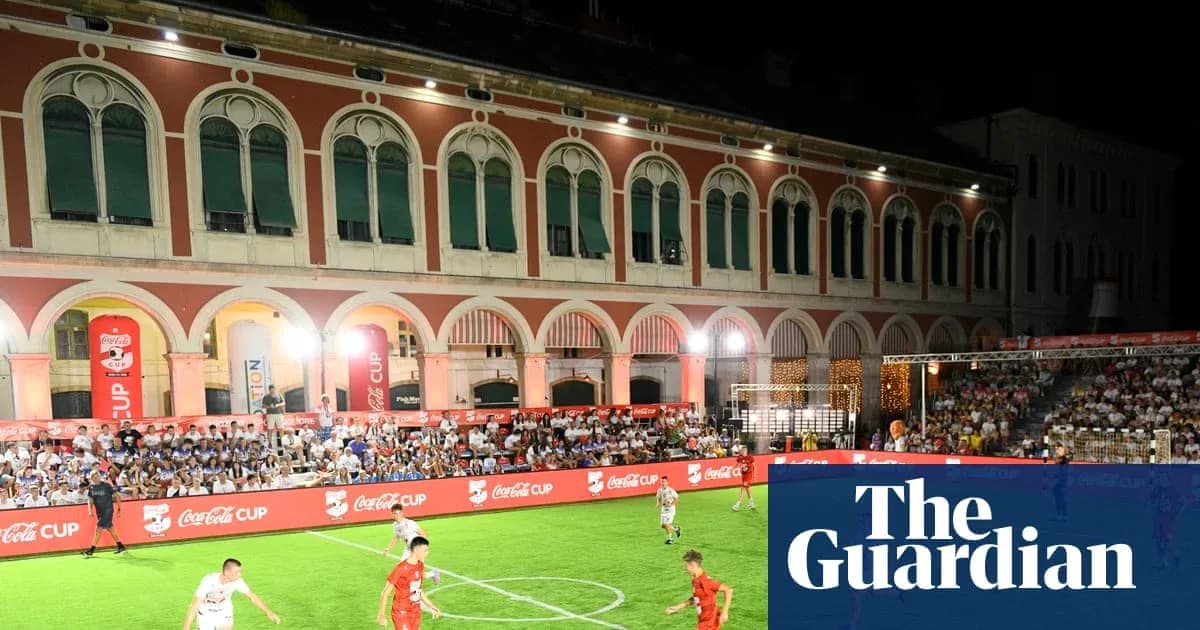
Strip away the VIPs, though, and the scale of the grassroots operation is what really jolts. Just under half a million children from Croatia, Bosnia and Herzegovina, Serbia, Slovenia and North Macedonia entered qualifying this year. Over one week in Split, the best of them contest finals in 10 sports – from chess and 3v3 basketball to mini-football – with the organisers pushing lessons in teamwork, collaboration and, crucially, time away from screens.
They insist Plazma is not just a sporting event but a “social project”.
That message has turned the Games into a magnet for ambassadors. Zlatan Ibrahimovic has lent his name. So has Alastair Campbell. Those who come tend to leave as converts.
Dyche, who spent the week immersed in the action, calls it “a brilliant, brilliant initiative”, and lights up when he recalls the girls’ mini-football final. “It was terrific, they were playing good football; getting properly stuck into each other, properly playing,” he said. “You could feel that they felt free and were being supported in that environment.”
Why England can’t copy it
Dyche doubts anything similar would have been allowed to grow in the UK.
“It seems to me that every time you try and get an initiative off in England, there’s a million rules and regulations that make it difficult,” he said. “I know how hard it can be to get funding too and times are tough for people.”
The irony is that the Plazma Games themselves were born from a time that was anything but easy.
They were founded by Zdravko Maric in the turbulent years after the breakup of Yugoslavia and the Bosnian war. His aim was not lofty talk of reconciliation or soft diplomacy. He wanted to drag young Croatians away from drugs and back into sport.
“It’s a lifetime project and we live with it every day,” says his brother, Slaven Maric, who has worked on the Games from the start. “But when Zladko started it we didn’t have an idea that it would develop into this. It’s not about sport or the results, its about social life, it’s about being together. There were many issues with drug abuse [then], now it’s about bringing the kids to spend sometime together in real life.”
The next battle is different.
Getting children off their phones has become a central theme for the 2026 edition. Esports companies have tried to muscle in, but Maric says their advances have been rejected. The Games want kids on courts, pitches and beaches, not behind screens.
Split: a small city with a giant sporting shadow
By anchoring the Games in Split, the Maric family tapped into a city with a sporting heritage that borders on the absurd. With a modern population of only around 160,000, Split has produced a conveyor belt of champions.
- Goran Ivanisevic, Wimbledon winner.
- Bernard Vukas, revered long before Luka Modric was crowned Croatia’s greatest footballer of all time.
- Branko Cikatic, a kickboxing great.
- Toni Kukoc, the NBA threepeat champion with the Chicago Bulls.
- Stipe Bozic, the mountaineer who conquered some of the world’s toughest peaks.
The city even has its own Olympic “walk of fame”, a Hollywood-style tribute to its 73 Olympic medallists. And its own homegrown sport, picigin – a kind of hand-played hackysack, performed in the shallows of the Adriatic, part acrobatics, part local ritual.
No surprise, then, that the connection between Split and the Games runs deep. The pride among locals is obvious.
Slaven Bilic, another son of the city and a former Premier League player and manager, is now a YSG ambassador almost by default. “I’m not objective because I’ve known Zdravko for more than 30 years but it’s great that at a time when there’s a lot of negativity in the world that this can exist,” Bilic said. “Especially in this part of the world that is supposed to be unstable.”
Billionaires, brands and a bigger map
The question hanging over the Adriatic this week is simple: where next?
Organisers talk openly about expanding the Games’ footprint. North Macedonia took part for the first time this year. Ukrainian teams arrived as invited guests. Talks have already been held with six more countries about joining in the future.
The commercial side is swelling too. Coca-Cola is on board as a partner, alongside Topps and the Croatian telecoms company Telemach. Behind the scenes, the money is getting heavier. There are now 11 billionaires associated with the Games, several of whom have invested directly.
One of them is understood to be Thiel, the PayPal and Palantir founder and mentor to US vice-president JD Vance. Asked by the Guardian why he had chosen to back the project, Thiel offered no explanation. He simply moved along the riviera, flanked by his security team, leaving the question hanging.
Ceferin’s pointed praise
Uefa president Aleksander Ceferin, whose organisation also provides funding, sees the YSG as a model for how elite sport should feed the grassroots. He was reluctant to engage in his ongoing political tug-of-war with Fifa while in Split, but his words about the Games carried a clear edge.
“I think that top sport, and the money that you get with top competition, should be used for the development of sport and this is the development of sport,” he said.
It was hard not to hear that and think of Gianni Infantino’s controversial attempts to sell a stake in the World Cup to private investors. One project, in Ceferin’s eyes, is pouring money back into children’s sport on the Adriatic. The other is trying to cash in on the biggest show on earth.
Soccer Aid, Split-style
The week closed on Friday night with a flourish: the Games’ own take on Soccer Aid.
On one side, a YSG select team of local players. On the other, an all-star XI that looked wildly unbalanced on paper, boasting Claude Makélélé, Pavel Nedved and Ibrahimovic. The mismatch in celebrity was obvious.
But the locals had one card to play. Their coach was Dyche.
It was a fitting final image: a Premier League touchline veteran barking instructions to teenagers, legends jogging around beside them, and a city that has never stopped producing sporting stories roaring from the stands.
Building bridges. Creating memories. Getting properly stuck in.
Not a bad way for the Plazma Youth Sport Games to celebrate 30 years – or to hint at what the next 30 might bring.