Pep Guardiola: A Beautiful Obsession and the Collapse of Manchester City
Pep Guardiola has never been more exposed.
Amazon’s four-part documentary, A Beautiful Obsession, drops the curtain on the final two seasons of his Manchester City reign and, against all expectations, barely spares him. This is no glossy farewell piece for a gilded era. It lingers instead on the collapse: the bleak, frozen heart of 2024-25, when a “machine built for winning” stalled and then shuddered.
Nine defeats and a single win in 13 games. Aura gone. Certainties smashed. And City’s cameras kept rolling.
Winter collapse, no soft focus
The series, produced and controlled by City, could easily have been a hagiography. It is not. The most harrowing campaign of Guardiola’s career is laid out in raw detail, stripped of excuses. The decision to move on from Kevin De Bruyne, the club’s greatest modern player of the modern era, is handled with a similar chill. There is no soft focus, no warm montage to ease the blow.
Khaldoon al-Mubarak’s fury at Guardiola’s decision to change 10 players for the 2-0 home defeat to Bayer Leverkusen in the Champions League? That stays in. No sanitising, no spin. Just a chairman admitting he was too angry to even speak to his manager.
The most arresting thread, though, is personal. Guardiola’s divorce is not just mentioned; it is woven into the narrative as both context and catalyst for a manager suddenly short of answers.
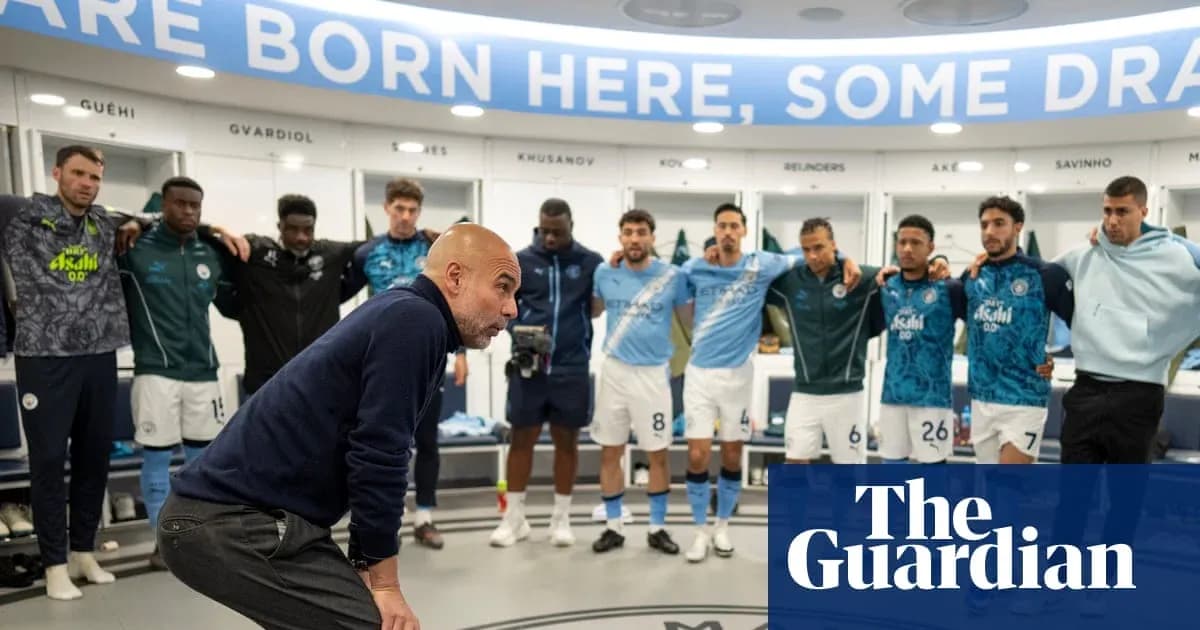
After a 2-0 loss to Juventus on 11 December 2024 – City’s seventh defeat in 10 – Guardiola stands before his players and detonates the boundary between private and professional.
“I’m fucking divorced from the most beautiful woman on your planet,” he tells them. “I love her unbelievably, but we lost the passion. How do you play football, because you are paid? Or because of something inside? Where is the passion?”
It is a startling choice of ammunition. Guardiola has every right to speak about his own life, but the moment lands strangely. Instead of galvanising, it risks making him look diminished, a man whose usual tools of persuasion have dulled. Later, when he defines what separates a true No 1, he says: “You have to convince your players [that they would] go to the penthouse, the roof and jump down [for you].” The implication is clear: that connection, that blind faith, has slipped.
A year on, after those 10 changes against Leverkusen, he returns to the same wound. “I leave my life, my divorce and my family is away, and everything for all of you. And what do you give back?” he asks. The line hits like a confession as much as an accusation.
A manager stripped back
If Guardiola seems exposed, Manuel Estiarte pulls the curtain back even further. In episode two, The Rebuild, City’s director of first-team operations and Guardiola’s long-time confidant reveals he went directly to the players to explain the divorce.
“I said to the team: ‘Please, you have to understand, you’re not playing with a coach who can be a bit impulsive, intense, sometimes a bit up and down. You’re seeing a human being. He’s getting a divorce.’ It was necessary for the team not only to visualise Pep as a manager but for the first time as a human being.”
The admission deepens the sense of a manager running low on solutions. Why did Guardiola not tell them himself? Did that missed moment blunt the impact he sought? And in the background, unasked but unavoidable: did Khaldoon and Ferran Soriano, the club’s CEO, ever sit down and question whether their manager’s private turmoil was eroding his edge?
Just as the tension peaks, the film cuts to a lighter Guardiola. He smiles. He jokes. “In my life I made a lot of changes – I got divorced and I have to settle a bit. But no complaints at all honestly,” he says, before drawing a sharp line. He insists he is a happy man – at least in one arena. “In my job, yeah,” he adds.
The message is conflicted, and that is the point. This is a portrait of a man who has given everything to his work and watched his life tilt out of balance.
Captains, loyalty and a dressing room fracture
Relationships are the documentary’s constant drumbeat. Episode three is titled Love and Hugs for a reason. But the warmth comes wrapped in conflict.
In The Desert, part one, Guardiola is close to tears as he addresses Kyle Walker’s departure in January 2025. The captain has walked away at the very moment City are teetering. Guardiola does not hide his sense of betrayal.
Walker, he tells the squad, did not behave like a leader. Then comes the barb: they had voted him captain. Why did they not hold him to account? Why did nobody “pin him to the wall” and demand loyalty when the club needed him most?
The scene that triggers the break is shot with a filmmaker’s eye. In the Anfield dressing room, after Walker’s mistake leads to a penalty converted by Mohamed Salah in a 2-0 defeat to Liverpool, Guardiola calls him out. Walker snaps back that he is being singled out “every meeting”. The exchange escalates, then fractures.
It ends with Guardiola in tears, delivering an emotional monologue about commitment. He had signed a new contract only 11 days earlier, right in the middle of the crisis, he reminds them, because he wanted to fight. In a striking piece of framing, Walker sits in the same shot, silent, absorbing every word.
“If captains first, then the other ones, for example [feel] that there’s a problem, tell me,” Guardiola says. “It’s not going to change the love I have for all of you. I’m sorry.”
The regret feels genuine. So does the distance between manager and dressing room.
De Bruyne’s goodbye and the cold edge of the machine
Episode two opens with another wound: Kevin De Bruyne’s exit. No new deal. No romantic last dance. Just a ruthless decision about age, value and the future of a squad.
Soriano stresses to Khaldoon that “Kevin gets the respect he deserves as the greatest player in the modern history of City”. The words are careful, almost ceremonial. Guardiola then reveals that “Super Kev” broke down in his office when he heard the news. The manager admits there had to be “coldness” in the call to move him on.
The cameras then find De Bruyne, asked what he will miss most. He does not talk first about trophies or teammates. He talks about home. “My kids don’t want to go,” he says, in tears.
The moment cuts through the tactical talk and the boardroom language. It shows what elite sport so often conceals: the emotional cost. The documentary keeps returning to that truth. Behind the public faces and the rehearsed lines are real bonds, and real damage when they break.
When the bosses turn the spotlight on Pep
The series is at its most bracing when the scrutiny turns upward. Guardiola’s controversial 10 changes against Leverkusen in November 2025 are not glossed over. They are dissected.
“Our attitude with Pep Guardiola should not be too negative. But it shouldn’t be too kind or accommodating either. This is his mistake this time,” Soriano says. No shield, no euphemism.
Khaldoon goes harder. “To pick an entire new [outfield] team in a game this important is probably one of the lowest points we’ve had. I can’t speak to him – I’m so angry.”
For a club that has long projected unity and control, it is an extraordinary admission. The machine is still humming, but its cogs are grinding against each other in plain sight.
Twenty trophies, and a final release
By the time part four, Nothing Is Eternal, draws to a close, the chaos has eased. City do not implode; they regroup. The Carabao Cup and FA Cup are added to the cabinet, lifting Guardiola’s haul to 20 trophies in a decade, Community Shields included. The league title slips away, but second place feels almost like a recovery mission completed.
The rebuild, at least in structural terms, is done. Guardiola receives a send-off that matches his impact, the club acknowledging the scale of what he has built and broken and rebuilt again.
He leaves with one last reflection. “Life should not just be about football. It’s too much to be honest.”
For a man who has lived inside the game’s furnace for so long, it sounds less like a line for the cameras and more like a verdict on his own obsession. The question now is whether he can live by it once the lights, and the cameras, finally move on.