PAOK vs Anderlecht Tactical Analysis: Control Without Penetration
PAOK’s 4-2-3-1 at Toumba Stadium was built to dominate territory and the ball, and the numbers confirm they achieved that structural aim. With 65% possession and a 5–1 advantage in corner kicks, Alessio Lisci’s side controlled the rhythm and spent long stretches in Anderlecht’s half. The double pivot of C. Zafeiris and B. Santamaria provided a stable platform, allowing full-backs Jogo and G. Michailidis to push high and pin back the Belgian wingers. Ahead of them, the narrow trio of A. Zivkovic, G. Konstantelias and Taison constantly sought inside pockets, trying to overload the half-spaces around E. Llansana and L. Ambros.
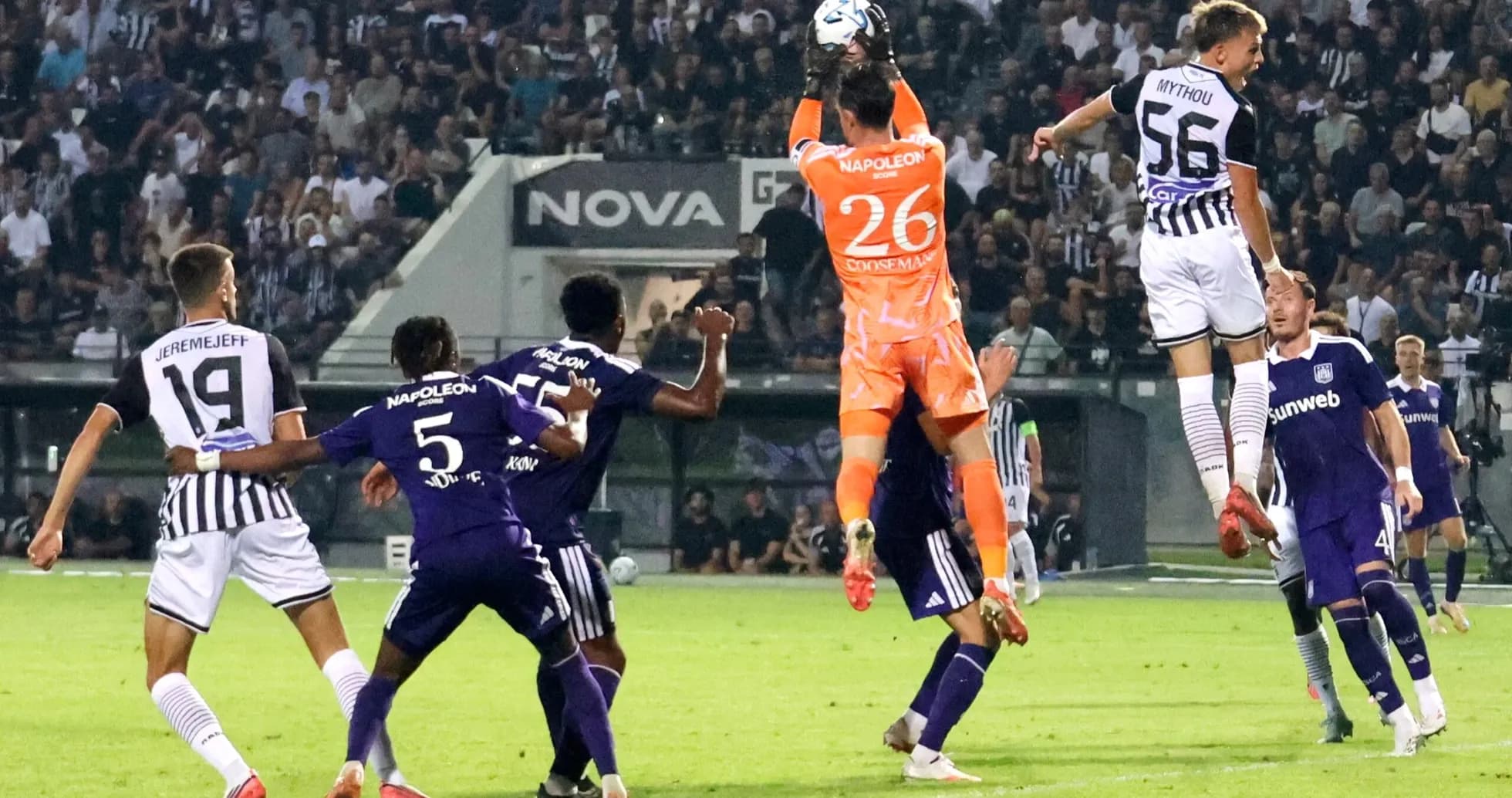
Yet PAOK’s territorial dominance never translated into clean penetration. Their shot profile – 3 shots on goal from 17 attempts (3 on target, 11 off target, 3 blocked) – underlines a side forced into low-quality finishing zones. Anderlecht’s 4-3-3, coached by Vitor Bruno, was extremely compact without the ball: the back four of M. N’Diaye, G. Biancone, L. Petrot and A. Maamar stayed narrow, with M. Kana dropping from midfield to form a situational back five in deeper phases. This squeezed central lanes and forced PAOK to cross or shoot early from the edge of the block.
The game’s tactical storyline was defined in the opening seconds. At 1', M. Cvetkovic struck the only goal for Anderlecht, assisted by E. Llansana. That early 0-1 scoreline instantly flipped the strategic equation. Anderlecht could retreat into a mid-to-low block, prioritising vertical compactness and defensive discipline over possession (they finished with 35% of the ball and only 4 total shots: 2 on goal, 2 off, 0 blocked). From then on, their 4-3-3 often resembled a 4-5-1 out of possession, with J. Onia Seke and M. Cvetkovic dropping alongside Ambros and Llansana to form a dense second line in front of the defence.
PAOK’s response was to increase the tempo and widen the pitch. Full-backs pushed aggressively, and J. Kenny in particular looked to overlap on the right to free Zivkovic inside. However, Anderlecht’s wingers worked diligently backwards, meaning PAOK frequently faced an 8- or 9-man block within 30 metres of goal. The Greek side’s shot volume reflects frustration as much as control: many of the 11 off-target efforts came from rushed or pressured situations rather than carefully constructed chances.
Discipline patterns reinforce the tactical picture. Anderlecht committed 23 fouls to PAOK’s 15, a typical profile of a team defending a lead and breaking up rhythm. The three yellow cards for Anderlecht – to Moussa Ndiaye (56'), Enric Llansana (58') and Danylo Sikan (90+1') – align with a game plan built on aggressive duels and tactical infringements to halt transitions. PAOK’s two bookings, for Pantelis Hatzidiakos (38') and Aritz Elustondo (86'), came more from isolated defensive moments than a systematic foul-heavy approach.
Lisci’s substitution pattern from 46' onward was a clear attempt to rebalance the attacking structure rather than change the fundamental shape. At 46', P. Hatzidiakos (OUT) made way for A. Elustondo (IN), a like-for-like central defensive swap likely driven by either physical concerns or a desire for more ball progression from the back. The double change on 63' was more tactically explicit: Jogo (OUT) for A. Baba (IN) at left-back, and B. Santamaria (OUT) for G. Taylor (IN). Baba offers more direct running and crossing from deep, while Taylor’s introduction in midfield suggested a push for extra energy and forward thrust in the central lane.
At 71', Taison (OUT) was replaced by A. Jeremejeff (IN), tilting the 4-2-3-1 towards a more direct, penalty-box-oriented approach. Jeremejeff’s presence allowed A. Mythou to attack wider channels and freed Konstantelias to roam between lines. The final attacking substitution at 83', A. Mythou (OUT) for D. Pelkas (IN), added another creative profile between the lines, effectively turning PAOK’s shape into a 4-2-4/4-2-2-2 in sustained possession, with Pelkas and Konstantelias both operating as advanced playmakers behind a front pairing.
Bruno’s changes for Anderlecht were more about energy management and preserving structural integrity. At 57', J. Onia Seke (OUT) for O. Antman (IN) refreshed the right side of the front line, maintaining the pressing triggers on PAOK’s left build-up. The 71' triple adjustment – L. Ambros (OUT) for N. Saliba (IN) in midfield and M. Cvetkovic (OUT) for T. Degreef (IN) up front – kept the 4-3-3 skeleton intact while injecting fresh legs to continue the high-defensive workload. Importantly, none of the substitutions altered Anderlecht’s core defensive principles: narrow back four, industrious midfield three, and wingers tracking full-backs.
Without goalkeeper save data, the defensive evaluation must lean on shot patterns and blocks. Anderlecht’s ability to limit PAOK to just 3 shots on goal despite conceding heavy possession and 17 attempts speaks to excellent box protection and timing in duels. The Belgian side recorded 0 blocked shots themselves in attack, underlining how rarely they committed large numbers forward after going ahead; their offensive play was pragmatic, focused on sporadic counters rather than sustained pressure.
Statistically, the match reads as a classic Europa League qualifying away performance: Anderlecht scored early, accepted territorial inferiority, and relied on compactness, fouls and game management to nurse a 0-1 away win. PAOK’s 65% possession and shot volume show that their structural framework and field tilt worked, but the lack of precision in the final third and an inability to disorganise Anderlecht’s low block left them chasing a game state Anderlecht were tactically prepared to defend for nearly 90 minutes.