Pafos 3-0 Hajduk Split: Tactical Mastery in UEFA Europa League
Pafos’ 4-3-3 at Alphamega Stadium delivered a structurally controlled, emotionally charged 3-0 win over HNK Hajduk Split in the UEFA Europa League 2nd Qualifying Round, settled after extra time but tactically defined long before the 120th minute. With almost all numeric performance data absent, the match must be read through shape, roles and event sequencing: Pafos built a compact, aggressive positional game around their midfield triangle and advanced full-backs, while Hajduk’s 4-2-3-1 never truly solved the home side’s central congestion or wide overloads. The scoreline, and the timing of goals, reflects that Pafos’ structural superiority only fully translated into the scoreboard late on.
From the outset, Albert Celades’ 4-3-3 was clearly defined: R. Majecki in goal behind a back four of Bruno, D. Goldar, David Luiz and N. Ioannou; a midfield three of D. Quina, I. Sunjic and Guga; with Biel and Jaja flanking Lele. The key tactical feature was the interior positioning of Guga and Quina, stepping high between the lines to pin Hajduk’s double pivot of R. Pukstas and A. Pajaziti, while Sunjic anchored and screened transitions.
The first goal on 40’ from Guga crystallised this plan. Pafos had been using their advanced interiors to arrive late in the box; Guga’s forward run from midfield, culminating in the opener, underlined how the 4-3-3 morphed into a 2-3-5 in possession, with both full-backs high and the three central midfielders staggering their heights. That Pafos led 1-0 at half-time (and 1-0 already at the 45’ mark) matched the territorial impression created by their structure.
Discipline events help map the defensive behaviours. D. Goldar’s yellow card for “Tripping” at 12’ came from an aggressive front-foot defensive line, stepping into midfield to compress space behind Sunjic. Later, Guga’s yellow for “Elbowing” at 45+4’ showed the intensity of Pafos’ counter-press in central zones; the risk of their high occupation of the half-spaces was always potential late or careless contact when trying to immediately recover the ball.
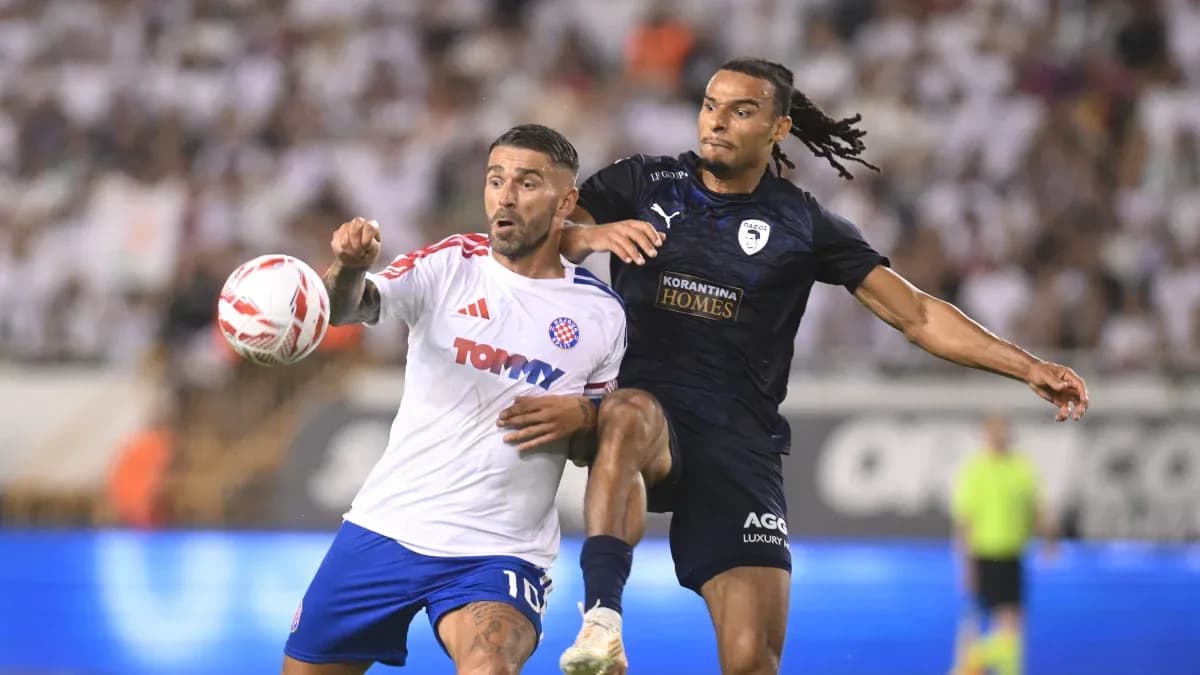
Gonzalo Garcia’s Hajduk in a 4-2-3-1 never fully imposed their intended pattern. The back four of M. Acapandie, D. Maresic, A. Van Hoorenbeeck and S. Hrgovic was protected by Pukstas and Pajaziti, with an attacking line of A. Guram, D. de Almeida and D. Melnjak behind lone striker M. Sego. On paper, this should have allowed fluid rotations between the “10” and wide players, but Pafos’ three-man midfield plus compact back four consistently denied central progression, forcing Hajduk to seek width and crosses rather than clean vertical combinations.
The second half substitutions revealed both coaches’ tactical adjustments. On 53’, A. Sanyang (IN) came on for A. Guram (OUT), a clear attempt by Hajduk to inject more direct running and pressing energy in the advanced midfield line. Shortly after, at 63’, N. Sigur (IN) replaced M. Acapandie (OUT) and M. Livaja (IN) came on for S. Hrgovic (OUT). Those twin changes suggested a more aggressive stance: fresh legs at right-back and a high-impact forward in Livaja, potentially shifting the attacking reference points and adding presence between Pafos’ lines.
Celades responded with a blend of control and verticality. At 45+2’, even before the break, V. Dragomir (IN) had already replaced Jaja (OUT), signalling a desire for more central craft and ball retention from the left side of the front line. Later, on 71’, J. Correia (IN) came on for D. Quina (OUT) and Pepe (IN) for Guga (OUT), re-energising the midfield with fresh runners and a different profile of interior: more legs, more late arrivals, and slightly less early build-up responsibility. These changes directly impacted the late goals, with Dragomir and Pepe both involved as providers in the second and third strikes.
The full-back rotation at 82’ was also telling: K. Sema (IN) for N. Ioannou (OUT) and M. Mammadov (IN) for I. Sunjic (OUT) shifted Pafos into a more transition-oriented, fresh-legged version of their 4-3-3. Sema offered thrust down the flank, while Mammadov brought energy in the central corridor, allowing Pafos to keep pressing high and attacking space even as the game moved towards extra time and fatigue set in.
The second goal at 90’ from D. Goldar, assisted by Dragomir, encapsulated Pafos’ set-piece and rest-defence organisation. The centre-back stepping up to score suggested either a dead-ball or a recycled attacking phase where the central defenders remained high. Importantly, Pafos’ structure behind the ball—anchored by refreshed midfielders—meant they could commit numbers forward without losing control of transitions.
At 93’, Biel’s goal for 3-0 further underlined the effectiveness of the wide forwards in Celades’ scheme. Even late in the game, Pafos’ front three were able to exploit gaps left by a Hajduk side forced to chase the tie. The introduction of A. del Moral (IN) for Pajaziti (OUT) at 85’ and A. Sutalo (IN) for D. de Almeida (OUT) at 98’ indicated Hajduk’s attempts to find more creativity and energy between the lines, but structurally they remained second best in central compactness and counter-pressing.
In extra time, Pafos’ bench depth became decisive. A. Brito (IN) for Biel (OUT) at 103’ maintained attacking intensity on the flank, while Hajduk’s final roll of the dice—M. Skelin (IN) for D. Maresic (OUT) at 106’—could not change the underlying dynamic. The clinching goal at 117’ from J. Correia, assisted by Pepe, was almost a pure expression of Celades’ midfield rotation: two substitutes combining from advanced central positions to finish a move that began with structural superiority rather than isolated individual brilliance.
Discipline again maps the defensive patterns. For Pafos, beyond Goldar and Guga, I. Sunjic’s yellow for “Holding” at 68’ shows the classic defensive midfielder’s foul: stopping a developing transition in the central lane. For Hajduk, Pajaziti’s “Roughing” yellow at 50’ and Pukstas’ “Tripping” caution at 96’ underline their struggles to contain Pafos’ midfield rotations without resorting to contact, especially as fatigue and scoreboard pressure increased.
With almost all statistical fields missing—no reliable possession, shots, passing or goalkeeper metrics—tactical evaluation rests on formations, substitutions, card patterns and the timing of goals. Within that frame, Pafos’ 4-3-3 consistently outmanoeuvred Hajduk’s 4-2-3-1: superior use of interiors, better synchronisation between full-backs and wingers, and a deeper, more impactful bench. The late scoring surge is less an accident of chaos and more the logical endpoint of a structure that kept Pafos fresher, more compact and more dangerous across 120 minutes at Alphamega Stadium.