Mjallby AIF vs Red Bull Salzburg: Tactical Analysis of Europa League Play-off
Mjallby AIF approached this Europa League Play-offs tie at Strandvallen with a clear structural plan: a 3-4-3 under Karl Aksum designed to compress central spaces and survive long periods without the ball. Against Red Bull Salzburg’s 4-2-3-1, that translated into a low-to-mid block, with the back three of T. Pettersson, M. Nielsen and A. Iqbal staying narrow and the wide midfielders dropping deep to form, effectively, a back five whenever Salzburg progressed into the final third.
The statistical split – 31% possession for Mjallby against Salzburg’s 69% – underlines that this was a containment game for the hosts. With only 1 shot on goal and 7 off target, plus 2 blocked, Mjallby’s attacking threat was sporadic and largely dependent on direct play and second balls. The front three of J. Bergstrom, A. Samuelsen and J. Kjaer were often isolated, asked more to screen Salzburg’s build-up than to combine between the lines. When they did get forward, it tended to be in quick, vertical surges rather than sustained positional attacks.
Salzburg, by contrast, controlled both territory and tempo. Danny Rohl’s 4-2-3-1, with D. Schmid and N. Veratschnig as full-backs and a double pivot of B. Mazurek and A. Barry, allowed them to circulate the ball patiently and pin Mjallby back. Their 8 shots on goal and 9 off goal, supported by 7 blocked efforts, show a side that repeatedly worked shooting positions around the box and inside crowded central channels. The blocked shot count in particular reflects how often Mjallby’s back line and midfield collapsed into their own area to protect the goal.
The key structural battle was wide. Mjallby’s nominal 3-4-3 became a 5-4-1 without the ball, with T. Miettinen and O. Lindberg (from the starting line-up) tasked with covering Salzburg’s wide overloads. Salzburg’s advanced trio behind H. Tabakovic – D. Redzic, Y. Vertessen and E. Baidoo – frequently rotated positions, dragging Mjallby’s outside centre-backs into uncomfortable zones. Yet despite this dominance, Salzburg initially struggled to convert possession into clear, high-quality chances, meeting a dense block and a home side willing to defend deep.
Mjallby’s foul count – 12 to Salzburg’s 7 – reflects the defensive burden they carried. They disrupted Salzburg’s rhythm with tactical fouls and physical duels, especially as the game wore on and transitions became more stretched. The only booking of the match, to Áki Samuelsen at 58', symbolised the edge Mjallby needed to maintain to stay competitive against technically superior opposition.
The substitution pattern from both benches underlined the tactical story. At 60', Salzburg refreshed their attacking structure: B. Mazurek (OUT) for M. Kjaergaard (IN) and Y. Vertessen (OUT) for K. Konate (IN) injected new energy and creativity in the half-spaces. Later, at 74', H. Tabakovic (OUT) for S. Kitano (IN) and D. Redzic (OUT) for A. Camara (IN) further rotated the front line, keeping pressure on a tiring Mjallby defence. These changes maintained Salzburg’s intensity and helped sustain the volume of attempts, even if the final breakthrough came via an own goal rather than a crafted finish.
Mjallby’s changes were more reactive and aimed at preserving structure. At 70', A. Samuelsen (OUT) for I. Hoffmann (IN) and O. Lindberg (OUT) for V. Granath (IN) suggested a shift towards fresh legs in midfield and possibly a slightly more conservative posture, reinforcing central areas and wide coverage. Later, V. Gustafson (OUT) for M. Enggaard (IN) at 84' and J. Kjaer (OUT) for L. Tidstrand (IN) at 90' pointed to an attempt to see out the draw, with additional defensive solidity and work rate rather than extra attacking punch.
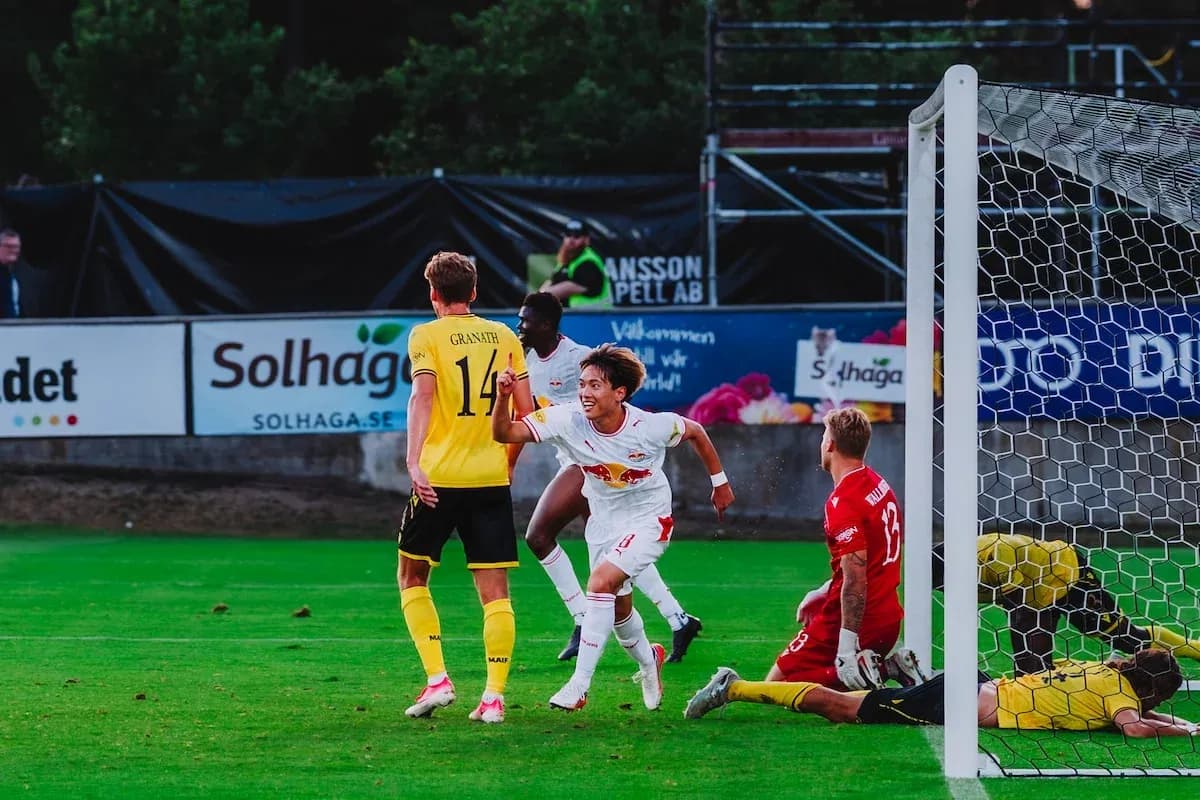
Ultimately, the decisive moment came at 90', when T. Pettersson’s own goal handed Salzburg the 1-0 win. Tactically, that incident encapsulated the cumulative pressure Salzburg had built: constant occupation of Mjallby’s box, repeated deliveries and shots, and defenders forced into last-ditch interventions inside a crowded penalty area. Even though the goal was not the product of a clean attacking pattern, it was the logical outcome of Salzburg’s territorial control and shot volume against a side that spent long stretches defending its area.
From a statistical verdict, Salzburg’s 69% possession, 8 shots on goal, 9 off target and 7 blocked attempts speak to a dominant away performance in terms of control and chance creation volume. Mjallby’s 1 shot on goal and 7 off target underline how limited their offensive output was, with their best hope resting on set pieces (2 corners) and sporadic counters rather than sustained pressure. The corner count – 6 for Salzburg versus 2 for Mjallby – further confirms where the game was played: largely in the Mjallby half.
Discipline-wise, the card tally was stark: Mjallby 1 yellow card, Salzburg 0, total 1. That asymmetry aligns with the game’s flow – a home side defending deep, making more challenges, and occasionally overstepping the line to halt Salzburg’s progress. In tactical terms, Mjallby executed a resilient, low-block plan for most of the night but lacked an outlet to relieve pressure or threaten consistently in transition. Salzburg, though needing an own goal to decide it, imposed their structure, controlled the ball and territory, and ultimately forced the decisive mistake that gives them a valuable 1-0 away advantage from Strandvallen.