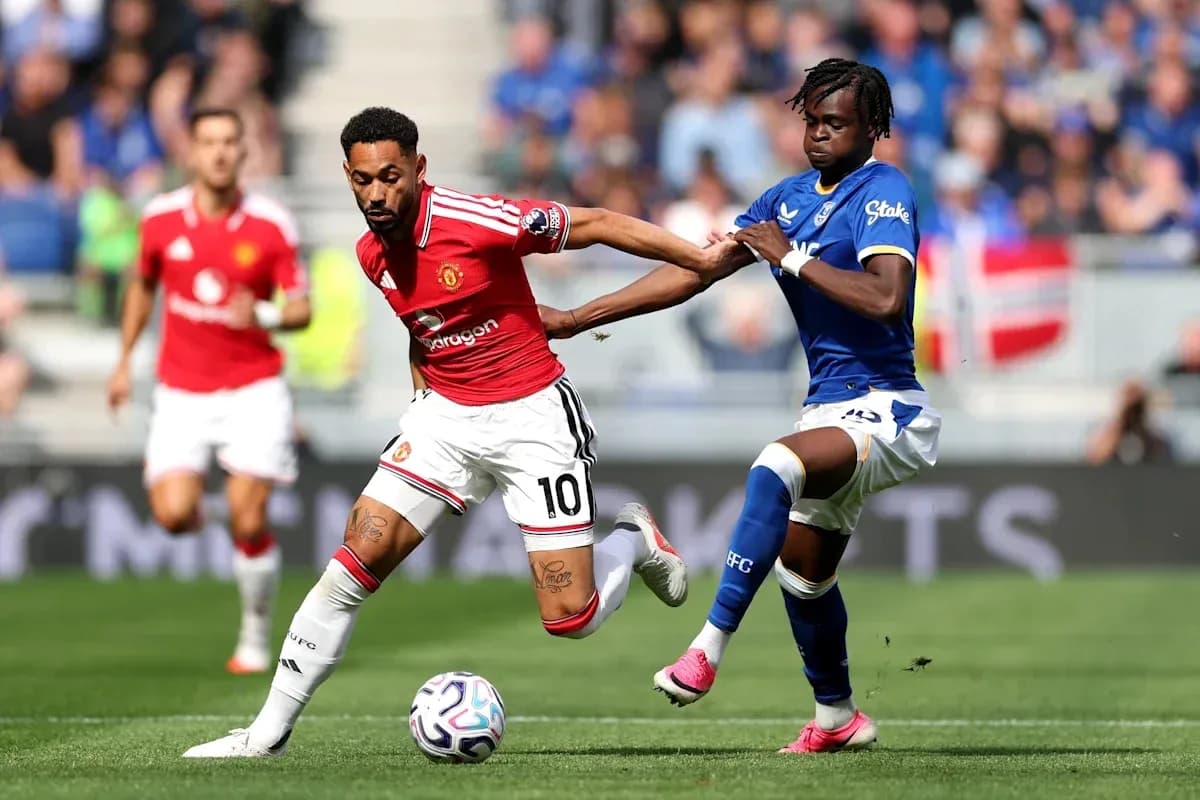
Manchester United's Defensive Issues Persist in 2-2 Draw at Everton
Manchester United left Goodison Park with a point, but it felt like two dropped and a warning siren rolled into one.
They led twice. They played some of their best attacking football of the season in spells. And still, they walked away with the same problem that has stalked them through August: they can’t finish games, and they can’t keep the ball out of their own net.
Everything but the finish
United did plenty right going forward. The first half had purpose and tempo, with three creative forwards knitting attacks together and dragging Everton’s back line around. They twice found breakthroughs from restarts, twice nudged themselves in front, and twice failed to slam the door.
The pattern was maddeningly familiar.
In the final third, United moved the ball well but lacked a true presence around the penalty spot. Neat interplay, promising angles, but not enough ruthless runs across defenders or into the six-yard box. The kind of runs that turn decent build-up into tap-ins.
That’s where the squad picture bites. Benjamin Sesko’s return to fitness offers one obvious solution. Bryan Mbeumo stepping back into a central striking role is another. The absence of Amad on the right is being felt, too. Shea Lacey looks a talent but not yet a guaranteed answer at this level, and there’s little sign that Michael Carrick sees Matheus Cunha as a genuine option on the wing.
United still found a way to score twice. They just couldn’t turn those moments into control. When they led, they didn’t suffocate Everton. They didn’t slow the game down, string passes together, or pin the hosts back. Instead, they invited chaos and got exactly that.
Three games into the season, the numbers are stark: two goals conceded in each of them. Six in total to Hull City, Ipswich Town and now an Everton side that has been blunt in attack. Personnel will eventually return and add balance, but the issue is already big enough to demand a tactical rethink.
A back four on the brink
The defense, again, told the real story.
For the third straight match, United shipped two. This time against an Everton team that has hardly been free-scoring. If that doesn’t set off alarms, nothing will.
Luke Shaw, at least, showed a response. After two rough outings at left back, he produced a far better display. He blocked shots, overlapped Marcus Rashford, and delivered dangerous crosses. One of them seemed to have won it: a late ball into the box that Sesko buried with an 88th-minute header.
But Shaw’s afternoon still carried a sting. On Tyrique George’s 83rd-minute equaliser, he drifted too far inside, the same mistake that has crept into his game this season. George had the yard of space he needed to whip a vicious effort into the near-post top corner. Arne Lammens got a hand to it, might feel he should have done more, but the ball still ripped into the net.
Shaw wasn’t alone in his inconsistency. Harry Maguire, Lisandro Martinez and Diogo Dalot all struggled. As a unit, they gave Everton too many looks.
Maguire was almost punished late in the first half when Thierno Barry rose unmarked and headed over from close range in the 42nd minute — a chance that should have levelled the match. Seconds before the break, Dalot tried to clear and instead teed up Jarrad Branthwaite, who could only fire straight at Lammens. Later, a poor Dalot cross in midfield turned into a sprint back towards his own goal, with Shaw and Martinez scrambling to shut down Brennan Johnson and only just managing to deflect his effort over.
The deeper issue was mindset. Protecting a 1-0 lead for most of the second half, United retreated. They stopped hunting the ball, stopped trying to keep it. Everton took control of possession and territory while United sank deeper and deeper, waiting for trouble.
Trouble arrived.
After George’s first rocket, Carrick turned to his bench. Noussair Mazraoui came on at left back, Leny Yoro on the right. The changes did not steady anything. In the 90th minute, Mazraoui lost George again, allowing another near-post effort that Lammens saved before the offside flag spared United.
The final act was brutal. Deep into stoppage time, with Everton chasing one last attack, Hayden Hackney drifted past Yoro far too easily and laid the ball off to Kiernan Dewsbury-Hall. Mazraoui’s attempted clearance fell straight to Ainsley Maitland-Niles, who unleashed a stunning strike worthy of any award shortlist. United’s lead, and their composure, were gone.
Carrick’s full-back substitutions backfired, but the questions run deeper than one decision. Would Dalot and Shaw, already stretched and error-prone, really have closed that game out? Will the imminent return of Matthijs de Ligt, out since November 2025, be enough to change the defensive dynamic? And is it time to give young Ayden Heaven a serious look, given how porous this back line remains regardless of personnel?
Right now, it doesn’t seem to matter who plays. United concede.
Structural flaw at the back
Strip away the individual mistakes and the pattern remains: this back four cannot cope when the game opens up.
United’s summer work focused heavily on the midfield. That part looks more coherent. The team can build through the thirds, sustain attacks, and create chances. But the balance of the squad is still off, and the full-back positions sit at the heart of it.
Shaw can still deliver quality, as he showed with Sesko’s goal, but he no longer has the recovery speed he once relied on. When United push numbers forward, that lack of pace becomes a glaring weakness. Dalot faces similar problems on the opposite side. When both full-backs are caught high, the centre-backs are left exposed, dragged into wide areas and forced to cover huge spaces.
Any opponent with pace and a plan will see it. They’ll target the flanks, force United’s defenders into races they can’t win, and exploit the gaps behind.
There were positives at Goodison. The new-look midfield showed promise. The front line created. The team showed enough to suggest they can score plenty this season.
But goals at one end won’t mask what’s happening at the other. Unless Carrick finds a way to protect his full-backs and tighten the structure behind the ball, United risk turning every match into a shootout.
And with the Champions League about to begin, how long can they live with that kind of gamble?