Manchester City Dominates Crystal Palace 3-0 at Etihad
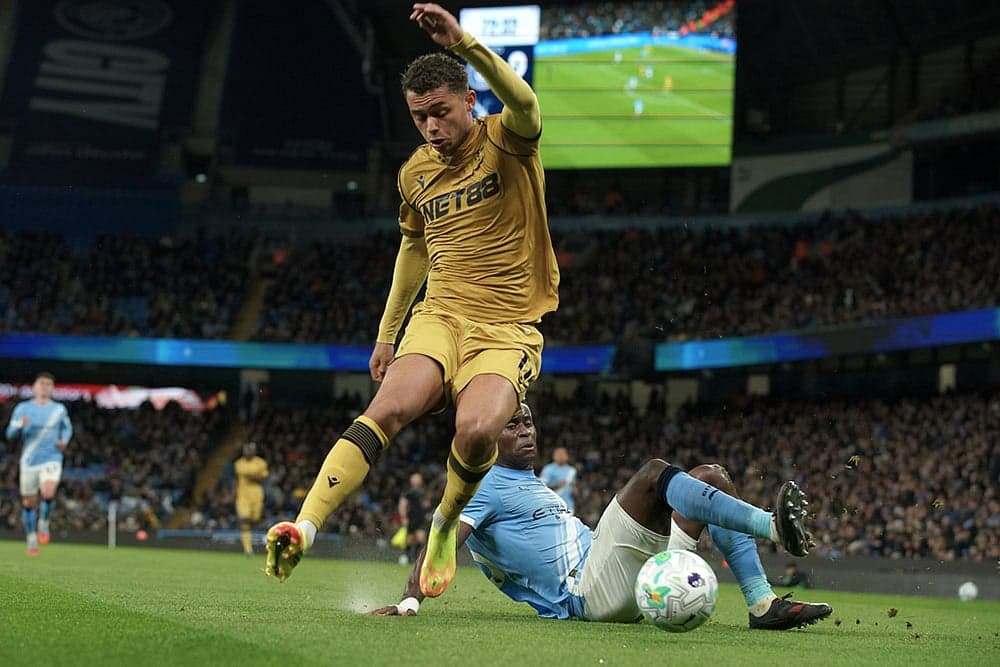
Manchester City’s 3-0 win over Crystal Palace at Etihad Stadium was a controlled, system-led performance built on structural superiority and relentless territorial pressure. Pep Guardiola’s 4-2-2-2 dominated both space and ball, turning 72% possession and 723 passes into a steady accumulation of chances that eventually matched the 3-0 scoreline. Crystal Palace, in Oliver Glasner’s 5-4-1, were forced into a deep, reactive block, rarely escaping City’s press and finishing with just 6 shots and 0.68 xG. City’s xG of 1.56 underlines that this was less about volume of clear chances and more about sustained control, with the front four’s rotations and the full-backs’ positioning suffocating Palace’s counters.
I. Executive Summary
Guardiola deployed a 4-2-2-2 with G. Donnarumma behind a back four of M. Nunes, A. Khusanov, M. Guehi and J. Gvardiol. Ahead of them, P. Foden and B. Silva operated as narrow playmakers, with Savinho and R. Ait-Nouri providing width and underlaps, while A. Semenyo and O. Marmoush formed a flexible front two. The structure aimed to pin Palace’s 5-4-1 into its own third, using double tens (Foden, Silva) between the lines to dismantle the visitors’ compactness.
Palace’s 5-4-1 had D. Henderson in goal, protected by a back five of D. Munoz, C. Richards, M. Lacroix, J. Canvot and Tyrick Mitchell. In midfield, B. Johnson and Y. Pino flanked W. Hughes and J. Lerma, with J. Mateta alone up front. The idea was clear: keep five in the last line, compress central spaces, and spring Mateta and the wide midfielders in transition. However, City’s rest-defense and counterpress largely neutralized that plan.
II. Scoring Sequence & Disciplinary Log
Goals (chronological, all Manchester City):
- 32' A. Semenyo (Manchester City) — assisted by P. Foden. City finally converted their territorial dominance when Foden received between the lines and slipped a vertical pass into Semenyo, whose movement off the front line exploited a channel between Palace’s right-sided centre-back and wing-back.
- 40' O. Marmoush (Manchester City) — assisted by P. Foden. Again Foden orchestrated, drifting into the left half-space to draw Palace’s midfield out before threading Marmoush in behind. The finish doubled the lead and crystallised City’s superiority in central overloads.
- 84' Savinho (Manchester City) — assisted by R. Cherki. With Palace stretched after multiple substitutions, Cherki, introduced from the bench, attacked the half-space and released Savinho, who had held the width and then cut inside to finish, sealing the 3-0.
Disciplinary log (chronological, all Crystal Palace):
- 52' Tyrick Mitchell (Crystal Palace) — Foul
- 81' Daichi Kamada (Crystal Palace) — Simulation
Total cards: Manchester City 0, Crystal Palace 2, Total 2. Both cautions reflected the strain on Palace’s defensive structure: Mitchell’s for a late defensive action under pressure, Kamada’s for Simulation as Palace tried to manufacture a route back into the game.
III. Tactical Breakdown & Personnel
City’s possession structure was textbook Guardiola: the nominal 4-2-2-2 often morphed into a 3-2-5 in possession. J. Gvardiol and M. Nunes started as orthodox full-backs, but the key was how the back line and double pivot managed rest-defense. A. Khusanov and M. Guehi held a high, aggressive line, with one stepping into midfield when Palace tried to play into Mateta’s feet. This allowed P. Foden and B. Silva to stay advanced as dual creators rather than repeatedly dropping to build.
The passing figures underline City’s method: 723 total passes, 645 accurate (89%). The ball circulation was not just sterile possession; it was used to shift Palace’s compact 5-4-1 laterally until gaps opened between wing-back and wide centre-back. Foden and Silva constantly occupied those pockets, with Savinho and R. Ait-Nouri either holding width or underlapping into the half-spaces. The first two goals both emerged from these overloads, with Foden’s timing and weight of pass decisive.
Up front, A. Semenyo and O. Marmoush played asymmetrical roles. Semenyo often dropped between the lines to create a temporary 4-2-3-1, while Marmoush stretched the last line. This staggered positioning made it difficult for Palace’s centre-backs to decide who to follow, contributing directly to the disorganisation seen on both first-half goals.
Out of possession, City’s defensive index was strong: only 6 shots conceded, 2 on target, and just 4 Crystal Palace offsides indicating that City’s line management was disciplined rather than overly aggressive. G. Donnarumma was rarely exposed, needing only 2 saves, but his goals prevented figure of -0.78 suggests Palace’s few on-target efforts were of moderate quality and that the model rates them slightly higher than the actual outcomes. Still, structurally, City’s counterpress was the real protection: immediate pressure on the ball-carrier after turnovers, with the nearest midfielder and full-back collapsing to deny forward passes into Mateta.
Crystal Palace, by contrast, were trapped between lines. Their 278 passes (215 accurate, 77%) and 28% possession show a side mostly defending deep. The back five stayed narrow, which initially blocked central combinations but left the wing-backs repeatedly isolated 2v1 against Savinho or R. Ait-Nouri plus an overlapping or underlapping teammate. Once City’s first goal arrived, Palace’s block had to push a few metres higher, which opened the exact spaces City’s system is designed to exploit.
Glasner’s substitutions at 60' — I. Sarr (IN) came on for Y. Pino (OUT), J. S. Larsen (IN) came on for J. Mateta (OUT), A. Wharton (IN) came on for W. Hughes (OUT) — were an attempt to inject ball-carrying and verticality. Later, D. Kamada (IN) came on for B. Johnson (OUT) at 75', and N. Clyne (IN) came on for D. Munoz (OUT) at 82'. These changes nudged Palace towards a more proactive 4-2-3-1/4-4-2 shape in phases, with Kamada as an advanced midfielder. However, City’s control of tempo and spacing meant these adjustments produced little more than isolated counters and the late yellow for Kamada for Simulation.
Guardiola’s changes were about energy management and preserving structure. At 58', J. Doku (IN) came on for J. Gvardiol (OUT), and N. Ake (IN) came on for M. Nunes (OUT), refreshing the wide defensive and wide attacking lanes while maintaining the same basic rest-defense principles. At 79', M. Kovacic (IN) came on for B. Silva (OUT) to stabilise midfield, and R. Cherki (IN) came on for O. Marmoush (OUT), adding a fresh creative profile between the lines. Finally, at 82', J. Stones (IN) came on for P. Foden (OUT), effectively locking down the back line and enabling a more conservative build-out as the game state at 2-0 (and soon 3-0) demanded control over risk.
IV. The Statistical Verdict
The numbers support the tactical story: Manchester City’s 15 total shots (4 on goal) from 1.56 xG show a team that prioritised control over chaos. The shot profile was balanced — 10 inside the box, 5 outside — suggesting patient chance creation rather than speculative efforts. Palace’s 6 shots, all inside the box but only 2 on target, underline how rare and rushed their attacking moments were.
City’s overall form in this match, judged by possession, pass accuracy and territorial dominance, was elite. Defensively, conceding only 6 shots and allowing 0.68 xG reflects a strong defensive index, with the high line and counterpress functioning effectively. Crystal Palace’s 7 fouls and 2 yellow cards, against City’s 10 fouls but no cards, show that while City were aggressive in duels, Palace’s defensive strain manifested in more desperate, card-worthy actions.
Both goalkeepers recorded goals prevented of -0.78, indicating that finishing variance slightly favoured attackers over keepers on the day. Yet the decisive factor was structural: City’s system repeatedly manufactured advantageous positions, while Palace’s deep 5-4-1 could not transition into meaningful attacks. The 3-0 scoreline, the shot and xG profiles, and the card distribution all align with a match in which Manchester City’s tactical organisation and in-possession mechanisms overwhelmed Crystal Palace’s reactive game plan.