Maccabi Tel Aviv Dominates Sheriff Tiraspol in UEFA Europa League
Maccabi Tel Aviv’s 1–0 win over Sheriff Tiraspol at Batumi Arena in the UEFA Europa League 2nd Qualifying Round was defined less by volume of chances and more by territorial control, structure without the ball, and set‑piece pressure. Both sides split possession exactly at 50–50, but Maccabi translated their share into more aggressive field position, 12 corners to 7 and an 8–4 edge in shots directed toward goal (3 on target, 5 off, plus 3 blocked). Sheriff, by contrast, failed to register a single shot on target, their threat limited to speculative efforts and half‑spaces rather than penalty‑box presence. The decisive moment came from an own goal by S. Kone, but it was the logical outcome of Maccabi’s sustained pressure and superior occupation of wide and half‑space zones in their 4‑3‑3.
Kenny Miller’s 4‑3‑3 for Maccabi Tel Aviv was built on a clear structural idea: a back four that could push both full‑backs high, a three‑man midfield to control central lanes, and a front line tasked with stretching Sheriff’s last line horizontally. With “Shots on Goal” at 3 and “Blocked Shots” at 3, Maccabi were not constantly peppering the goalkeeper, but they consistently forced Sheriff’s defensive block to defend deep and narrow, especially through the volume of corners. Twelve corners indicate repeated entries into the final third and an insistence on crossing or cut‑backs that were either cleared behind or deflected, keeping Sheriff under continuous set‑piece strain.
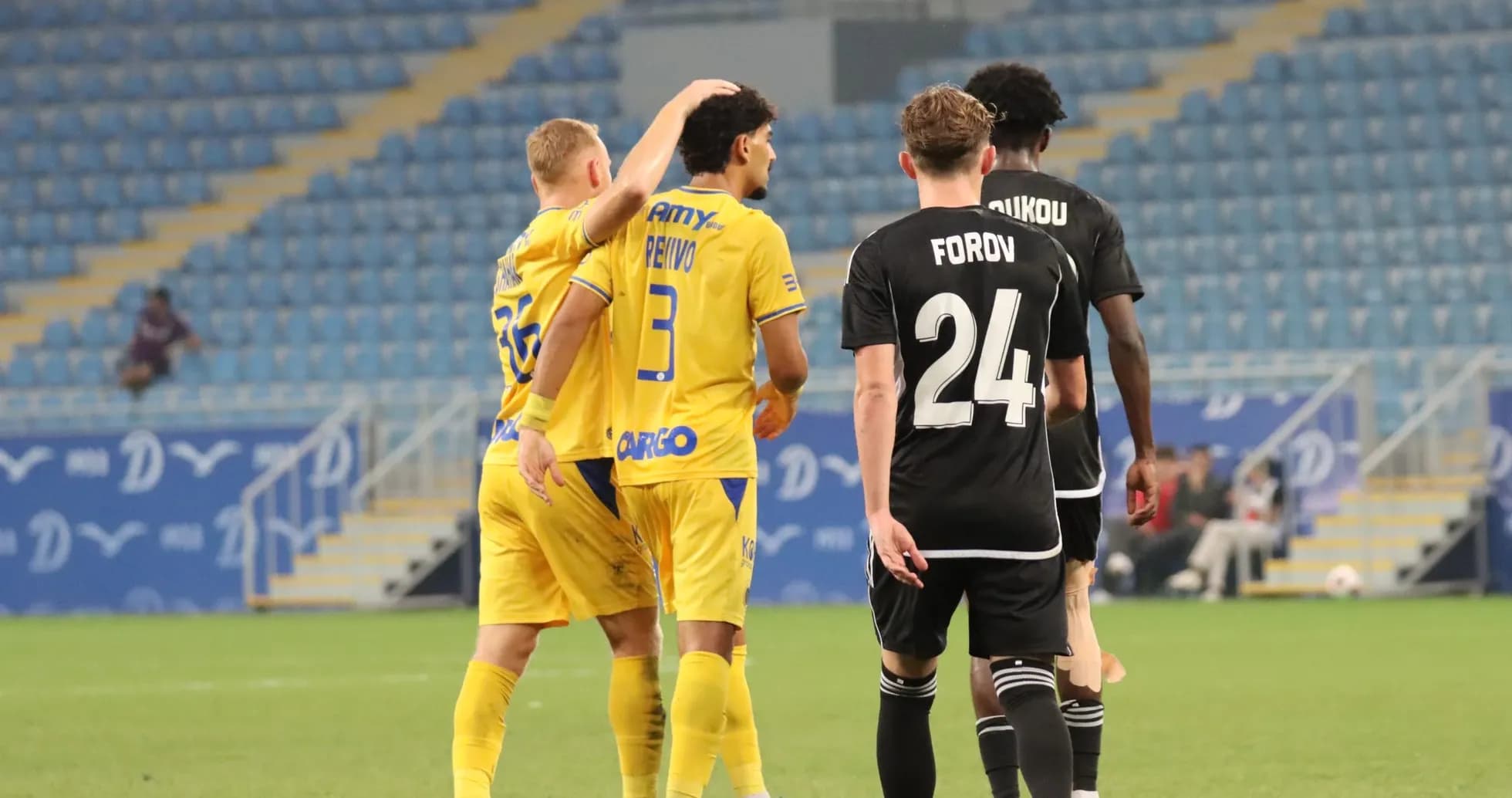
The full‑back pairing of R. Revivo and N. Ben Harush, supported by S. Jehezkel on one side and S. Abu Farkhi as the central forward reference, gave Maccabi width and the ability to pin Sheriff’s wingers and full‑backs. In midfield, D. Peretz, I. Sissokho and I. Shahar formed a triangle that allowed Maccabi to recycle possession and keep the ball in front of Sheriff’s defensive line. Even without pass‑completion data, the pattern is clear from the corner count and shot profile: Maccabi used their 50% share of the ball more territorially, progressing high and forcing clearances rather than simply circulating in deeper zones.
Sheriff Tiraspol also lined up in a 4‑3‑3 under Victor Mihailov, but their version was markedly more conservative. Their 0 “Shots on Goal” versus 4 “Shots off Goal” and 2 “Blocked Shots” underline a side that struggled to convert possession into penalty‑area presence. Much of their build‑up stalled before the final third, with efforts coming from distance or under pressure. The front three, with S. Kone and D. Forov among the advanced midfielders/attackers, rarely received clean service between Maccabi’s lines, and when they did, Maccabi’s back four stepped out aggressively to contest.
The key tactical turning point arrived in the 29th minute. Sustained Maccabi pressure, reflected in their corner dominance and territorial control, culminated in S. Kone diverting the ball into his own net. Though officially logged as an own goal, it was a product of Maccabi’s insistence on delivering balls into crowded central zones and forcing Sheriff’s defenders to make hurried interventions inside their own box. From that moment, the game state shifted decisively: Maccabi could manage space and tempo, while Sheriff were required to chase an equaliser without having shown any consistent route to goal.
Sheriff’s substitution pattern from 57 minutes onward reflected a reactive attempt to rebalance the midfield and inject more verticality. Mota (OUT) for Sapata (IN) at 57', followed by S. Kone (OUT) for V. Nihaev (IN) at 59', signalled a desire for fresher legs and possibly more direct running from midfield. Later, at 77', the triple change — A. Pergjoni (OUT) for N. Swen (IN), L. Jaures‑Ulrich (OUT) for V. Cozma (IN), and D. Forov (OUT) for J. Modelo (IN) — was a wholesale reconfiguration of the midfield and wide zones, aimed at pushing more bodies forward. Yet the underlying numbers did not shift meaningfully: Sheriff still ended with no shots on target and only 7 corners, suggesting that structural issues in progression and final‑third occupation were not solved by personnel changes alone.
Maccabi’s substitutions were more about game management than tactical overhaul. At 63', I. Shahar (OUT) for I. Ben Simon (IN) and S. Jehezkel (OUT) for O. Davida (IN) preserved the 4‑3‑3 shape while refreshing energy in midfield and wide areas, helping maintain pressure on Sheriff’s build‑up and providing legs to press transitions. Later, at 79', H. Varela (OUT) for I. Noy (IN) and N. Ben Harush (OUT) for I. Ben Hamo (IN) further reinforced defensive stability on the flanks and in midfield, supporting a compact block to protect the 1–0 lead and manage Sheriff’s late positional reshuffles.
Discipline also told a tactical story. Sheriff committed 11 fouls to Maccabi’s 9 and collected both yellow cards in the match — V. Nihaev at 71' and B. Ciss at 90+3', both for “Tripping”. These bookings underline how Sheriff’s attempts to disrupt Maccabi’s rhythm often came from late or recovery challenges, particularly as they pushed higher in search of an equaliser and were then forced to defend transitions in open space. Maccabi, by contrast, maintained control without crossing the disciplinary line, which helped them manage the closing stages without the risk of a red card reshaping the tactical landscape.
From a statistical verdict perspective, the 1–0 scoreline aligns closely with the underlying pattern. Maccabi’s 3 shots on goal, 5 shots off target and 3 blocked efforts, combined with 12 corners, depict a side that consistently advanced into dangerous areas, even if they did not generate a high volume of clear‑cut chances. Sheriff’s 0 shots on target, 4 off target and 2 blocked, alongside only 7 corners, confirm that their 50% share of possession was largely sterile, spent in safer zones without penetration. Without explicit xG or goalkeeper data, the clearest tactical truth lies in shot quality and field position: Maccabi Tel Aviv turned parity in possession into territorial dominance, forced the decisive error from S. Kone, and then managed the game state with disciplined structure and intelligent substitutions to carry a narrow but deserved advantage out of Batumi Arena.