
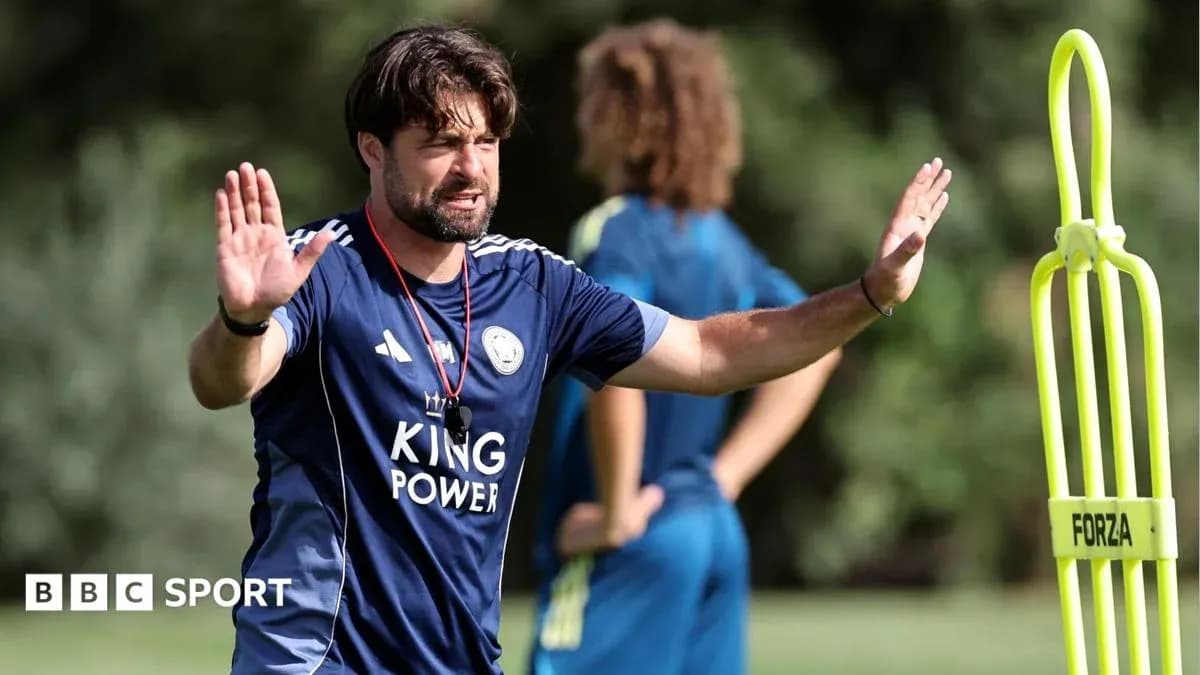
Leicester City: Russell Martin's Challenge to Rebuild
Leicester City have been told to stop staring at the statue and start dealing with the scaffolding.
Russell Martin walked into a club still haunted by its own miracle, yet he wants no part in being measured against 5,000-1 odds and Premier League parades. His Leicester will be judged, he insists, on something far more mundane and far more urgent: whether they can drag themselves out of League One.
“History,” in his eyes, is background noise.
A decade on from that impossible title win and only three years removed from lifting the FA Cup, Leicester are back in the third tier for just the second time in their 142-year existence. Back-to-back relegations have stripped away the gloss and left a once-model club scrambling to comply with spending rules, offloading big earners and blue-chip prospects just to stay within the lines.
Into that turbulence steps Martin, a coach whose own reputation has taken a battering. He guided Southampton to promotion to the Premier League a little over two years ago, then endured a bruising 123-day spell at Rangers. Now he drops into League One, looking to rebuild himself at a club trying to do exactly the same.
“I know the club got relegated but, prior to that, that club had amazing success over a sustained period of time – like, huge – and of course maybe you get judged based on that,” he told BBC Radio Leicester. “We have to find our own way and then be judged on that, because I can't judge people on the last couple of years.”
That line matters. Leicester’s modern story has been dominated by contrasts: title winners to relegated, FA Cup glory to points deductions. Martin wants no part of being boxed in by either extreme.
“Hopefully I'll be judged on the job I do here and not on my previous job and all that stuff. It's the same for me,” he added, tying his own journey directly to the club’s.
A new power structure under scrutiny
Martin is the first big call of a new internal order. His appointment was the headline decision since James McCarron stepped up as sporting director last season, operating beneath chief football officer Jon Rudkin. Alongside owner and chairman Khun Aiyawatt ‘Top’ Srivaddhanaprabha, Rudkin has become a lightning rod for supporter anger during Leicester’s slide.
So how has the new manager found the hierarchy many fans blame for the mess?
When asked about his dealings with the club’s powerbrokers, Martin chose his words carefully but clearly. He praised them for being upfront about the damage.
“There was real honesty about what's gone on, but now there's real honesty and openness and willingness to move forward,” he said. “I can't judge anything that has gone on before because I've not been here.
You watch it from the outside, and people will make assumptions, but I've been really open to being surprised since I got here and people have been great.”
Honesty behind closed doors is one thing. Repairing a broken squad is another.
Promotion or bust
No one at Leicester is pretending this is a gentle reset. The target placed in front of Martin is stark.
“It's to get promoted, first and foremost,” he said. No caveats, no soft landings. Straight back up.
The second demand is more nuanced but just as important to him: “[And] to play in a way that everyone understands and believes in, feels connected to and makes the fans proud.”
So the brief is clear. Win, and win with a style that reconnects a disillusioned fanbase to a team that has lurched from crisis to crisis.
The problem? Right now, the squad looks like a half-finished jigsaw.
A squad stripped back
The summer has been dominated by exits. Leicester’s fight to meet financial regulations, which already cost them points last season for historical breaches, has forced the club to cash in on both established names and emerging talent.
Jannik Vestergaard, the Denmark international, had his contract terminated by mutual consent. Harry Winks, once an England midfielder and a symbol of Leicester’s attempt to reboot with Premier League experience, has gone to Cagliari. Abdul Fatawu’s move to Ipswich Town brought in around £20m.
The most painful departure from a long-term perspective might be Jeremy Monga. At 17, he was one of the brightest young prospects at the club, but the pull – and the fee – from Manchester City proved too strong in a window shaped by necessity rather than ambition.
An end-of-season clear-out saw 10 out-of-contract players leave. The consequence was stark: Leicester finished the cull without a senior striker on their books. Patson Daka and Jordan Ayew were among those to depart, leaving a gaping hole at the top of the pitch for a manager who leans heavily on structure and patterns in possession but still needs someone to finish moves.
So far, the rebuild has been cautious rather than dramatic. Conor Chaplin, the former Ipswich Town forward who top scored when the Tractor Boys climbed out of League One four seasons ago, is one of only two signings since relegation. His arrival hints at the profile Martin wants: intelligent movement, work-rate, end product at this level.
It is nowhere near enough on its own.
The hunt for firepower
Martin knows it. He did not dress it up.
“Ideally, we'd have two or three strikers,” he said. “We don't just want one of the same, and it's the same with wingers.
“Whatever we are looking at, whatever profile it is, it has to be right for us. They need to be desperate to come here and play, they need to be desperate to help us to be successful.”
That word – desperate – cuts through the usual transfer-speak. Leicester can no longer sell themselves as a stepping stone to the Champions League or a club that lives permanently in the top half of the Premier League. They are in League One, under pressure, with limited room to manoeuvre on wages and fees.
They need players who see opportunity, not status loss. Players who want the ball in front of a demanding crowd that remembers Riyad Mahrez and Jamie Vardy but will now turn up to watch Burton and Port Vale.
Martin has built teams before that play with clarity and courage, that press, pass and commit. At Southampton, that approach carried them back to the top flight. At Rangers, it unravelled quickly. Leicester offers him both risk and redemption.
The history banners will still hang. The title story will still be told. But in a division where romance rarely counts for much, the real question is blunt: can Martin’s Leicester be judged on what they do next, rather than what they used to be?




