
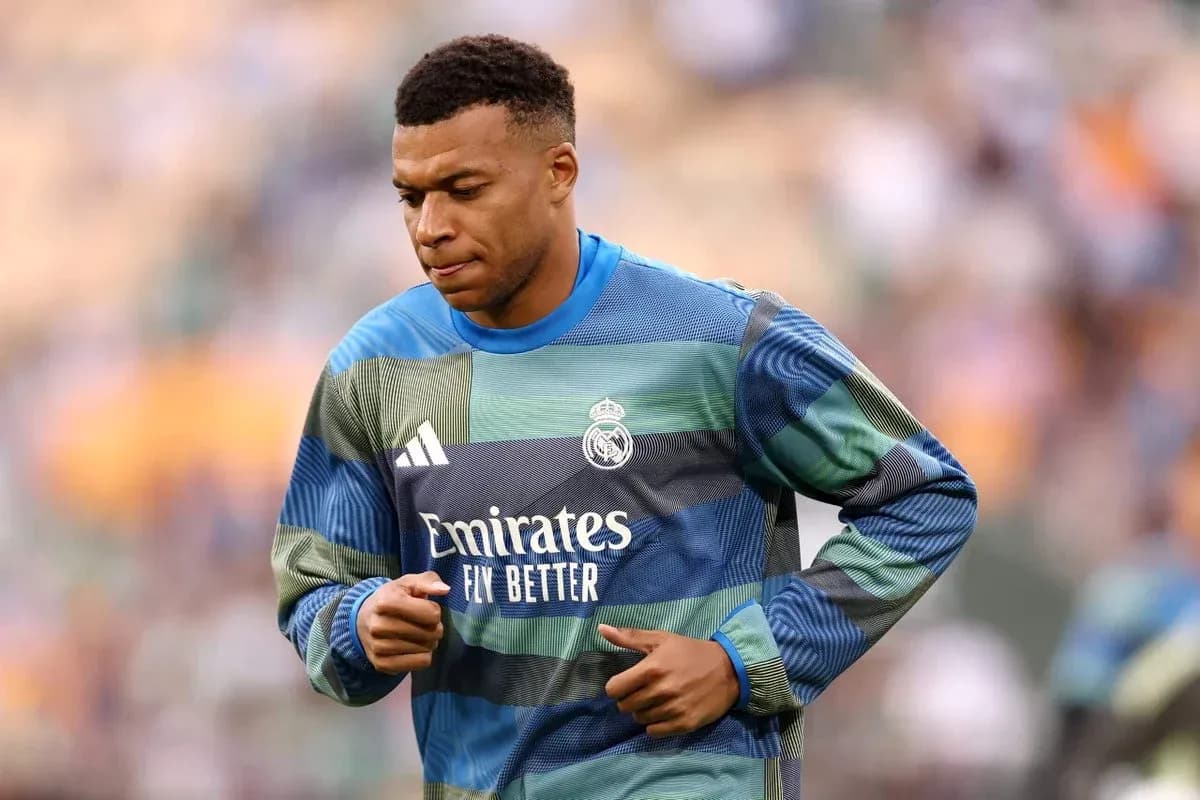
Kylian Mbappe: A Superstar's Impact on Real Madrid's Identity
As Real Madrid’s players leave the dressing room and step into the Bernabeu tunnel, they walk past Alfredo Di Stefano’s words, etched into the wall and into the club’s identity.
No player is as good as all of you together.
For decades, it read like a celebration of the collective in a club obsessed with the individual. This season, it feels like an accusation.
The greatest star of Madrid’s golden age, the man who drove them to five straight European Cups between 1956 and 1960, has become an unlikely voice in the debate surrounding the club’s newest galactico. Di Stefano, who later coached Madrid twice and was made honorary president in 2000 before his death in 2014, looms over a squad that has lost its way — and a fanbase that has turned on its idols.
Vinicius Junior, Jude Bellingham, Kylian Mbappe. Names that should define an era have instead become lightning rods. Whistles cut through the Bernabeu air for them, and even for Florentino Perez, the president who built the modern galactico model and staked his legacy on it.
The tension isn’t confined to the stands. Aurelien Tchouameni and Federico Valverde came to blows in training last week, a flashpoint that exposed the strain inside a dressing room heading towards a second straight season without a major trophy.
And right in the middle of it all: Mbappe.
A superstar under the microscope
Madrid chased Mbappe for years. Turned windows into soap operas. Took rejection in 2022, swallowed their pride, and came back again. When he finally arrived on a free transfer from Paris Saint-Germain in June 2024 — with a colossal signing fee — it felt like the final piece dropping into place.
They had just won La Liga and the Champions League. Bellingham and Vinicius Jr were electric. The squad looked primed to extend its domestic and European dominance.
Now, the picture is fractured.
On paper, Mbappe has delivered. He is Madrid’s leading scorer since he walked through the door, with 77 goals across La Liga and the Champions League. He won the Golden Boot in 2024–25. In this season’s Champions League, he has 15 goals — close to Cristiano Ronaldo’s record of 17 in 2013–14 — and was one of the few Madrid players to meet the occasion in the quarter-final defeat by Bayern Munich, scoring twice over the two legs.
He has almost doubled the goal tally of any team-mate in that period and hoovers up the bulk of Madrid’s attacking chances. The underlying numbers back him up: he has outperformed his expected goals by seven. This is not a forward hiding behind reputation.
Yet the Bernabeu still booed him in the first home game after that Bayern exit.
Since then, the criticism has swelled and shifted off the pitch. A training-ground row with a member of the coaching staff before the trip to Real Betis on April 24 added fuel to the fire, with sources describing it as another sign of a souring atmosphere. His decision to travel to Italy with his partner during an injury recovery drew internal irritation and external scrutiny.
His camp pushed back. “A portion of the criticism is based on an over-interpretation of elements related to a recovery period strictly supervised by the club, and does not reflect the reality of Kylian’s commitment and daily work for the team,” read a statement from his representatives.
Still, the question lingers around Valdebebas and the Bernabeu alike: after all the years of pursuit, has this journey been worth it?
The case against Mbappe: brilliance with a cost
When Mbappe’s signing was finally nearing completion two years ago, one member of Carlo Ancelotti’s staff pointed to a specific concern: his work without the ball.
The numbers were stark then, and they are starker now.
Across La Liga and the Champions League, Mbappe registers the fewest tackles, interceptions and ball recoveries per 90 minutes of any Madrid player. Look at “true” tackle attempts — tackles won, tackles lost and fouls committed — and the picture gets even harsher. In La Liga, among 461 outfield players, he ranks 461st, with roughly 0.6 attempts per game.
He does not press, he does not chase, he does not tackle. With rare exceptions — certain Clasicos, the occasional Champions League night — he is the player doing the least defensive work in white.
For a superstar forward, that is not automatically a crime. Many greats conserve energy to explode in the final third. The problem is what happens when you pair that profile with other attacking stars who also need freedom: Vinicius Jr, Bellingham, Rodrygo.
The balance cracks.
Then comes the positional headache. Mbappe wants the left. Vinicius lives on the left. The pitch map tells the story: both gravitate to the same channel in build-up. They drift into each other’s zones, step on each other’s toes, and while they have produced the odd thrilling combination, their connection has not approached the fluency Vinicius once shared with Rodrygo.
This is not a tactical quirk; it is a structural flaw. Who decided that stacking two dominant, left-sided attackers was a long-term plan? How sustainable is a system where your most prolific scorer crowds out your other main weapon?
The team numbers raise awkward questions. Madrid scored 87 league goals in 2023–24, when Bellingham often played as a false nine and Joselu came off the bench as a traditional target man. There was no clear attacking reference point, yet the attack flowed.
Last season, with Mbappe, they scored 78 in La Liga. This season, they sit on 70 with three games left. The goals are there, but not at a rate that screams evolution. The attack has become more Mbappe-centric without becoming more devastating.
Project forward and the issue deepens. Any future signing with high potential in attack will have to bend around Mbappe’s positional needs. The team becomes a puzzle built around one piece.
Then there is the dressing room.
Mbappe arrived as a leader by status and salary — the highest-paid player in the squad, the face of the project, the man Perez hailed for making a “great effort” to join. Yet his 2022 rejection still stings among fans, and the Champions League, the trophy that defines Madrid careers, remains missing from his club CV.
In moments of crisis, the expectation is that such a figure sets the tone. Madrid’s internal tensions and public spats suggest a leadership still under construction.
The case for Mbappe: echoes of Cristiano
Strip away the noise, and one truth remains: Mbappe is still one of the best players on the planet.
This summer’s World Cup with France could easily become his stage again. He won it as a teenager in 2018, then scored a hat-trick in the 2022 final — joining Geoff Hurst in a club of two — only to lose to Lionel Messi’s Argentina. On the biggest platforms, he rarely shrinks.
He thrives when he is the undisputed focal point. With France, the team bends towards him. In the first half of this season, when former coach Xabi Alonso gave him a more prominent role ahead of Vinicius Jr, Mbappe looked lighter, sharper, more consistently brilliant.
He is 27. He has three years left on his contract. There is room, and time, for him to adjust his game, especially defensively. If Madrid commit to him as the main protagonist rather than one of several competing suns, there is a strong chance his output and influence climb even higher.
In a squad that has lost the voices of Karim Benzema, Toni Kroos and Luka Modric in recent years, the club cannot casually discard the leadership that flows from sheer ability. Whether he wears the armband or not, Mbappe carries weight in that dressing room.
He has also shown he can handle a microphone. There have been missteps, but his public defence of Vinicius Jr after the Brazilian alleged racist abuse from Benfica winger Gianluca Prestianni in February — Prestianni denied racism and was later banned for homophobic conduct — underlined a player capable of speaking clearly and forcefully on sensitive issues.
There is a template for this kind of uneasy early chapter at Madrid, and it belongs to Mbappe’s childhood idol.
Cristiano Ronaldo’s first two seasons in Spain yielded only a Copa del Rey. The Champions League drought stretched to five years before La Decima arrived in Lisbon in 2014. Along the way, there were storm clouds. In September 2012, after scoring twice against Granada, Ronaldo refused to celebrate and later said: “I’m sad and the people at the club know it.”
The relationship between superstar and institution looked fragile. It hardened into legend. Four Champions League titles followed, and Ronaldo left in 2018 as Madrid’s all-time leading scorer.
The parallel is not perfect — different eras, different dressing rooms, different personalities — but the lesson is clear enough. Sometimes the turbulence is the price of having a forward who can bend games, seasons, even eras to his will.
A club between its past and its future
So Madrid stand at a crossroads, Di Stefano’s words echoing louder than ever.
No player is as good as all of you together.
Mbappe has given them goals, spectacle, and a focal point. He has also forced them to confront what kind of team they want to be: a collective that absorbs a superstar, or a superstar’s team that learns to function around him.
The numbers argue both ways. The atmosphere argues both ways. The history of this club suggests patience with genius can be rewarded in silver and in statues.
The real test is coming, not in the tunnel under the Bernabeu, but in the decisions made above it. Will Madrid bend to Mbappe, or will Mbappe finally bend to Madrid?




