KuPS vs Craiova: Tactical Stalemate in 1-1 Draw
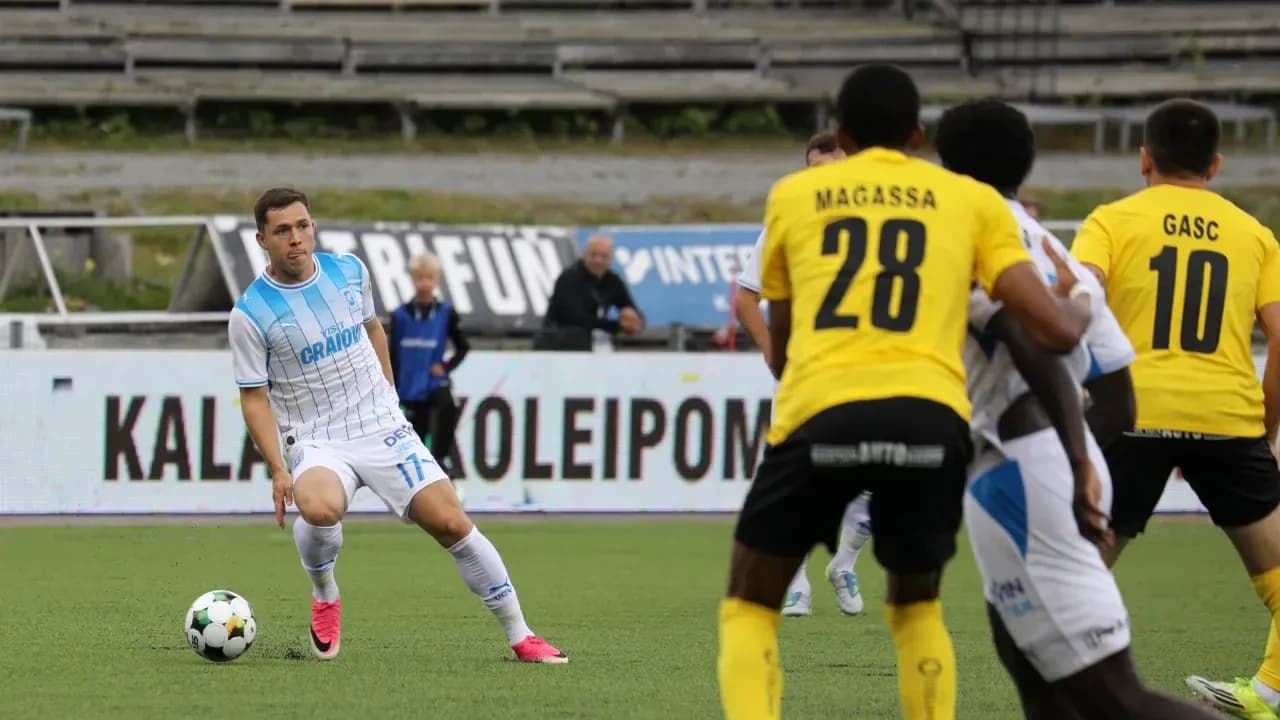
KuPS’ 4-2-3-1 against Universitatea Craiova’s 3-4-3 produced a tactically tight 1-1 draw at Savon Sanomat Areena, defined more by structural battles than volume of chances. KuPS edged the ball with 53% possession and a 6–2 advantage in corners, but Craiova were more incisive in the final third, registering 4 shots on goal to KuPS’ 1 and striking first to control the game state for over half an hour.
Craiova’s 3-4-3 was built to compress central spaces and spring quickly into wide channels. The back three of A. Rus, N. Stevanovic and V. Screciu held a relatively high line, trusting the wing-backs C. Mora and N. Bancu to manage KuPS’ wide overloads. Out of possession, the shape often flattened into a 5-4-1, with S. Baiaram and the other forwards dropping to screen KuPS’ double pivot of V. R. Gasc and S. Touray. This compactness limited KuPS’ ability to play vertical passes through midfield, forcing them into more speculative balls and contributing to their 7 offsides, a sign of repeated attempts to break beyond Craiova’s line too early.
KuPS’ 4-2-3-1 relied heavily on the central trio behind the striker. With J. J. Moreno Ciorciari as the lone forward, the band of three — J. Luyeye-Lutumba, T. Jyry and B. Armah — had to find pockets between Craiova’s midfield and defence. Early on, though, KuPS struggled to connect those zones cleanly. Their 19 fouls indicate a team frequently forced into defensive transitions after turnovers, particularly when their full-backs, notably Clinton Antwi on the left, pushed high and left space behind.
The first-half yellow card for Antwi at 36' encapsulated KuPS’ risk profile: full-backs stepping aggressively to press and then being exposed when possession was lost. Two minutes later, Craiova capitalised. With KuPS stretched, Craiova built down the right, and a well-timed contribution from A. Rus as provider allowed S. Baiaram to finish at 38', a move consistent with their plan to use wide overloads and quick combinations to attack the box. That goal, one of Craiova’s 4 shots on goal, underlined their superior efficiency: fewer overall attacks but higher-quality final actions.
At 0-1 down and having created just one shot on goal all match, KuPS’ tactical response came in a decisive triple substitution on the hour. S. Savolainen (IN) came on for V. R. Gasc (OUT), C. Kabuye (IN) for B. Armah (OUT), and P. Parzyszek (IN) for A. Puukko (OUT). These changes rebalanced the side: Savolainen added fresh legs and aggression in midfield, Kabuye injected more direct threat in the attacking band, and Parzyszek’s presence offered a more physical reference up front. The intent was clear: increase verticality, second-ball pressure and penalty-box occupation.
Craiova responded almost immediately with a triple change of their own at 59', signalling a shift to game management. A. Al Hamlawi (IN) replaced S. Nsimba (OUT), Teles (IN) replaced A. Cicaldau (OUT), and D. Matei (IN) replaced S. Baiaram (OUT). Removing the goalscorer and a key midfield organiser in Cicaldau reduced some of their creative ceiling but added fresh energy and defensive discipline to protect the lead. The effect, however, was to gradually cede territory and initiative to KuPS.
The turning point came from KuPS’ improved occupation of the half-spaces. With more bodies between Craiova’s lines, KuPS finally broke through at 72': J. J. Moreno Ciorciari finished after service from T. Jyry, whose positioning and timing had become increasingly influential as KuPS pushed higher. The goal was the product of sustained pressure, supported by KuPS’ 6 corner kicks, and highlighted how their structure, once tilted more aggressively, could pin Craiova’s wing-backs deep and disconnect their front three from the rest of the team.
Substitution sequences around 73' further underlined the tactical chess match. A. Heinonen (IN) replaced J. Luyeye-Lutumba (OUT) for KuPS, adding fresh energy in the advanced midfield line, while Heriberto Tavares (IN) replaced M. Etim (OUT) for Craiova, a like-for-like change to maintain the 3-4-3 shape but with more running to threaten on the break. Later, at 83', S. Heiskanen (IN) replaced Antwi (OUT), a move that shored up KuPS’ left side while also maintaining their ability to step into midfield. Heiskanen’s late yellow card at 88' reflected KuPS’ continued front-foot approach and willingness to take risks to sustain pressure.
Discipline patterns reinforced the tactical narrative. KuPS collected 2 yellow cards to Craiova’s 1, with a total of 3 in the match. The higher KuPS foul count (19 to 15) and their bookings came from a strategy that accepted aggressive challenges to prevent transitions once their full-backs and midfielders had committed forward. Craiova’s single yellow for Adrian Rus at 68' aligned with a defender repeatedly tasked with holding a high line under increasing direct pressure from KuPS’ reshaped attack.
In the final phases, Craiova’s substitution of T. Baluta (IN) for A. Mekvabishvili (OUT) at 90+5' was a late attempt to regain some midfield control and ball retention, but by then the tactical pattern was set: KuPS pressing for a winner, Craiova primarily concerned with protecting the draw and managing space rather than chasing a second goal.
Statistically, the draw feels like a balance between KuPS’ territorial and set-piece dominance and Craiova’s sharper final-third work. KuPS’ 53% possession, 6 corners and high offside count point to a team that spent more time in advanced zones but struggled to translate that into clear shots, finishing with only 1 shot on goal and 1 blocked shot. Craiova, with 47% possession and just 2 corners, were more selective but more dangerous when they did attack, posting 4 shots on goal and 1 blocked shot.
The absence of recorded goalkeeper saves and passing metrics limits deeper quantification of build-up quality and shot-stopping impact, but the pattern of fouls and offsides is revealing. KuPS’ repeated attempts to get in behind and their willingness to foul in transition show a side intent on forcing the tempo, especially after falling behind. Craiova’s lower foul count and offside-free performance suggest a more controlled, structure-first approach, leaning on the stability of the back three and the wing-backs’ discipline.
Overall, the 1-1 at Savon Sanomat Areena emerges as a tactical stalemate: KuPS using a more expansive, risk-tolerant 4-2-3-1 to chase and then sustain pressure, Craiova using a compact, transition-oriented 3-4-3 to strike first and then manage space. Each side imposed its game model in different phases, and the statistical profile mirrors the scoreboard: neither team did quite enough, in volume or efficiency, to tilt a finely balanced European tie.