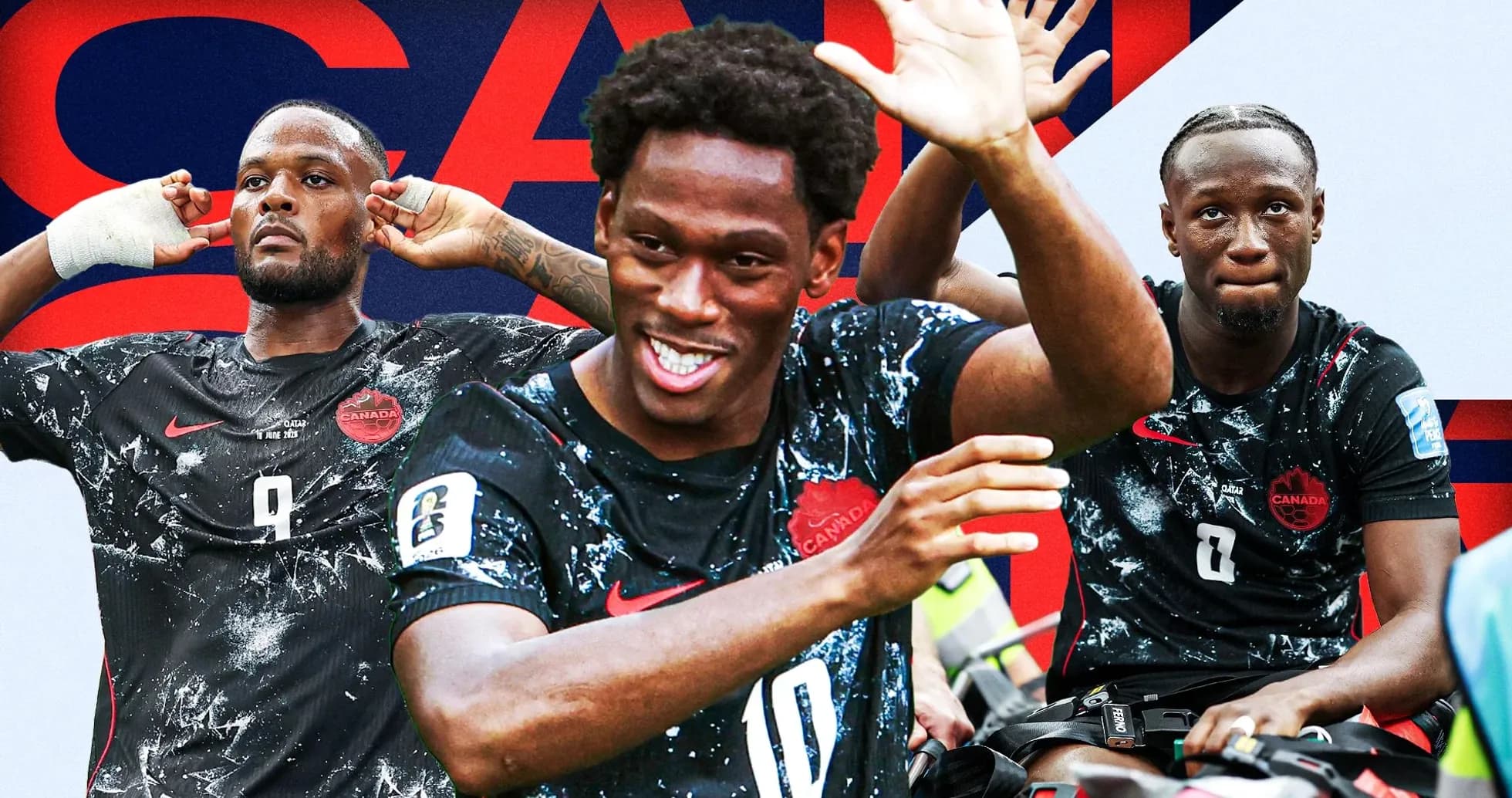
Jonathan David's Hat-Trick Ignites Canada's World Cup Hope
Jonathan David walked into this World Cup week with questions hanging over him and walked out of Thursday night with a hat-trick, a statement, and a nation exhaling in relief.
The noise had been loud. Pulled before the hour in the opening draw with Bosnia and Herzegovina, his touch off, his threat muted, the debate over his big‑stage temperament had flared again. He didn’t answer it with words. He rarely does. He answered it with the kind of ruthless finishing that changes the temperature of a tournament.
David erupts, Larin feeds off the chaos
From the opening whistle against Qatar, David looked like a man intent on clearing his name. He hunted defenders, chased lost causes, snapped into duels. Every loose ball around the Qatari box suddenly felt dangerous.
The breakthrough came early. In the 16th minute, David unleashed a ferocious right-footed volley that the goalkeeper could only spill. Cyle Larin, alive to the chaos, crashed in the rebound for his second goal of the tournament. One narrative quieted, another began to stir.
The pressure didn’t ease. Canada swarmed down the right, Tajon Buchanan and Alistair Johnston carving out triangles that Qatar simply couldn’t track. The move for David’s first World Cup goal was everything Jesse Marsch wants this team to be: sharp, quick, confident. Buchanan, Johnston, David – one touch, two touch, then the striker curling a precise finish into the net. No hesitation, no doubt.
Minutes later, the roles flipped again. Larin took aim, his shot parried into danger, and David stormed through to bury the rebound. The Juventus striker, questioned for his lack of edge in front of goal just days earlier, suddenly looked like the coldest finisher on the pitch.
The night still had one more historic twist. Deep into the closing stages, with Qatar broken and Canada relentless, David burst through again. One more chance, one more clean strike, and with it he became the first Canadian to score a hat-trick at a World Cup. Six for Canada, three for their No. 9, and a resounding answer to a week’s worth of doubt.
“It was amazing. After every goal, it got louder and louder,” David said of the crowd. “It gave us motivation to get the next goal and the next goal.”
By the final whistle, the country’s all-time leading scorer stood on 42 international goals, his confidence finally matching the expectations that have long surrounded him.
“That’s a player, that's a striker, that's a goal scorer,” Marsch said afterwards. “I never had any doubts in Jonny, and the one thing I said is, for us to really be successful as a team, we need Jonny driving what we do in the attacking part of the pitch. He set up the first goal with the shot, then he obviously scored the hat trick, but I thought he was fantastic in general.”
A brutal blow: Koné’s injury silences the party
For all the noise around David’s redemption and Canada’s six-goal eruption, the celebrations never quite turned into a full-throated party. They couldn’t. Not after Ismaël Koné went down.
The midfielder had been central to everything Canada wanted to do between the lines. Those elusive touches under pressure, the disguised passes through compact blocks, the ability to carry the ball out of tight spaces – Koné was the hinge between defence and attack.
Then came the moment that changed the mood.
“You could hear the bone snap,” Marsch revealed, a stark, chilling detail after confirming Koné had gone to hospital for surgery. “Your heart goes out to him. Everybody’s shaken for him.”
There is no official prognosis yet, but the early signs are grim. Canada may have to play out the rest of this World Cup – and possibly a long stretch beyond – without the one midfielder on the roster who can consistently thread passes through defences and slice through lines with the ball at his feet. There are replacements, but no replica.
Injuries have stalked Canada’s build-up to this tournament, so the “next man up” mantra is already well-worn. Alphonso Davies is on his way back. Samuel Saliba stepped in and even curled home a free-kick after replacing Koné. The profiles are good. The specific skillset Koné offers is unique.
“For us to be at our best, he's a big part of it. But, look, it's given us now something else to play for," Johnston said. “That's what this team is all about, it really is a brotherhood. So it's really difficult to see one of your brothers go down. But, look, if we needed any extra motivation for this tournament, we got it now.”
Johnston walks the tightrope, then takes over
On the opposite flank of the emotional spectrum stood Alistair Johnston, who managed to play on the edge all night without tumbling over it.
One yellow card would have ruled him out of the Group B finale against Switzerland. Many players, carrying that risk, retreat into themselves. Johnston did the opposite. The Celtic fullback played as if unshackled, not restrained – aggressive in the press, relentless in support of Buchanan and Koné down the right, constantly available in wide overloads.
He set up Canada’s second goal, swung in four accurate crosses, and finished with six big chances created. All while staying just the right side of the referee’s patience, preserving his availability for the decisive group match, when bookings will be wiped clean before the Round of 16.
“We knew that the idea was kind of to build up against the Akram Afif. He's a maverick; you could see some of the quality he had on the ball,” Johnston explained. “Defensively, though, the idea was to play against him, make him defend, because we didn't think he was going to. We're trying to find that balance of me being in the defensive three in a build-up, but then also give me the license, as I have with my club, to really join in and help Tajon.”
When Koné fell, Johnston’s role shifted again. One of the most vocal players in the dressing room, he moved quickly to steady shaken teammates, glancing repeatedly towards his stricken colleague. Leadership isn’t just about tactics or tone; on nights like this, it’s about holding a group together in the seconds after they’ve seen a friend suffer a serious injury. Johnston did that, too.
Qatar unravel as Canada surge
For Qatar, this was a step backwards of alarming proportions.
Four years after finishing bottom of their home World Cup, they arrived with a point to prove and a gritty draw against Switzerland already in the bank, secured by a late equaliser and a display of disciplined defending. That resilience vanished under Canada’s intensity.
They struggled to cope with the tempo, the pressing, the wide rotations. The structure that had held firm against Switzerland simply fell apart. Canada kept coming, and Qatar had no answer.
Julen Lopetegui has seen almost everything in this sport, but he could not drag his players back into the contest. The composure went, the distances between lines grew, and the belief drained out of them long before the final whistle.
Now they stand on the brink of another early exit from a World Cup, likely to bow out of Group B and forced to play their final match without two starters. If Thursday’s display is any indication of where this team is headed, the road back to this stage could be long.
Doubters silenced, stakes raised
The story of Canada’s attack in this tournament has already swung wildly. Before Bosnia, the spotlight fell on Larin, his starting place under threat to the point Marsch dropped him for Tani Oluwaseyi. Larin responded with goals in back-to-back matches, one in each game, and the criticism eased.
With Larin’s questions answered, the glare turned to David. Was he ready to carry this team on the biggest stage? Did the numbers in qualifying flatter him? Ninety minutes and three goals later, that conversation has been put to bed.
With this commanding win, Canada did more than rack up a scoreline. They showed they can not only survive at a World Cup, but impose themselves, dictate, and overwhelm. They did it without Davies, too, buying their captain and superstar another precious week of recovery before a showdown with Switzerland that will likely decide the top of the group.
Now comes the hard part: playing on without Koné, trying to keep the fluidity in midfield while carrying the weight of his absence. The belief is there, the goals are flowing, and the path to the knockout rounds is clear.
The question is whether this team, galvanized by a brutal loss in the middle of the park, can turn one of the most painful moments of their tournament into the fuel for its biggest ones.