Jagiellonia's Tactical Masterclass in 2-1 Win Over Rangers
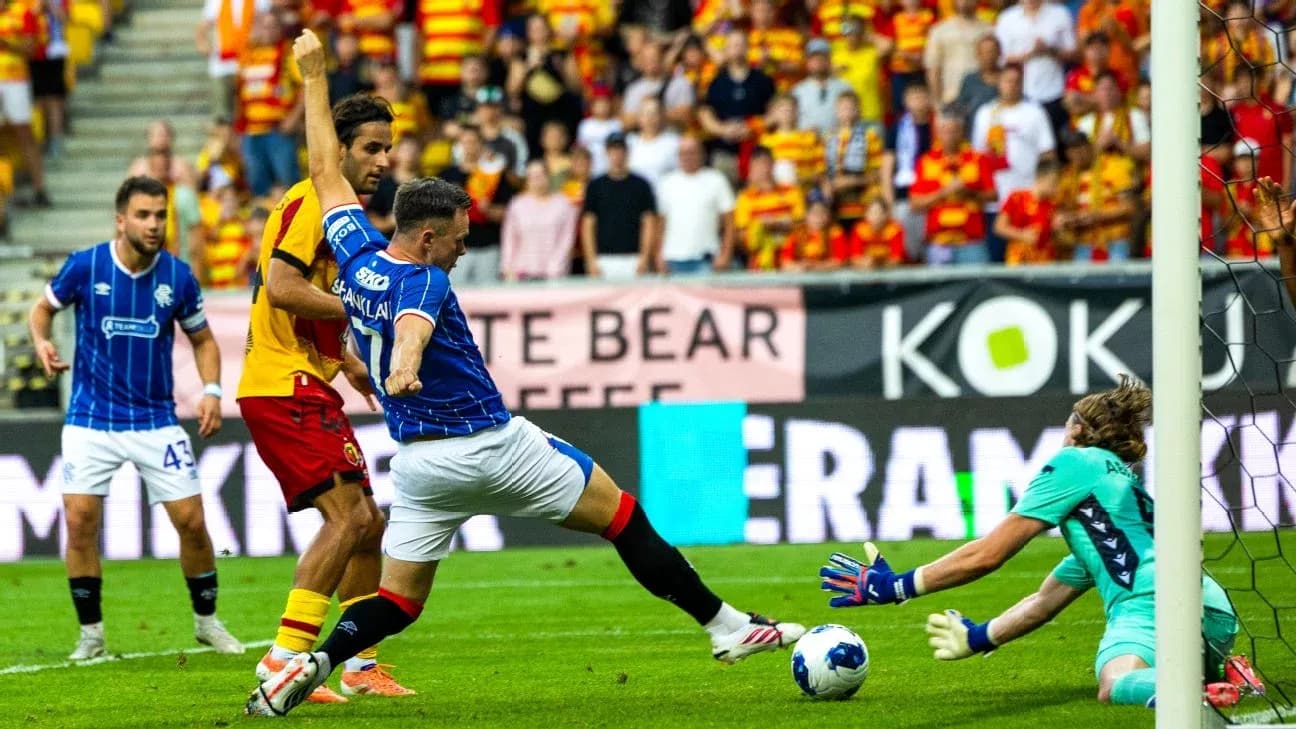
Jagiellonia’s 2-1 home win over Rangers at Chorten Arena was built on a clear structural plan and ruthless exploitation of early chaos, rather than territorial dominance. Adrian Siemieniec’s 4-3-3 used a compact mid-block and sharp transitions to turn a volatile opening quarter into a platform to protect. Derek McInnes’ 4-2-3-1 for Rangers had more territorial balance and more corners, but never converted structural possession into sustained threat, and the tie’s first leg slipped away in the details.
Jagiellonia’s shape without the ball was the foundation. The nominal 4-3-3 often flattened into a 4-1-4-1, with T. Romanczuk sitting as the single pivot in front of the back four. The full-backs, G. Montoia and N. Wojtuszek, held relatively conservative starting positions, rarely stepping high at the same time, which helped control the wide zones against D. Yokota and T. Aasgaard. Inside, S. Lozano and K. Szmyt worked as shuttlers, stepping onto Rangers’ double pivot of T. Chukwuani and D. Neil to block central progression and force Rangers around the block rather than through it.
In possession, Jagiellonia’s 52% of the ball was used pragmatically rather than expansively. The centre-back pairing of A. Konstantopoulos and Y. Kobayashi circulated from side to side, but the main progression pattern was vertical: early passes into the feet of J. Imaz between the lines or into the channels for N. Prelec. With only one corner won all evening and no blocked shots, Jagiellonia did not rely on sustained pressure or second-ball waves; they preferred quick, clean attacks that ended in clear efforts on goal. Seven shots on target from a relatively modest volume of total attempts underline that efficiency: when they got into the final third, they made it count.
Decisive Phase
The decisive phase was the first half. The early own goal by G. Montoia could have destabilised Jagiellonia’s back line, but structurally they responded by tightening distances between the full-backs and centre-backs, ensuring Rangers could not isolate 1v1s in wide areas. The equalising own goal from E. Fernandez and the subsequent strike by K. Szmyt flipped the game-state in Jagiellonia’s favour. From that point, the tactical emphasis shifted from construction to control. The midfield three became more risk-averse, with fewer third-man runs and more focus on screening passes into Chermiti’s feet.
Siemieniec’s substitutions on 65 and 80 minutes reinforced that trend. J. Agbonifo (IN) came on for R. Conceicao (OUT), and A. Klynge (IN) replaced S. Lozano (OUT), freshening the midfield legs and preserving the intensity of the central press. Later, D. Drachal (IN) for J. Imaz (OUT) and Y. Sylla (IN) for N. Prelec (OUT) further tilted the side toward ball retention and counter-pressing rather than pure attacking threat. The message was clear: protect the 2-1, compress the central lane, and force Rangers into low-probability crossing situations.
Rangers' Approach
Rangers’ 4-2-3-1 had logical spacing but lacked incision. With 48% possession, five corners and four shots off target to go with three on target, they managed to tilt the field periodically but not to overwhelm. The double pivot of T. Chukwuani and D. Neil was tasked with both building and protecting, but under Jagiellonia’s pressure they often received with their back to play and were forced sideways. When Rangers did reach the final third, the presence of only one blocked shot suggests that Jagiellonia’s back four defended their box cleanly, closing shooting lanes early rather than relying on last-ditch interventions.
McInnes’ triple substitution at 46 minutes was an aggressive tactical reset. C. Devlin (IN) for T. Chukwuani (OUT), N. Raskin (IN) for D. Neil (OUT), and F. Curtis (IN) for D. Yokota (OUT) reconfigured the midfield to add energy and forward thrust. Devlin and Raskin offered more dynamism and pressing range, and Curtis’ introduction aimed to refresh the attacking band behind Chermiti. The idea was to increase the tempo and pin Jagiellonia deeper. Structurally, Rangers began to push full-backs D. Sterling and T. Rommens higher, which contributed to their superiority in corners (5-1) and a slight swing in territorial pressure after the break.
However, the downside of that higher posture was vulnerability to transitions. Each time Rangers committed numbers forward, Jagiellonia looked to break through the half-spaces via Szmyt and the substitute forwards, forcing Rangers’ centre-backs to defend large spaces facing their own goal. The lack of a second Rangers goal owed as much to Jagiellonia’s compactness and decision-making in rest defence as to any missed chances from the visitors.
Discipline and Game Management
Discipline also shaped the rhythm. Rangers committed 15 fouls to Jagiellonia’s 11, picking up three yellow cards to the hosts’ one. While no card reasons were specified, the pattern reflects a Rangers side increasingly forced into late challenges as they chased the game and tried to disrupt Jagiellonia’s counters. The late yellow for Nicolas Raskin at 90+2’ symbolised that frustration: Rangers were still trying to impose themselves physically, but Jagiellonia’s structure and game management held.
With no recorded goalkeeper saves, xG or goals prevented values in the data, the tactical verdict rests on territorial and chance-quality proxies. Jagiellonia turned marginal possession superiority and fewer set-piece opportunities into a higher volume of accurate shots on goal, while Rangers’ more frequent fouling and reliance on corners point to a side struggling to create from open play. Over 90 minutes, the 2-1 scoreline matches the underlying tactical story: Jagiellonia were more efficient, more controlled in defensive structure, and more adept at managing the game-state once they turned an early setback into a lead.