HNK Hajduk Split's Tactical Mastery in UEFA Europa League
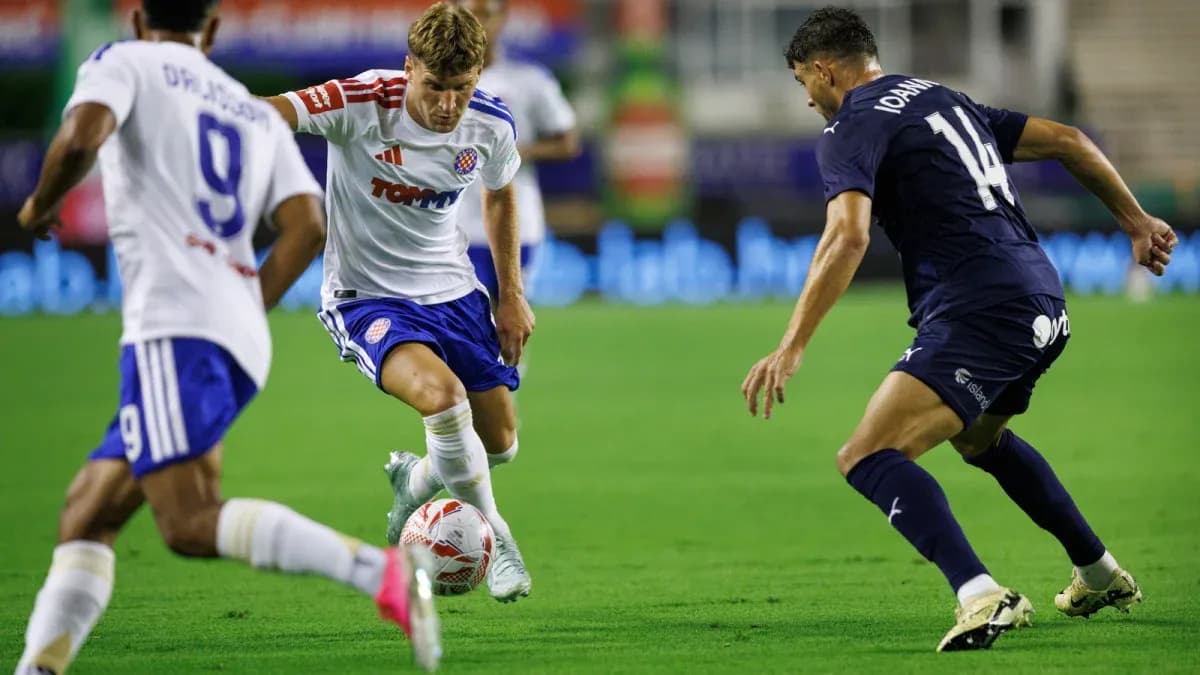
HNK Hajduk Split’s 2-0 win over Pafos at Stadion Poljud in the UEFA Europa League 2nd Qualifying Round was built on a clear structural plan: a compact 4-2-3-1 that absorbed more possession and shots, then struck with precision and controlled the game state once ahead. Pafos, in a 3-4-3, saw more of the ball and attempted more efforts on goal, but struggled to convert territorial and shot volume into truly dangerous situations.
First Half
Hajduk’s 4-2-3-1 was designed first to protect the central corridor. The back four of S. Hrgovic, A. Van Hoorenbeeck, D. Maresic and M. Acapandie stayed relatively narrow, inviting Pafos to build in wide areas while keeping the three Pafos forwards away from direct runs through the middle. In front of them, the double pivot of R. Pukstas and Adrion Pajaziti gave Gonzalo Garcia a stable base: Pukstas could step out to engage Pafos’s advanced midfielders, while Pajaziti focused on screening passes into Lele and Biel.
With only 45% possession, Hajduk accepted long spells without the ball but used them to set pressing traps. The first line, with M. Sego as the lone striker and D. de Almeida plus R. Brajkovic operating as the advanced midfielders, rarely pressed Pafos’s back three high in sustained fashion. Instead, they allowed circulation across the Pafos defensive line, then jumped aggressively when the ball was played into a central midfielder with his back to goal. This helped disrupt Pafos’s rhythm despite the Cypriot side’s 55% share of the ball.
Goals
In attack, Hajduk were extremely efficient: 8 total shots, 2 on target, and both of those efforts produced goals. The first, at 56’, came from M. Sego, reflecting the value of directness once Hajduk broke the initial press. The structure of the 4-2-3-1 meant that when Hajduk won the ball, they could immediately find vertical lanes through de Almeida and Brajkovic, with Sego running channels off the shoulder of the outside centre-backs. The second goal at 64’, scored by left-back D. Melnjak and assisted by right-back M. Acapandie, underlined how the full-backs were encouraged to advance once Hajduk had a platform. It also showed a well-rehearsed pattern: switching play from one flank to the other to exploit the spaces behind Pafos’s wing-backs.
Second Half
Pafos’s 3-4-3 under Albert Celades was front-foot in intent. With 14 total shots (11 off target, 3 on target), they clearly carried attacking volume, but the shot profile betrayed structural issues. The front three of Biel, Lele and V. Dragomir (before his substitution) tried to stretch Hajduk horizontally, while the wing-backs Jaja and Nikolas Ioannou pushed high to pin Hajduk’s full-backs. However, the central pairing of Pepe and I. Sunjic (then adjusted with A. Brito and D. Quina from the bench) often received the ball under pressure, and too many attacks ended in speculative efforts rather than clean chances.
The possession figures (55% for Pafos) suggest control, but Hajduk’s block forced Pafos to circulate without consistently breaking lines. The three centre-backs — S. Mmaee, David Luiz and D. Goldar — were frequently the deepest playmakers, yet when they stepped into midfield, Hajduk’s first line quickly closed the lane into central zones. This often pushed Pafos into early crosses or long-range shots, explaining the high number of shots off goal.
Discipline and Game Management
Discipline and game management further underlined Hajduk’s tactical maturity. They collected three yellow cards, all directly linked to duels in midfield or late-game control: Adrion Pajaziti for “Foul” at 4’, Adam Huram for “Foul” at 87’, and Alberto del Moral for “Professional foul” at 88’. Each of these moments reflected a willingness to interrupt Pafos’s attempts to accelerate transitions, especially once Hajduk were two goals up and protecting the lead. Pafos, for their part, took two bookings: Nikolas Ioannou for “Foul” at 55’ and Alexandre Brito for “Professional foul” at 64’, both indicative of struggles to contain Hajduk’s breakouts down the flanks and through the half-spaces.
Substitutions
Substitutions were used by both coaches as tactical levers rather than simple like-for-like changes. Celades reacted first at 63’, with Bruno (IN) coming on for D. Goldar (OUT) and A. Brito (IN) for Pepe (OUT), signalling a desire for more progressive passing and energy in midfield. Later, at 74’, D. Quina (IN) came on for V. Dragomir (OUT) and Guga (IN) for I. Sunjic (OUT), moves aimed at injecting creativity and more vertical running from midfield. Despite these changes, the underlying structure remained a 3-4-3, and the same issues in accessing central zones persisted.
Gonzalo Garcia’s changes were more about consolidating control. At 77’, M. Livaja (IN) came on for M. Sego (OUT), giving Hajduk a forward who could drop deeper, hold the ball and link play, ideal for protecting a two-goal advantage. Simultaneously, Alberto del Moral (IN) replaced D. de Almeida (OUT), adding fresh legs and defensive awareness in the advanced midfield line, and M. Skelin (IN) came on for D. Maresic (OUT), ensuring the back line retained intensity. At 83’, A. Guram (IN) replaced the goalscoring left-back D. Melnjak (OUT), a clear defensive adjustment to guard the flanks. Finally, at 90+2’, R. Raci (IN) came on for S. Hrgovic (OUT), another move to close down any late Pafos pressure on the right side.
Match Statistics
Statistically, the match paints a classic picture of a side winning through efficiency and structure rather than volume. Pafos led in possession (55% to 45%), total shots (14 to 8), and corner kicks (7 to 8 in Hajduk’s favour by a small margin for the hosts). Yet Hajduk’s 2 shots on goal both found the net, while Pafos’ 3 shots on goal failed to beat the home defence. Neither side registered blocked shots, which aligns with the pattern of many efforts being taken from less congested zones but at suboptimal angles or distances.
The disciplinary balance — three yellows for HNK Hajduk Split and two for Pafos, no reds for either — shows a game that was competitive but largely controlled. With no free kicks recorded in the data, the focus shifts entirely to open-play structures, where Hajduk’s compact 4-2-3-1 and ruthless attacking transitions outperformed Pafos’s more possession-heavy but less incisive 3-4-3. In a two-legged European tie context, this kind of tactical clarity and clinical edge gives Hajduk both a scoreline advantage and a clear blueprint for how to manage the return fixture.