France Dominates Sweden 3-0 in Round of 32 Clash
France’s 3-0 win over Sweden at MetLife Stadium was a methodical, structurally dominant Round of 32 performance built on control between the lines and relentless pressure on the last line of defence. Didier Deschamps’ 4-2-3-1 imposed itself both territorially and technically, turning 61% possession and a 25–8 shot advantage into a scoreboard that accurately reflected the balance of play. Graham Potter’s 4-4-2 tried to stretch the pitch vertically through Viktor Gyökeres and Alexander Isak, but Sweden’s attacks were repeatedly suffocated before they could reach sustained danger, reflected in their modest 0.65 xG against France’s 3.17.
In possession, France’s structure was the foundation of their control. The nominal 4-2-3-1 often morphed into a 2-3-5 in settled attacks: Dayot Upamecano and William Saliba held a high rest-defence line, Lucas Digne and Jules Koundé pushed on to pin Sweden’s wide midfielders, while Aurélien Tchouaméni dropped centrally to form a three-man platform with Adrien Rabiot and the ball-near full-back. This gave France stable circulation and constant access to the half-spaces for Michael Olise and Bradley Barcola.
The shot profile underlines how effectively France attacked those interior channels. Sixteen of their 25 attempts came from inside the box, backed by 3.17 xG, a clear sign that the attack was generating repeated, high-quality looks rather than speculative efforts. Ousmane Dembélé and Barcola stretched the width, but the real damage came when they inverted into pockets between Sweden’s full-backs and centre-backs, dragging the back four into uncomfortable decisions. Kylian Mbappé, starting as the lone forward, frequently dropped off the last line to combine, allowing wide runners to attack the space he vacated and creating the classic Deschamps pattern of third-man runs and cut-backs.
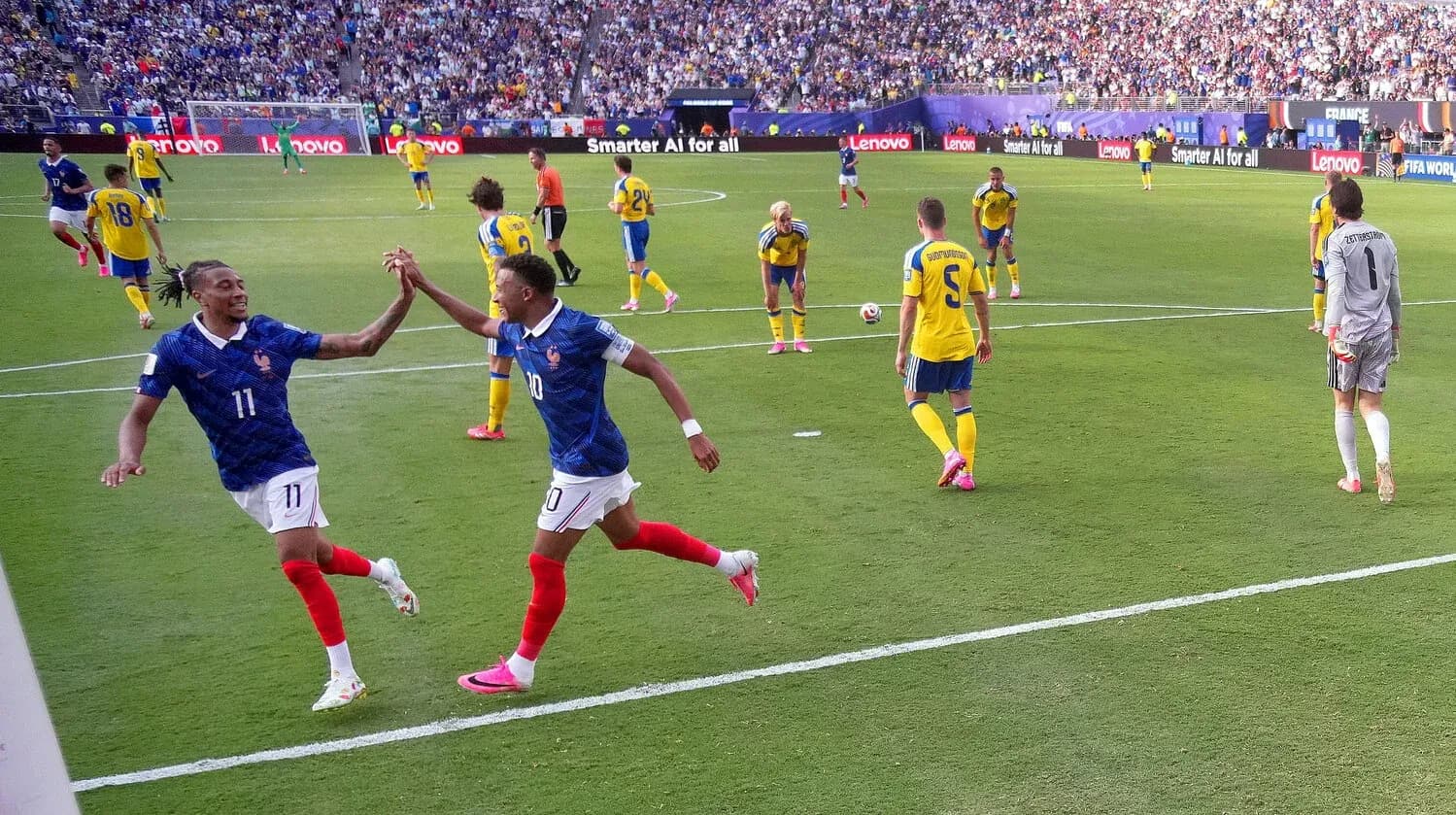
The three goals followed that logic. Mbappé’s opener on 45', assisted by Dembélé, crowned a half in which France had steadily compressed Sweden into their own third. The second, from Barcola on 53' via Olise, came as France immediately reasserted control after the break, exploiting a Sweden side forced to open up slightly. Mbappé’s second at 74', this time assisted by Olise, reflected the cumulative effect of France’s positional play: Sweden’s block, already stretched horizontally, could no longer track every diagonal run into the box.
Defensive Structure
Off the ball, France’s 4-2-3-1 pressed in a compact 4-4-2 shape, with Olise stepping up alongside Mbappé to close Sweden’s centre-backs. The front two curved their runs to screen access into Yasin Ayari and Lucas Bergvall, forcing Sweden to play wide and long. From there, Saliba and Upamecano dominated aerially and in duels, which helps explain why Sweden managed only eight shots and just three on target despite a front pairing of Gyökeres and Isak. The 14 fouls France committed were largely the product of aggressive counter-pressing in midfield rather than structural instability at the back.
The double pivot of Tchouaméni and Rabiot was crucial in controlling transitions. Whenever Sweden tried to break through Anthony Elanga or Elliot Stroud, one pivot stepped out to confront the carrier while the other held a staggered position to protect the back line. This balance allowed the full-backs to maintain advanced positions without exposing Mike Maignan’s goal. Maignan (France) faced three shots on target and, supported by that compact structure, dealt with them cleanly; the defensive unit in front of him limited Sweden’s touches in truly dangerous central zones, which aligns with the low Swedish xG.
Sweden's Strategy
Sweden’s 4-4-2 had clear intentions but lacked connectivity. With only 39% possession and 352 passes (280 accurate, 80%), their midfield often found itself bypassed, forced to choose between dropping deep to help the build-up or pushing on to support the front two. When they did manage to progress, attacks tended to be linear: early balls into Gyökeres and Isak, hoping to exploit individual quality rather than orchestrated overloads. The fact that seven of their eight shots still came from inside the box suggests they occasionally broke through France’s line, but the low xG indicates those chances were from poor angles or under heavy pressure.
Potter’s substitutions on 66' and 82' — Besfort Zeneli for Stroud, Taha Abdi Ali for Bergvall, Benjamin Nygren for Ayari, and Mattias Svanberg for Daniel Svensson — were attempts to inject more creativity and ball-carrying into midfield and the flanks. However, by that stage France’s three-goal cushion and game-state management allowed them to drop the block slightly, close central lanes, and attack the spaces left as Sweden chased the game. Deschamps’ own changes — Malo Gusto for Koundé, Désiré Doué for Dembélé, Theo Hernández for Digne, Jean-Philippe Mateta for Olise, and Rayan Cherki for Mbappé between 75' and 85' — were less about altering the structure and more about maintaining intensity and vertical threat with fresh legs in the same roles.
The statistical picture reinforces the tactical story. France’s 551 passes, with 485 accurate at 88%, show a side comfortable circulating under pressure and repeatedly finding the free man between Sweden’s lines. Sweden’s 80% pass accuracy and lower volume meant they struggled to sustain possession phases long enough to disorganise France’s block. On set pieces, France’s nine corners to Sweden’s one added another layer of territorial dominance, keeping Sweden penned in and forcing their defensive line to defend repeated deliveries.
In goal, Jacob Widell Zetterström (Sweden) was a rare positive. He made nine saves and, with 1.16 goals prevented, significantly limited the damage on the scoreboard; without his interventions, France’s chance volume and xG suggest the margin could easily have been heavier. Maignan (France), backed by the same 1.16 goals prevented figure on the French side, was less busy but similarly efficient when called upon.
Ultimately, this was a match where structure and execution aligned for France. Their superior possession, shot quality, and passing accuracy were not isolated numbers but the direct outcome of a coherent 4-2-3-1 that controlled space, tempo, and transitions, while Sweden’s 4-4-2 never found a consistent way to disrupt that platform or to connect their forwards to the rest of the team.