Ferencvarosi TC and Twente Share Spoils in Tactical Draw
Ferencvarosi TC and Twente produced a tactically volatile 2-2 draw at Groupama Aréna in the UEFA Europa League 2nd Qualifying Round, a match split into two distinct phases: 11v11 control from the hosts, and a long, structurally strained 10v11 resistance after the red card. With no reliable possession or shooting figures available, the game must be read through structure, roles and event sequencing rather than volume metrics.
Ferencvarosi TC started in a 4-3-3 under Balazs Borbely, with D. Dibusz in goal, a back line of Cadu and A. Osvath as nominal full-backs, and M. Gomez with T. Raemaekers as the central pairing. The midfield triangle of P. Rommens as the deeper organiser with G. Kanichowsky and M. Corbu ahead supported an asymmetric front line: K. Zachariassen and C. O’Dowda attacking from the half-spaces around central forward L. Joseph. The structure was clearly designed to progress through the interior lanes, using Kanichowsky and Corbu to connect into Joseph’s feet and then release wide runners.
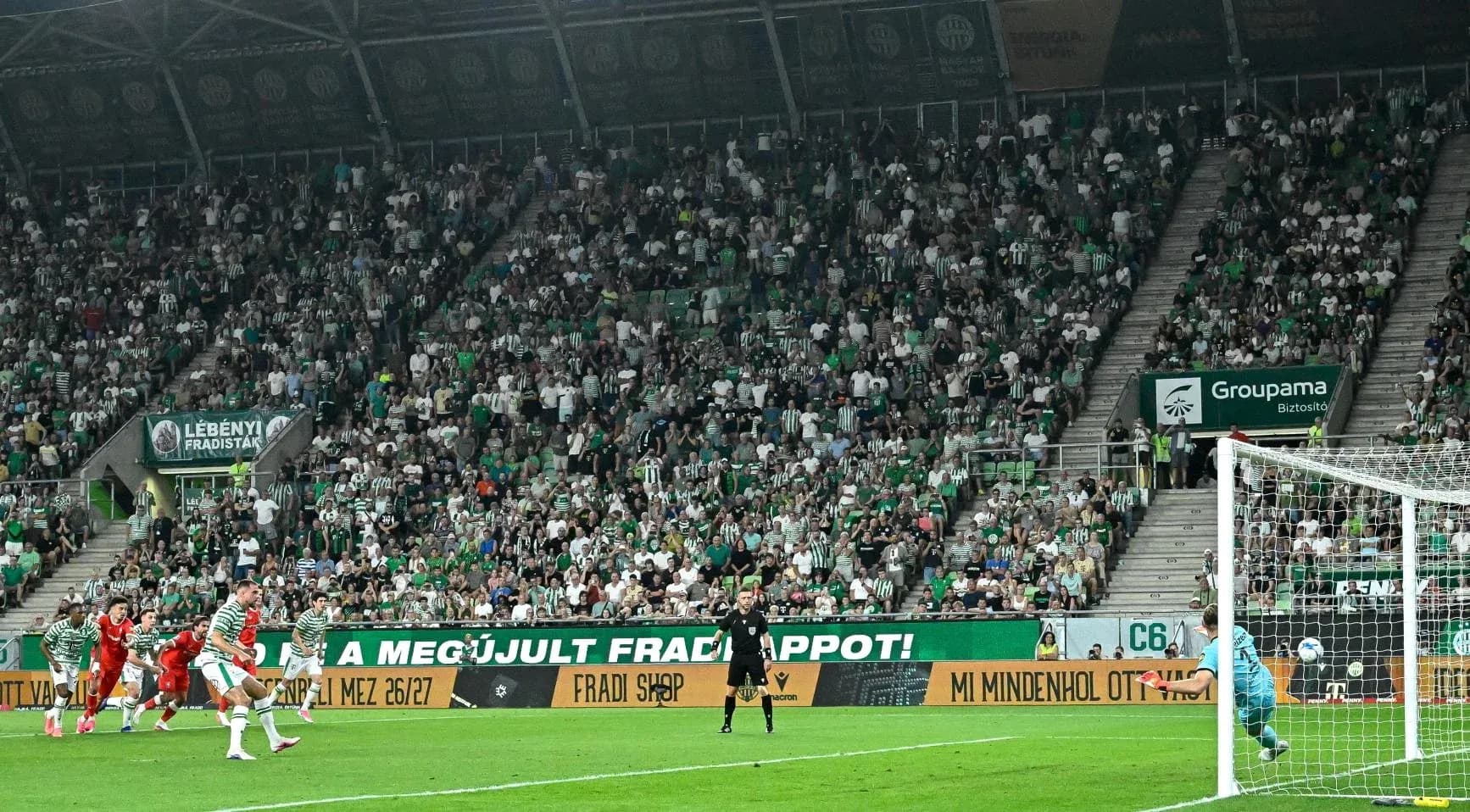
The 22nd-minute penalty converted by T. Raemaekers underlined Ferencvarosi TC’s early territorial control: a centre-back stepping into a decisive moment in the box reflects how high the defensive line and rest defence were positioned. At 1-0, Borbely’s side could compress the pitch, with Cadu and Osvath holding advanced positions to lock in second balls and sustain pressure.
The tactical axis of the match flipped on 36 minutes. The red card to P. Rommens for “Serious foul” removed Ferencvarosi TC’s central pivot and forced an immediate rebalancing. Out of possession, the hosts effectively morphed into a 4-4-1: one of the advanced midfielders had to drop alongside Kanichowsky, while Joseph became an isolated reference point up front. The pressing height necessarily dropped, and the back four had to defend larger spaces without the same screening in front.
Remarkably, Ferencvarosi TC still found a way to extend their lead early in the second half. On 50 minutes, L. Joseph struck for 2-0, a goal that tactically spoke to directness and efficiency: with one fewer midfielder, the hosts leaned more on early balls into the striker and quick, vertical transitions rather than elaborate buildup. That goal bought them a cushion, but it also locked them even deeper into a reactive game plan.
Twente, also in a 4-3-3 under John van den Brom, had started with L. Unnerstall in goal behind a back four of B. van Rooij, S. Lemkin, R. Nijstad and A. Adelgaard. The midfield trio of R. Zerrouki, K. Hlynsson and T. van den Belt sat behind a front line of D. Rots and S. Orjasaeter supporting W. Weghorst. Their initial problem was breaking down a compact, numerically balanced block; once Rommens was dismissed, the problem became how to convert territorial dominance into penalty-box presence without losing protection against counters.
Van den Brom’s double change at 46 minutes was clearly structural rather than reactive to the scoreline alone. K. Hlynsson (OUT) made way for S. Lammers (IN), and A. Adelgaard (OUT) was replaced by D. Weidmann (IN). Introducing Lammers added a second penalty-box threat around Weghorst, shifting Twente towards a more aggressive 4-2-4 or 4-2-3-1 in possession, with extra occupation of central channels. Weidmann’s entry at left-back provided fresher legs and more thrust on the flank to stretch a now-numerically inferior Ferencvarosi TC.
The 56th-minute simultaneous yellow cards to Cadu and T. van den Belt, both for “Unsportsmanlike conduct”, reflected the tension of this new game state: Ferencvarosi TC defending deeper and more desperately, Twente pushing numbers high and trying to accelerate the tempo. Lemkin’s booking on 61 minutes, also for “Unsportsmanlike conduct”, further underlined Twente’s increasingly risky posture as they committed defenders into advanced areas to keep Ferencvarosi TC penned in.
Twente’s substitutions around the hour and into the final quarter-hour were all about layering attacking profiles. At 63 minutes, T. van den Belt (OUT) was replaced by Y. Taha (IN), who later received a yellow card on 88 minutes for “Foul”. This swap tilted the midfield from balance to aggression, prioritising line-breaking and runs ahead of the ball. On 72 minutes, D. Rots (OUT) made way for M. Pjaca (IN), and S. Orjasaeter (OUT) for L. Vennegoor of Hesselink (IN). With Pjaca and L. Vennegoor of Hesselink joining Weghorst and Lammers, Twente effectively flooded the final third, often pinning Ferencvarosi TC into a low 4-5-0 block with only sporadic outlets.
Borbely’s response was necessarily conservative. On 73 minutes, C. O’Dowda (OUT) was replaced by Dele (IN), a move that kept fresh legs in wide areas to chase clearances and offer minimal counter-threat. At 78 minutes, goalscorer L. Joseph (OUT) was withdrawn for N. Zohore (IN), preserving the structure of a single central reference while giving Ferencvarosi TC a more physical outlet to contest aerial balls and hold up play under pressure. The 88-minute change of Cadu (OUT) for J. Levi (IN) was a late attempt to stabilise the right flank after Cadu’s booking and heavy defensive workload.
The late goals conceded tell the tactical story of attrition. On 82 minutes, W. Weghorst struck to make it 2-1, exploiting the cumulative effect of Twente’s central overload and Ferencvarosi TC’s fatigue in the box. By then, Twente’s shape in possession resembled a 2-4-4, with full-backs and midfielders camped high and repeated deliveries targeting Weghorst. Just four minutes later, at 86 minutes, L. Vennegoor of Hesselink levelled at 2-2, validating van den Brom’s decision to stack the area with multiple aerial and second-ball threats. The equaliser encapsulated the strategic arc: Twente’s insistence on adding strikers and attacking midfielders eventually overwhelmed a numerically reduced, increasingly passive defensive block.
Discipline played a clear, asymmetrical role in the tactical narrative. Ferencvarosi TC finished with 1 yellow card and 1 red card; Twente with 3 yellow cards and no reds. The red to Rommens fundamentally redefined the match, forcing Ferencvarosi TC to abandon their higher-possession, interior-positional plan and retreat into a compact, counter-based shell. Twente’s three yellows, all for “Unsportsmanlike conduct” or “Foul”, were the by-product of a side relentlessly chasing a deficit, willing to accept disciplinary risk to sustain pressure.
Without concrete data on shots, possession, passes, xG or goals prevented, the clearest conclusion is structural: 11v11, Ferencvarosi TC’s 4-3-3 was balanced, proactive and effective enough to build and then double a lead. Once reduced to 10 men, they were pushed into a deep defensive posture, and Twente’s layered attacking substitutions—Lammers, Weidmann, Taha, Pjaca, and L. Vennegoor of Hesselink—eventually converted territorial dominance into two late, centrally-focused goals. The 2-2 final score accurately reflects a match where initial home control was ultimately cancelled out by sustained, numerically aided away pressure.