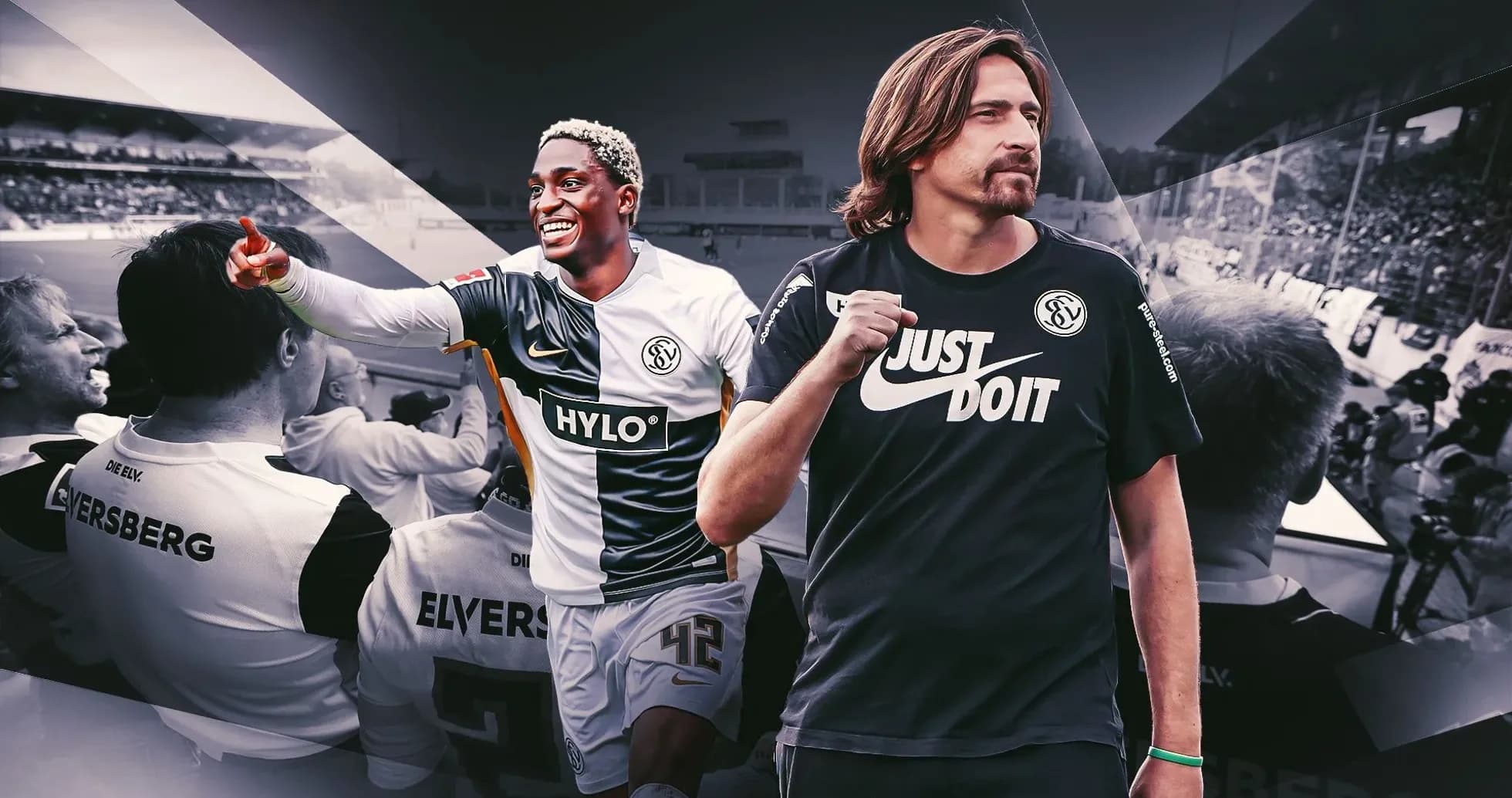
Elversberg: From Village Club to Bundesliga Contender
In Elversberg, you can walk from one end of town to the other in half an hour. There is no train station, no community hall, and barely 13,000 people. Yet this speck on the map now hosts a Bundesliga club.
They call them the Dorfverein – the village club. It no longer feels big enough.
From village pitch to professional dream
Elversberg’s story begins in 1907, pauses for the First World War, and restarts in 1918. For almost 100 years they lived in the shadows, an amateur side tucked away in the Saarland, far from the bright lights of German football.
The turning point arrived in the early 2000s. Local pharmaceutical company Ursapharm stepped in under club president Frank Holzer and later his son Dominik. Money, structure, and ambition followed.
Promotion to the 3. Liga came in 2013. So did immediate relegation. Still, the foundations hardened. Ursapharm bought the naming rights to the stadium, now the Ursapharm-Arena an der Kaiserlinde, a ground that grew to 10,000 seats while clinging to the memory of the century-old lime tree that once stood guard before it fell in 2015.
What the club still lacked was a footballing identity. That arrived in 2018 with Horst Steffen.
He installed a bold, front-footed style, the kind of football that made season tickets feel like a promise of chaos. Goals, risk, entertainment – and, eventually, trophies. In 2021-22, Elversberg stormed to the Regionalliga Südwest title and climbed back into the 3. Liga.
This time, they were ready.
Shockwaves in the cup, dominance in the league
You could feel it from the first whistle of 2022-23. In the DFB-Pokal, Elversberg ripped up the script and shredded Bayer Leverkusen 4-3 in the first round, the biggest scalp in their history.
Bochum ended the cup run in the next round, but the league became their stage. Over 38 games, they outlasted Freiburg in a ferocious promotion battle where the top five teams finished within five points. Elversberg finished on top.
They did it their way. No one scored more than their 80 league goals. Ten came from Stuttgart loanee Nick Woltemade. Steffen once admitted he preferred a “spectacular victory” to a tight 1-0. His players treated that as a mission statement.
The reward: promotion to the 2. Bundesliga. Their first year was a bruising education, but they held their own and finished 11th. Respectable. Stable. Then, in 2024-25, they almost tore the door off the Bundesliga.
Agony on the brink of paradise
Elversberg finished third in the 2. Bundesliga, behind Köln and Hamburg, and earned a promotion/relegation play-off against Heidenheim.
The first leg ended 2-2. The second was locked at 1-1 deep into stoppage time. One goal away from the promised land. One mistake away from heartbreak.
Leo Scienza struck in the 95th minute – for Heidenheim. Elversberg’s dream dissolved on the spot.
The blow doubled days later. Steffen, the architect of their rise, left for Werder Bremen. The club banked €300,000 in compensation, a decent sum for a minnow, but it barely touched the emotional cost of losing the man who had dragged them into the national spotlight.
Sporting director Nils-Ole Book now faced the most important hire in club history. He wanted a coach who would stay true to Elversberg’s identity: modern tactics, high intensity, attacking football, and a clear pathway for young players.
They landed on Vincent Wagner, the coach who had just led Hoffenheim’s reserves into the 3. Liga.
“With everything he brings to the table, he fits in very well with us,” Book said at Wagner’s unveiling. “Vincent will not only continue our current path, but also enrich and develop it with new energy.”
On paper, it was a gamble. In practice, it turned out to be a masterstroke.
Losing stars, keeping belief
Optimism was scarce at first. The club waved goodbye to key loanees Fisnik Asllani and Muhammed Damar, their goal-scoring double act. Defensive leader Robin Fellhauer left for Augsburg. Several others followed him out.
The predictions came quickly: mid-table at best, maybe worse.
Book refused to let the squad hollow out. Working with limited means, he rebuilt. Lukasz Poreba, Bambase Conté and Jarzinho Malanga arrived on loan from Bundesliga clubs. Lasse Günther and Jan Gyamerah joined permanently to strengthen the back line.
The new faces clicked. Wagner’s ideas did too. The 2025-26 campaign turned into the season that changed everything.
Elversberg flew out of the blocks, winning seven of their first nine league matches. The form dipped in spells, but they never fell away. Schalke eventually surged clear to secure top spot, but the race for second – and automatic promotion – went to the final day.
Elversberg held second place, ahead of Paderborn on goal difference, with rock-bottom Preußen Münster visiting the Ursapharm-Arena. The kind of fixture that can paralyse a small club.
Wagner’s side didn’t blink. They smashed Münster 3-0 and, after 119 years, Elversberg became a Bundesliga club.
“Of course, this is something special,” Wagner said afterwards. “A friend of mine said this week, ‘If Elv can get promoted, it’s like flying to the moon.’ And we managed to make the moon landing today.”
They did it despite selling the league’s top scorer, Younes Ebnoutalib, to Eintracht Frankfurt in January and losing Book to Borussia Dortmund in March.
Others stepped up. Lukas Petkov carried the attack, scoring six times in the second half of the season and finishing with 11 assists across the campaign. Tom Zimmerschied proved the perfect foil, adding nine goal contributions of his own.
Elversberg finished with a league-high 64 goals scored and just 39 conceded – the second-best defensive record behind Schalke. Stylish and solid. Not bad for a “village club”.
Building a Bundesliga club out of scaffolding
Promotion brought sweeping change. The Ursapharm-Arena needed to grow, and fast. Renovation work began to meet Bundesliga standards, with capacity set to rise to 15,000 by next spring. Right now, one side of the ground looks like a building site, journalists perched on a temporary steel gantry.
Behind the scenes, Christian Weber arrived from Fortuna Düsseldorf after 16 years as scout and sporting director. Replacing Book was a daunting assignment; the outgoing chief had built a reputation as one of the sharpest eyes for undervalued talent in Germany.
Weber answered with a flurry of smart moves. He prised 21-year-old attacking midfielder Maurice Krattenmacher from Bayern for just €2m. He leaned into the loan market again, bringing in Francis Onyeka from Bayer Leverkusen, Noah Darvich from Stuttgart and Noel Futkeu from Eintracht.
Then came the headline deal: Cole Campbell from Dortmund for €6m, a club-record fee and a statement of intent.
Campbell is widely regarded as one of the United States’ brightest young prospects. New technical director Josef Welzmüller did not hide his excitement.
“He’s a fantastic player. He’s very fast and strong with the ball and in one-on-one situations,” Welzmüller told Bulinews in August. “We are very, very sure that he will have a breakout season.”
Welzmüller also made one thing crystal clear: there would be no tactical retreat just because the opponents now wore Bayern, Dortmund and Leipzig badges. No deep block, no bus to park.
Wagner, fond of his space analogies, framed survival as a “mission to Mars”. The club refused to abandon its principles.
“We won’t do anything different,” Welzmüller told BBC Sport. “The identity stays the same and it is built on three core pillars. The first is to be brave, the second is to be intense and the third is to be clever.”
Those pillars looked unshakeable on the opening weekend.
Leverkusen stunned, a statement made
Carles Martínez brought Leverkusen to town expecting to spoil the party. Instead, his side walked into a whirlwind.
Inside 10 minutes, Elversberg led 2-0. Petkov struck first with a deflected effort. Moments later, Campbell announced himself to the home crowd with a thunderous drive that Mark Flekken could not keep out. The 20-year-old’s surge towards the box, after pouncing on a loose pass, radiated the kind of confidence you don’t usually see in a newly promoted side.
Just after half-time, Elversberg killed it. Twenty-five seconds after the restart, David Mokwa arrived to bury a low Petkov cross from close range. 3-0. The Ursapharm-Arena shook.
Leverkusen rallied. Patrick Schick and Christian Kofane pulled goals back, but the damage was done. Wagner had started seven Bundesliga debutants. Campbell, with just 10 top-flight appearances to his name, was the most experienced player in the matchday squad.
And yet Elversberg overpowered Leverkusen.
“We fortunately did this with our fans behind us. We’re small but mighty,” Wagner said. “We’ll have to continue to play courageous football as it’s the only way we’re going to have a chance in this league.”
Courage would be tested even more a week later.
Chaos in Gladbach, character in full view
At ista-Borussia-Park, Elversberg walked into a different kind of storm. Borussia Mönchengladbach turned the screw and led 3-1 before the hour. To make matters worse, Wagner was sent off for protesting the hosts’ second goal, awarded after the referee mistakenly gave Gladbach a throw-in that should have gone the other way.
From the stands, Wagner still found a way to influence the game. His substitutions flipped the script.
One minute after coming on, Krattenmacher headed against the bar and then reacted fastest to slide the rebound home. 3-2. The belief surged back.
In the 80th minute, Felix Heidel stepped up and whipped a free-kick into the net to level it at 3-3. Gladbach staggered. Elversberg smelled blood.
Deep into stoppage time, Futkeu broke free and squared for Krattenmacher. The 21-year-old swept in his second. 4-3. A newly promoted side had just turned a two-goal deficit into an away win in one of Germany’s most intimidating arenas.
“I enjoyed the way we played football – simply a sensational team performance from everyone,” Wagner told reporters.
Club captain Lukas Pinckert did not underplay it either: “We were 1-3 down in front of this crowd and turned the game around as a newly-promoted team – that’s remarkable. We’re simply a unit, we never give up.”
The message was unmistakable. Elversberg were not in the Bundesliga to make up the numbers.
Staring down Bayern with no fear
Next up: Bayern. If results fall their way, an Elversberg win on Sunday could send the Dorfverein to the top of the Bundesliga table.
Dreamland? Absolutely. Impossible? They have heard that word before.
Schalke held Bayern to a 0-0 draw last time out, showing that even Harry Kane and Michael Olise can be subdued. But Elversberg will not copy Schalke’s blueprint. No low block, no eleven men pinned to the edge of their own box.
They will go after Bayern. They don’t know any other way.
For Welzmüller, a Munich native who grew up supporting Germany’s most decorated club, the occasion is loaded with emotion.
“It will be insane. [But] we don’t fear anybody,” he said.
That defiance, more than the goals, the transfers or the metaphors about moon landings and Mars missions, is what truly defines Elversberg.
A village club, no train station, one side of the stadium under scaffolding – and absolutely no intention of bowing to anyone.