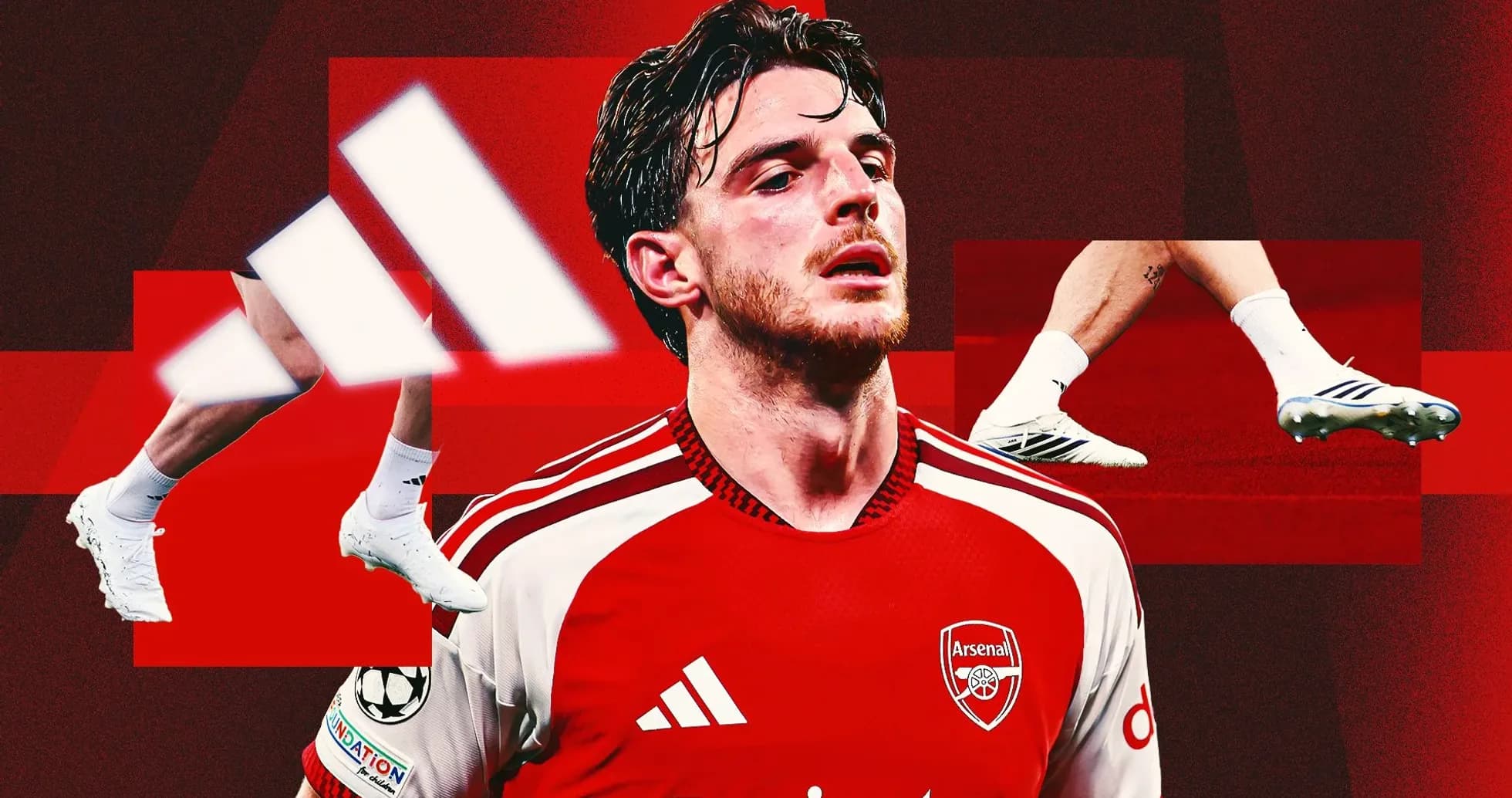
Declan Rice's Boot Switch Signals End of Adidas Era
Declan Rice’s boots are telling a story – and it doesn’t look good for adidas.
The Arsenal and England midfielder has been quietly turning his training sessions into a live shop window, rotating through brands and blackout prototypes as his seven-year relationship with the Three Stripes edges towards an apparent end.
From COPA comfort to Nike nostalgia
It started in late August. Rice, usually a loyal wearer of adidas COPA Pure, suddenly appeared at Arsenal training in a gleaming pair of Nike’s white, red and gold Tiempo Maestri.
Boot obsessives noticed immediately. So did the industry.
A player of Rice’s stature doesn’t just change silos on a whim. The switch was widely read as a sign his adidas deal is running down and that he’s actively testing the market. If he does jump to Nike, it wouldn’t be a leap into the unknown. It would be a return.
Rice began his professional career as a Nike athlete, lacing up Tiempos during his breakthrough at West Ham before moving to adidas in 2019. The Tiempo is familiar territory: a comfort-and-control boot, Nike’s answer to the heritage feel of the COPA. For a midfielder who thrives on rhythm and security in possession, the transition would be seamless.
But Rice hasn’t just slipped back into the Swoosh and stayed there.
A whiteout twist – and a left-field contender
After those Nike sessions in August, he briefly reverted to his COPAs. Then, early in September at London Colney, came the clearest signal yet that something is shifting.
Rice turned up in an unbranded, all-white pair of boots. No logos. No colours. Just a clean, anonymous silhouette.
To the trained eye, that anonymity doesn’t last long. Boot analysts soon identified the shape as Under Armour’s new Magneto 6, a model that quietly dropped at the end of August. Far from the obvious Nike-or-adidas duopoly, this was a move towards a more disruptive, second-tier player in the market.
Whiteouts and blackouts are football’s version of a “for sale” sign. They usually mean one thing: a contract is expiring or already over, and the player is testing alternatives before committing to a new, lucrative deal. Rice has still been wearing adidas in competitive matches – almost certainly down to existing contractual obligations – but his training ground choices are doing the talking.
Why walk away from adidas?
What’s driving the change? That part remains unclear.
After seven years, Rice may simply want something new. The explanation might be more pointed. A sense of dissatisfaction with his current commercial terms. A feeling he’s not being pushed as a headline star.
He has been one of the faces of adidas’ more understated COPA line and has featured in various campaigns. But when you scan the brand’s top tier of men’s footballers, Rice is not front and centre. Those spots currently belong to Lionel Messi, Lamine Yamal and Jude Bellingham.
The omissions tell their own story. Rice was nowhere to be seen in adidas’ glossy five-minute World Cup short film, “Backyard Legends”, which paired Hollywood actor Timothee Chalamet with the brand’s leading football names, including Dembele, Pedri, Raphinha and Florian Wirtz. The same pattern emerged before Euro 2024, when Bellingham, his England team-mate and fellow midfielder, fronted the pre-tournament campaign.
Domestically, Rice is a huge character and one of the Premier League’s most likeable personalities. On the pitch, he’s among the elite in his position. Globally, though, his profile hasn’t quite hit the heights of some of his contemporaries. A new boot supplier, with a different strategy and more aggressive promotion, could change that equation.
At Nike or Under Armour, Rice would instantly rank among the biggest names in their football portfolios. That status – and the marketing muscle that comes with it – will weigh heavily in his thinking.
There is also the possibility that adidas, not Rice, initiated the split. Brands routinely trim their athlete rosters for financial and strategic reasons if they feel they’re not getting sufficient commercial return. When a player is in the final year of a deal, they are told if no extension is coming. Funding and visibility often drop off from that point, which could help explain Rice’s absence from recent adidas campaigns.
Money, power and the modern boot deal
Post-pandemic, the landscape has hardened. Nike, for example, cut ties with several elite players to focus spending on a handful of global faces such as Cristiano Ronaldo, Kylian Mbappe and Marcus Rashford.
Sources have also described a growing frustration among top players who feel overlooked by the biggest brands. Some, they say, “require more attention and promotion than they have sometimes received from the largest brands” and are prepared to move to get it. That sentiment would fit Rice’s situation if he believes his value has been underestimated.
The financial side is impossible to ignore. At the top end, boot contracts can be worth 10-15% of a player’s club wages. For someone on a Premier League star’s salary, that’s a major revenue stream. If Nike, Under Armour or another challenger comes in with better terms, heads will turn.
Control is another powerful lure. Players are increasingly seeking autonomy over their image and how they are marketed.
Vinicius Junior famously blacked out his Nike boots in 2022, a public show of displeasure at the terms on offer after his contract expired. A source at the time said he wanted a partner “willing to invest in his brand through campaigns and activation worldwide”. Nike eventually improved the deal.
Now, even Mbappe – the modern poster boy of Nike Football as Ronaldo winds down – has been linked with a sensational departure after two decades with the Swoosh. The rumoured destination is an “unknown” disruptor, widely thought to be Swiss running brand ON, where he would reportedly have equity, a say in product strategy and the chance to co-design his own signature line.
At a slightly lower commercial tier, players like Neymar, Kai Havertz, Bukayo Saka, Eberechi Eze and Ibrahima Konate have already walked away from Nike or adidas to front PUMA, New Balance, Under Armour or Mizuno. These brands offer prominence, big money and the chance to be the face of a project rather than just another name on a crowded roster.
Others have taken the nuclear option. Bayern Munich and France star Michael Olise doesn’t have a boot deal at all. Hector Bellerin once went as far as buying his own boots online rather than signing up.
A door not fully closed
For all the signals, an adidas renewal for Rice cannot be ruled out.
Players often test the waters. They try different models, black out logos, let the speculation swirl – then ultimately re-sign with their original supplier on upgraded terms. Erling Haaland did it. Vinicius did too before Nike came back with an offer he liked.
Rice’s recent carousel – COPA, Nike Tiempo, whiteout Under Armour – could be part of the same dance. A reminder to adidas of his value. A demonstration to rivals of his willingness to move.
What’s certain is this: every training session at London Colney has become a clue. Every unbranded boot, every colourway, every silhouette is being scrutinised.
Declan Rice is weighing up his next move. The brands are circling. And somewhere, a contract is being drafted that will say as much about his global standing as any performance in an Arsenal shirt.