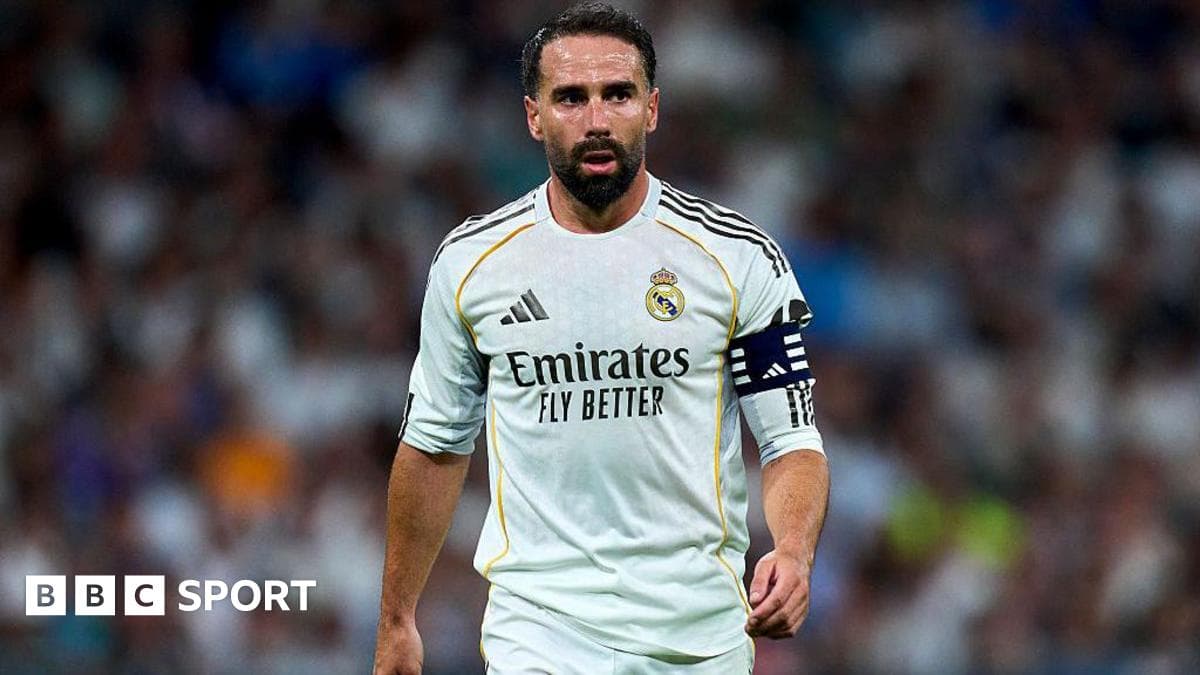
Dani Carvajal Leaves Real Madrid After 23 Years: A Legendary Farewell
The end will come under the lights of the Santiago Bernabeu, on a late May evening, with the crowd on its feet and a captain saying goodbye to the only club he has ever truly called home.
After 23 years, two spells and 450 appearances, Dani Carvajal will leave Real Madrid at the end of the season when his contract expires in June. He goes at 34, not just as a long-serving right-back, but as a symbol of an age of almost relentless conquest.
From academy kid to captain
Carvajal walked into the Real Madrid academy in 2002, a local boy from Leganés trying to make it at the biggest club in the world. He leaves as one of the most decorated players in the game’s history, with 27 trophies in white.
The route was not entirely straight. In 2012 he went to Bayer Leverkusen for a single season, a calculated gamble that forced Madrid’s hand. His performances in Germany were so convincing that the club triggered a buy-back clause, bringing him home in 2013. From that point, the right flank of the Bernabeu belonged to him.
He did not have Cristiano Ronaldo’s numbers or Karim Benzema’s glamour. He did not need them. Year after year, Carvajal’s value lay in something more understated: consistency, edge, and a refusal to disappear when the pressure rose.
A right-back who defined an era
At his peak, Carvajal stood among the most complete right-backs in world football. Aggressive in the duel, sharp in his positioning, and intelligent in his timing when he surged forward, he stitched Madrid’s structure together.
Under Carlo Ancelotti and Zinedine Zidane, he became non‑negotiable. He hugged the touchline to stretch defences, stepped into midfield to help Madrid play through pressure, and sprinted back to kill counters before they became chances. He made difficult tasks look routine, and in a team stacked with superstars, that reliability became priceless.
The numbers tell their own story. Six Champions League titles – one of only five players ever to reach that mark. He is the only player to have started in all six finals he won. Four La Liga titles. Two Copa del Rey trophies. Six Club World Cups, five UEFA Super Cups, four Spanish Super Cups. This is not just longevity; it is dominance.
The Champions League man for the big nights
Madrid’s modern relationship with the Champions League cannot be told without Carvajal. He did not simply appear on the teamsheet; he imposed himself on the biggest nights.
The 2024 final against Borussia Dortmund at Wembley became his personal masterpiece. He scored the opening goal, set the tone, and walked away with the man-of-the-match award. On a stage usually reserved for forwards, the right-back stole the spotlight.
Those European performances helped propel him into the FIFPro 2024 World XI and into The Best FIFA Men’s World XI that same year. Recognition, at last, for a player who had spent a decade doing the hard work while others took the headlines.
Leader of a changing dressing room
As Real Madrid’s great spine aged and departed – Sergio Ramos, Karim Benzema, Toni Kroos, Luka Modric – the dressing room needed new voices. Carvajal stepped into that void.
He did not suddenly become a different player. He simply allowed more of himself to be seen: demanding, vocal, fiercely competitive. Over time, the academy graduate became captain, the standard-bearer for a club that prides itself on its ruthlessness and refusal to accept second best.
That mentality mattered even more in the last two seasons. Madrid have gone through managerial instability and will finish this campaign without a major trophy for the second year running. In those stretches, Carvajal’s presence – on the pitch when fit, in the dressing room when not – became a reference point.
The cost of time and the arrival of Trent
The body, inevitably, began to push back. A cruciate ligament tear in October 2024, then another serious knee injury a year later, dragged him into a new phase of his career. The warrior who had spent years flinging himself into tackles and overlapping relentlessly now had to manage minutes and pain.
This season he has played just 892 minutes in La Liga. Not by choice. Injury problems combined with the arrival of Trent Alexander-Arnold from Liverpool last summer shifted the balance. Under Alvaro Arbeloa, the England international has grown into the preferred option at right-back, the clearest sign yet that Madrid were preparing for life after Carvajal.
Even so, the team often looked more fragile without him. That sense of vulnerability whenever he was absent underlined how hard he has been to replace, both tactically and emotionally.
A farewell written in white
Florentino Perez did not hide the weight of the moment.
“Dani Carvajal is a legend and a symbol of Real Madrid and its academy,” the club president said. “Carvajal has always exemplified the values of Real Madrid. This is and will always be his home.”
On Saturday 23 May, against Athletic Club, the Bernabeu will pause to honour him. Madrid will end another season without silverware, an unusual backdrop for a farewell to a man who spent his career lifting trophies. The night will belong to him all the same.
The ovations he still receives every time he steps onto the pitch show what he means to the supporters. For them, Carvajal is not just a right-back. He is the kid from the academy who never flinched, the captain who bridged generations, the constant presence in one of the club’s most successful eras.
He leaves with 51 caps for Spain, a Nations League title in 2023 and a European Championship in 2024 on his international record. He leaves as a World XI defender and as the best player in a Champions League final. More than anything, he leaves as one of the greatest right-backs in Real Madrid’s history.
The club will move on. It always does. The question, as the curtain comes down on Carvajal’s time in white, is how long it will take before the Bernabeu sees a right-back like him again.