Craiova's Tactical Approach in UEFA Europa League Draw
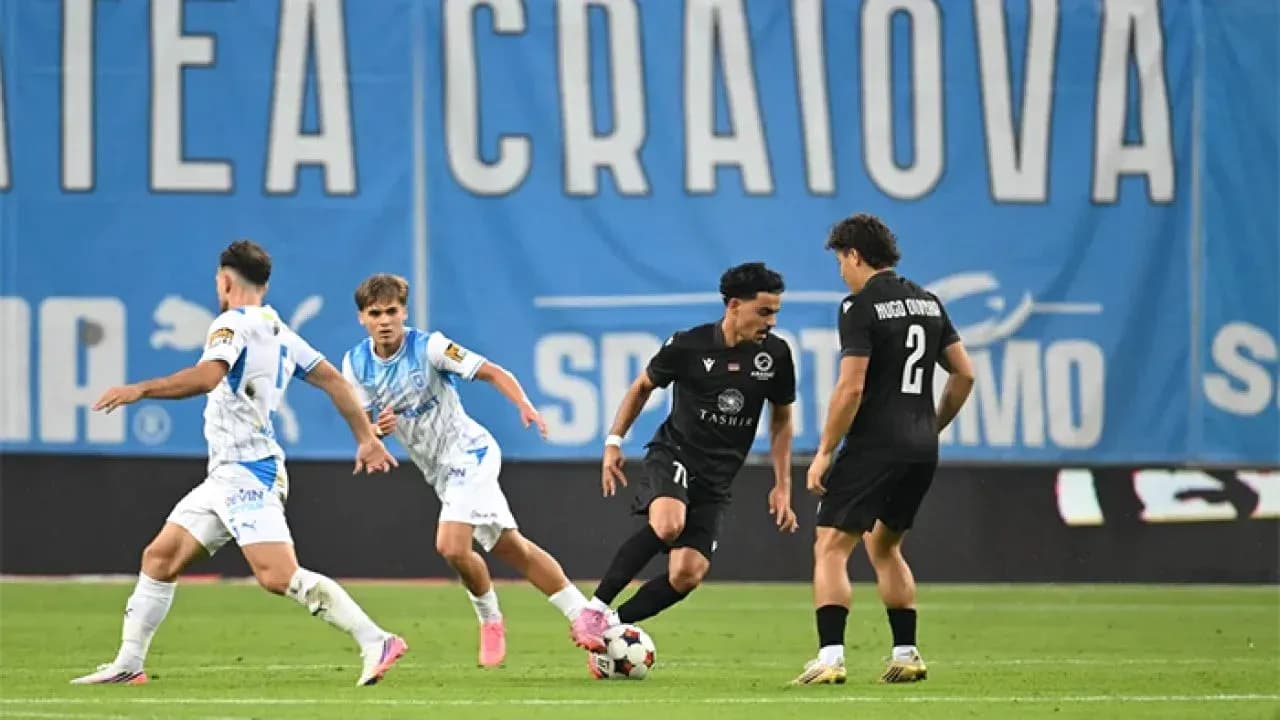
Universitatea Craiova’s 3-4-3 at Stadionul Ion Oblemenco was built for territorial dominance and width, and the pattern of the game reflected that intent even if the raw “0%” possession readings in the data are clearly placeholders rather than a true picture. The home side produced 7 shots on goal to Ararat-Armenia’s 2 and forced 8 corners to 4, underlining a sustained attacking initiative against a more conservative 4-3-3 from the visitors that morphed into a compact 4-5-1 without the ball.
Craiova’s back three of V. Screciu, A. Rus and O. Romanchuk allowed both wing-oriented midfielders, N. Bancu and C. Mora, to push high and pin Ararat-Armenia’s full-backs. With A. Mekvabishvili and A. Cicaldau as the central pair, Craiova tried to create central overloads, then release the ball wide. The equaliser on 33’ from Bancu, assisted by Cicaldau, was a direct expression of this structure: the central midfielder found the advanced wide midfielder breaking into the final third from the left, exploiting the space outside Ararat’s narrow central block.
In contrast, Tulipa’s nominal 4-3-3 for Ararat-Armenia was more about vertical punches than sustained pressure. The early goal at 20’ from centre-back A. Malis, assisted by H. Oliveira, came from one of the few moments they could step into advanced zones with their defensive line, likely via a set piece or a second phase where both defenders could join the attack. That both goal-scorers were defenders/midfielders rather than the front lines hints at how hard it was for either front three to get clear, repeatable chances in open play.
Defensively, Ararat-Armenia’s numbers tell a story of a low-foul, compact block: just 5 fouls and no yellow cards across 90 minutes. They accepted pressure, conceded more corners (4 versus Craiova’s 8) and shots (2 shots on goal, 4 off versus Craiova’s 7 and 7), but stayed disciplined in duels and positioning. Their 2 blocked shots compared with Craiova’s 1 underline how frequently they got bodies between the ball and Joao Bravim’s goal, even though goalkeeper-specific save data is not provided.
Craiova, on the other hand, paid for their territorial ambition with a heavier disciplinary load: 15 fouls and 4 yellow cards. The bookings for David Matei (39’), Oleksandr Romanchuk (47’), Adrian Rus (69’) and Monday Etim (78’) show that Filipe Coelho’s side were repeatedly forced into interventions to halt transitions or break Ararat’s rare but dangerous forward surges. The fact that three of those cards went to defensive-line or defensive-phase players (Romanchuk, Rus, Etim operating from advanced positions but still involved in pressing and counter-pressing) underlines how much defending Craiova had to do in open space whenever their high structure was bypassed.
The substitution pattern from Coelho sharpened that attacking tilt. At 62’, he made a double change: S. Nsimba (IN) came on for A. Al Hamlawi (OUT), and M. Etim (IN) came on for D. Matei (OUT). This kept the 3-4-3 shape intact but refreshed the front and half-space roles, seeking more penetration and 1v1 threat rather than structural change. Later, at 69’, Teles (IN) came on for A. Cicaldau (OUT), suggesting a desire for different passing angles or fresher legs in central midfield to keep the tempo high as Craiova chased a winner.
The final wave of changes on 85’ — T. Baluta (IN) for A. Mekvabishvili (OUT) and L. Basceanu (IN) for S. Baiaram (OUT) — again preserved the broad positional map while injecting new energy and perhaps a more direct approach. Coelho clearly trusted the system; the tweaks were about personnel profiles, not altering the 3-4-3’s basic geometry.
Ararat-Armenia’s substitutions were more about shoring up and redistributing defensive work. Franca Carlos (IN) for Benny (OUT) at 69’ adjusted the midfield profile, likely adding fresh legs and perhaps more ball security. At 75’, J. A. Balanta (IN) for H. Oliveira (OUT) removed the original assist provider and one of the more adventurous defenders, a logical step in protecting the 1-1 scoreline. The triple change at 80’ — Z. Shaghoyan (IN) for Z. Banjaqui (OUT), M. Carlier (IN) for K. Muradyan (OUT), and A. Tera (IN) for A. Serobyan (OUT) — essentially rebuilt the midfield and wide lines, reinforcing the block for the closing stages and ensuring fresh runners to contest Craiova’s late surges.
Without explicit passing or xG figures, the clearest statistical contrast is in shooting volume and discipline. Craiova’s 7 shots on goal and 7 off goal, with 1 blocked, show a side that consistently reached finishing zones but struggled to turn volume into a winning margin. Ararat-Armenia, with 2 shots on goal and 4 off, accepted a lower attacking output in exchange for stability. The 4–0 yellow-card split and 15–5 foul differential underline that trade-off: Craiova were the aggressors, Ararat the structured spoilers.
In tactical terms, the 1-1 draw in this UEFA Europa League Play-offs fixture reflects a clash between a proactive back-three system seeking width and overloads, and a disciplined back-four that absorbed pressure and capitalised on set or semi-set situations. Craiova’s structure created more and better shooting opportunities; Ararat-Armenia’s restraint and compactness ensured those chances did not translate into a decisive second goal.