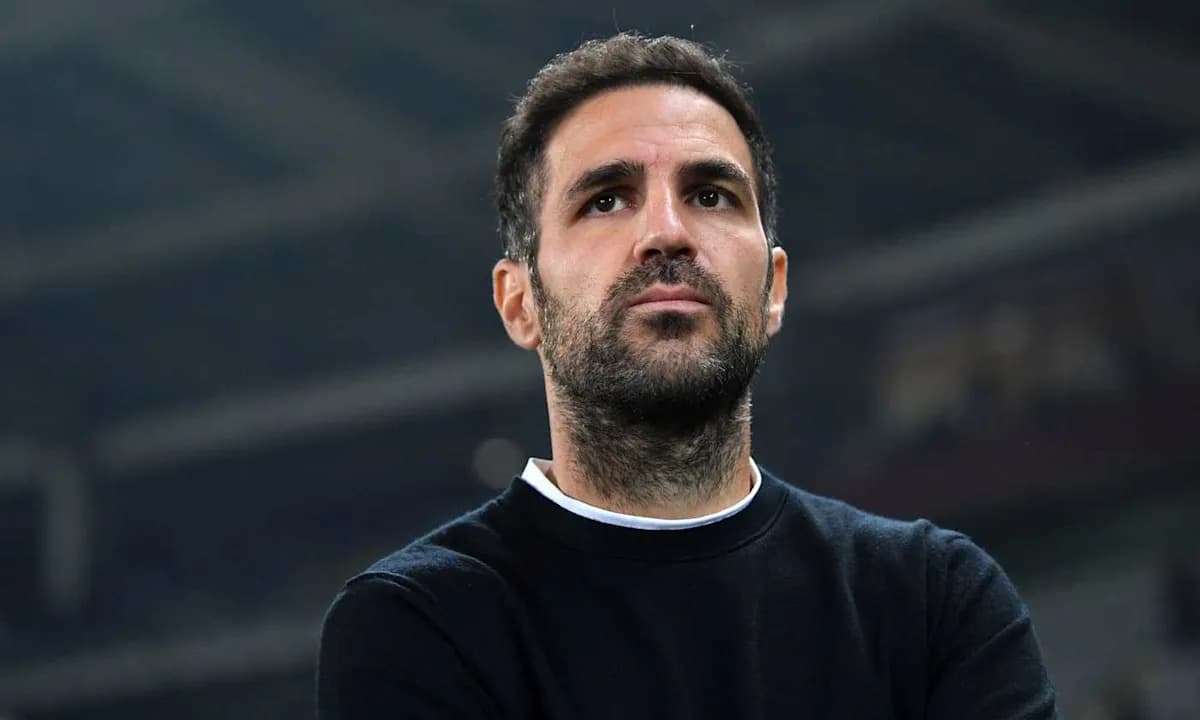
Cesc Fàbregas Considers Future with Real Madrid on His Own Terms
Cesc Fàbregas has never been afraid of crossing lines. From La Masia to Arsenal, from Barcelona to Chelsea, his career has been a study in footballing pragmatism over tribal loyalty. Now, as a coach making waves in Serie A with Como, he is refusing to close off even the most controversial of future paths.
Real Madrid included.
The former Spain international, who grew up in Barcelona’s academy and returned to the Camp Nou for three seasons as a senior player, did not dismiss the idea of one day taking charge at the Santiago Bernabéu when asked in an interview with Cadena Cope. The question carried weight; the answer, even more.
“I don’t have a red line,” he said, before clarifying that the only thing he refuses to contemplate is serving as an assistant. Head coach or nothing. The rest? Open.
Como first, everything else later
The intrigue around Fàbregas has grown rapidly in Italy. Como have just secured their first ever European qualification, a landmark moment for the club and a powerful line on the 37-year-old’s early coaching résumé. His work has not gone unnoticed. Top clubs, including former side Chelsea and Real Madrid, have been linked with admiration rather than offers, but the noise is getting louder.
Fàbregas, though, insists he is not looking for the exit.
“I’m a shareholder in the club (Como), I saw a project to start coaching, I have a contract and I’m very relaxed… I’m in a place that helps me grow and I’m very happy. I’m the one who makes the signings.”
This is not a coach passing through. It is a coach who has literally bought into the project, shaping it from the boardroom to the touchline. That dual role gives his words extra weight: he is not only building a team, he is protecting an investment.
So when Real Madrid’s name comes up, he does not lunge at the hypothetical. He parks it.
“The other thing (the possibility of Real Madrid)? I haven’t even thought about it or considered it. I haven’t had time for anything.”
No rejection. No declaration of eternal loyalty to Barcelona. Just a man too busy making a small club punch above its weight to plot his own next move.
Admiration for Ancelotti, respect for Luis Enrique
Pressed on the managers who shape his thinking, Fàbregas pointed to two familiar figures.
He highlighted the work of Luis Enrique over the last two years, a coach whose intensity and tactical clarity he clearly values. Yet when asked which manager he would have liked to play under, he chose Carlo Ancelotti, stressing the Italian’s human touch.
That detail matters. Fàbregas is building his reputation not only on tactical innovation at Como, but on man-management – the same quality he sees in Ancelotti, the man currently in the Madrid dugout. If he ever does walk into the Bernabéu as head coach, it is that model he seems keen to echo: authority without losing the dressing room, demands without drama.
How he’d handle a Vinicius-style flashpoint
The conversation inevitably drifted back to Madrid in another way. After a disastrous season at the club, some have traced the roots of their problems to a flashpoint involving Vinicius Junior and Xabi Alonso during El Clásico, when the forward reacted angrily to being substituted.
How would Fàbregas have handled such a moment?
“What happened with Xabi Alonso and Vinicius… it’s a moment where you have to be prepared to make a good decision, and above all, what makes you a better coach is that you have to think about the team first. Nobody is better than the team, nobody is stronger than the team, and nobody is above the team.”
That is the core of his coaching creed. The individual star, however brilliant, cannot be allowed to overshadow the collective. The authority of the coach, in his view, rests not on confrontation for its own sake but on an unshakeable hierarchy: the team at the top, always.
“If you have a united and strong group, whoever wants to mess things up can do whatever they want, you’ll have the group’s respect and you’ll always do better in the long run.”
It is a line that could easily be read as a manifesto. Build the group, and the group will protect you. Allow the group to fracture, and no tactical plan will save you.
For now, Fàbregas is applying that philosophy on the shores of Lake Como, steering a club unused to European nights into uncharted territory. The Bernabéu remains a distant idea, not an active ambition. But the door, crucially, is not locked.
If he keeps winning with Como, someone, somewhere, will try the handle.