Cesc Fàbregas Praises Arsenal's Patience Amid Challenges
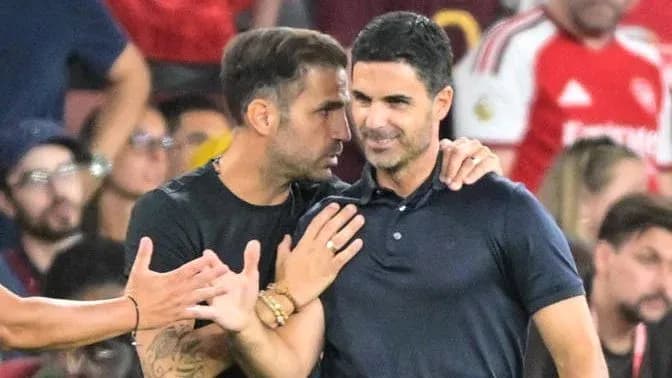
Cesc Fàbregas knows what turbulence looks like at Arsenal. He lived through enough of it. That is why, standing back at the Emirates Stadium, he reserved his biggest praise not for a single player or a trophy, but for something far less glamorous: patience.
The former Arsenal captain, who racked up 303 appearances for the club, highlighted how the hierarchy refused to blink during the early, awkward years of Mikel Arteta’s reign and stayed locked on to their long-term plan.
“Congratulations to the club in general starting from seven, eight years ago when they first started with this project,” Fàbregas said after the match. “Because what you see in football every day, what Arsenal did, especially in the difficult moments, it doesn’t exist.”
He has watched the evolution closely. Fàbregas recalled visiting last season for a Champions League night and making a point of speaking to Edu and Andrea Berta behind the scenes, underlining how rare Arsenal’s approach has been in an era of snap judgements and short fuses.
“I told Edu, I told Andrea when I came last year to a Champions League game, I said congratulations to the whole club for the patience, for sticking together, for sticking to the plan,” he explained. “When for three years in a row, correct me if I’m wrong, finished eighth, eighth, eighth, fourth year nearly Champions League, it was a big disappointment, Tottenham came, you finish fifth, but you keep going because you have a plan, because you have an objective, because you have progression, you keep going forward.”
That run would have cost many managers their jobs. Arsenal chose the opposite route. They absorbed the noise, rode out the anger, and doubled down on Arteta and the broader project.
For Fàbregas, that stance cuts directly against the modern reflex to sack a coach the moment results dip.
“We lack this in football today,” he said. “You lose three games, change the coach, he was playing one style, now you play another, at the end of the day I don’t believe in this a lot.”
He sees the consequences clearly now he is trying to build something of his own. At Como, where he is helping shape a club with far less history and heft than Arsenal, he is trying to import the same principles he admired in north London.
“I’m very lucky I’m in a project, of course with much lower level, the history, everything, but we’re trying to look at the stability Arsenal had, the values, the culture that they are bringing,” he said.
The respect for Arteta’s work runs deep. Fàbregas spoke with the conviction of someone who has seen the dressing room up close and recognises a squad fully aligned with its manager.
“I think Mikel has done a tremendous job. So I can only wish them the best, really,” he added. “Because most of the group, these guys now you talk to them, I don’t know… they’re good guys, they want to play good football, they are respectful, you can see how they stick to the plan all the time. Really, I’m super happy to come back here and smell this feeling.”
That “feeling” now has to withstand another test of nerve. Arsenal’s next stop is Cardiff, where they face Manchester City in the Community Shield on Sunday, 16 August, a curtain-raiser that will instantly measure their sharpness against the side they dethroned.
Six days later, the serious business begins. The Premier League champions open their title defence against newly promoted Coventry City, a fixture that on paper looks gentle but will quickly reveal whether Arsenal can maintain the standards that finally delivered the crown.
While Arsenal chase more silverware, Fàbregas will be juggling his own busy schedule. On that same Sunday, Como are set for a double-header of friendlies against Liverpool. The first game will be played behind closed doors, a more controlled environment, before supporters are welcomed in for the second.
Those matches will act as a tune-up for Como’s leap into the spotlight. The Italian side then turn fully to their Serie A opener against Udinese the following Saturday, a fixture that will show just how far Fàbregas’s cherished ideas about stability, culture and patience can carry a club trying to grow on its own terms.