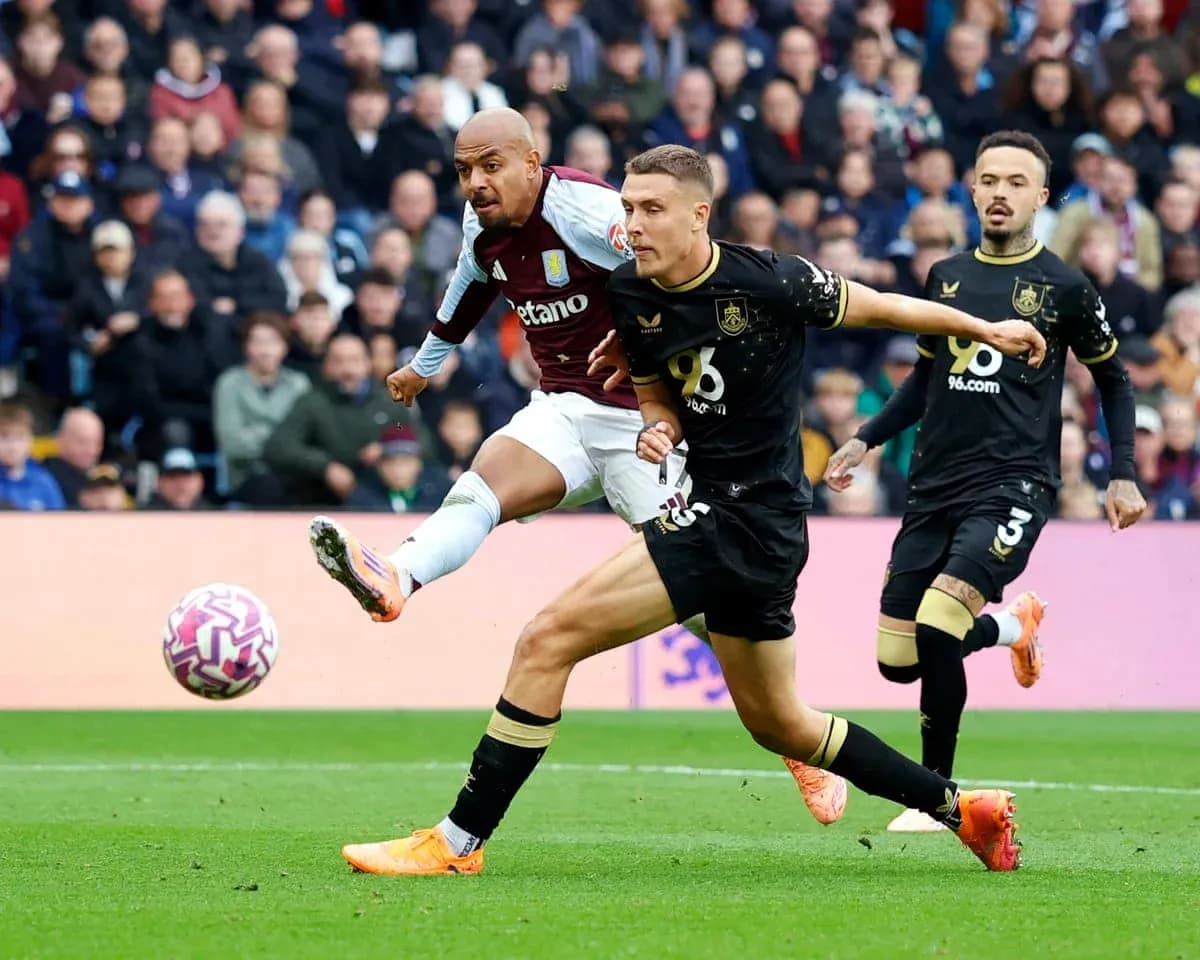
Burnley vs Aston Villa: Premier League Clash at Turf Moor
Burnley host Aston Villa at Turf Moor in a late regular season Premier League fixture (Round 36) that carries very different pressures for each side. In the league phase, Burnley sit 19th on 20 points with a -36 goal difference (35 scored, 71 conceded) and are locked in the relegation zone, making every remaining home game close to must-win territory. Aston Villa arrive 5th on 58 points with a +4 goal difference (48 scored, 44 conceded), chasing Champions League qualification; dropping points here would significantly damage their push to secure a top-four–equivalent finish.
Head-to-Head Tactical Summary
The recent head-to-head record tilts clearly towards Aston Villa, with Villa consistently finding ways to outscore Burnley in open games.
On 5 October 2025 at Villa Park in the Premier League (Regular Season - 7), Aston Villa beat Burnley 2-1. Villa led 1-0 at half-time and managed the second half well enough to preserve the advantage.
On 30 December 2023 at Villa Park (Regular Season - 20), Villa again prevailed 3-2. The match was already high scoring by the interval, with Villa 2-1 ahead at half-time, underlining their ability to trade chances and still edge Burnley.
The most recent meeting at Turf Moor came on 27 August 2023 (Regular Season - 3), where Aston Villa won 3-1. Villa built a commanding 2-0 half-time lead and controlled the scoreboard from there, showing how dangerous they are when they can attack space against Burnley’s back line.
In 2022, the sides drew 1-1 at Villa Park on 19 May 2022 (Regular Season - 18). Burnley were 1-0 up at half-time before Villa responded after the break to level, a rare instance in this sample where Burnley converted an early advantage into points.
Earlier that month at Turf Moor, on 7 May 2022 (Regular Season - 36), Aston Villa won 3-1 after establishing a 2-0 half-time lead. Across these Turf Moor fixtures, Villa’s pattern of scoring early and repeatedly has been consistent.
Overall, the last five league meetings show Aston Villa with four wins (3-1 at Turf Moor in 2022, 3-1 at Turf Moor in 2023, 3-2 and 2-1 at Villa Park in 2023 and 2025) and one draw (1-1 at Villa Park in 2022), with Burnley conceding at least two goals in four of those games.
Global Season Picture
- League Phase Performance: In the league phase, Burnley are 19th with 20 points from 35 matches, scoring 35 and conceding 71 (goal difference -36). Their home record is weak: 2 wins, 5 draws, 10 losses, with 15 goals for and 26 against. Aston Villa, in contrast, are 5th with 58 points from 35 matches, with 48 goals for and 44 against (goal difference +4). Away from home they have 6 wins, 5 draws and 6 losses, scoring 20 and conceding 24.
- All-Competition Metrics: Across all phases of the competition, Burnley average 1.0 goals scored and 2.0 goals conceded per match (35 for, 71 against over 35 games), reflecting a vulnerable defence and limited attacking punch. They have failed to score in 13 matches and kept just 4 clean sheets, pointing to a low-margin attack and fragile back line. Their use of multiple formations (4-2-3-1 in 10 games, 5-4-1 in 9, 3-4-2-1 in 8, plus several others) suggests tactical searching rather than stability. Discipline-wise, Burnley accumulate yellow cards fairly evenly across the match, with notable spikes between minutes 16-30 and 76-90 (12 yellows in each range), which hints at stress reactions in both early and late phases of games.
- Aston Villa, across all phases, average 1.4 goals scored and 1.3 conceded per match (48 for, 44 against over 35 games), indicating a more balanced profile. They have 9 clean sheets and 10 matches without scoring, which points to a side that can be compact but occasionally blunt. Their attacking output is stronger at home (1.6 goals per game) than away (1.2), but the overall numbers show a competitive top-half side. Villa’s tactical identity is stable: 4-2-3-1 has been used in 31 matches, with only occasional switches to 4-4-2 and 4-2-2-2. Card distribution shows a concentration of yellows between minutes 46-60 (15 yellows), indicating an aggressive or proactive start to second halves.
- Form Trajectory: In the league phase, Burnley’s current form string is "LLLLL", meaning five consecutive defeats. That sequence underlines a team in freefall, with confidence and defensive structure both under severe pressure at precisely the wrong moment in a relegation battle.
- Aston Villa’s league form reads "LLWDW" over the last five. Two defeats in that run show vulnerability, but with 2 wins and 1 draw they are still collecting points at a reasonable rate. The pattern suggests inconsistency rather than collapse: Villa remain competitive in the Champions League race but cannot afford another dip.
Tactical Efficiency
Without explicit numerical attack/defence indices from the comparison block, the best proxy is to align each team’s scoring and conceding rates with their league-phase context.
Across all phases of the competition, Burnley’s attack is low-output (1.0 goals per game) and heavily dependent on sporadic spikes rather than sustained pressure. Their defence concedes 2.0 goals per game, and they have allowed as many as 4 at home and 5 away in single matches. That combination — low scoring and high concessions — translates into a poor efficiency profile: they need to overperform their usual xG and chance creation to win matches, and any defensive lapse is often fatal given how rarely they keep clean sheets (4 in 35).
Aston Villa’s all-phase averages (1.4 scored, 1.3 conceded per game) map onto a more efficient, top-half profile. They do not overwhelm opponents but usually create and convert enough to justify a positive goal difference. Their 9 clean sheets show they can protect leads, and their biggest away win (2-0) indicates a pragmatic, control-oriented away approach rather than all-out attack. Combined with a stable 4-2-3-1 structure, Villa’s tactical efficiency is built on repetition and familiarity, while Burnley’s constant formation changes point to reactive problem-solving rather than a defined game model.
In the head-to-head context, Villa’s attacking efficiency has been particularly pronounced: they have scored 3 goals in three of the last five meetings (3-1, 3-1, 3-2), consistently exploiting Burnley’s defensive weaknesses. For Burnley to reverse this pattern, they must compress the game, limit transitions and keep the scoreline low — something their season-long defensive numbers (2.0 conceded per match) suggest they struggle to do.
The Verdict: Seasonal Impact
From a seasonal perspective, this fixture is high leverage at both ends of the table.
For Burnley, in the league phase, sitting 19th on 20 points with a -36 goal difference, failure to win at Turf Moor would push them closer to confirmed relegation. Their remaining margin for error is minimal; with only 4 wins in 35 matches and five straight defeats, this game is less about style and more about survival. A win would not guarantee safety, but it would at least keep the mathematical door open and potentially apply pressure to the teams immediately above them. A draw or loss, given their current trajectory and poor goal difference, would likely leave them needing near-perfect results elsewhere and help consign them to the Championship in 2026.
For Aston Villa, in 5th place on 58 points, this is the type of away match a Champions League-chasing side must target for three points. With a modest +4 goal difference and recent form of "LLWDW", dropping points here would risk being overtaken by rivals with stronger momentum or goal differences. A win would consolidate their top-five position and keep them firmly in the conversation for Champions League (League phase) qualification, especially as their head-to-head record and season-long metrics suggest they have a clear tactical edge over Burnley.
Strategically, the match sets up as a clash between desperation and structure. Burnley’s season-long inefficiency at both ends means they are likely to need an outlier performance to change their fate. Aston Villa, by contrast, know that if they reproduce their average levels — 1.4 goals scored, 1.3 conceded across all phases, and a historically strong output against this opponent — they not only damage Burnley’s survival hopes but also take a significant step toward locking in European football in 2026.