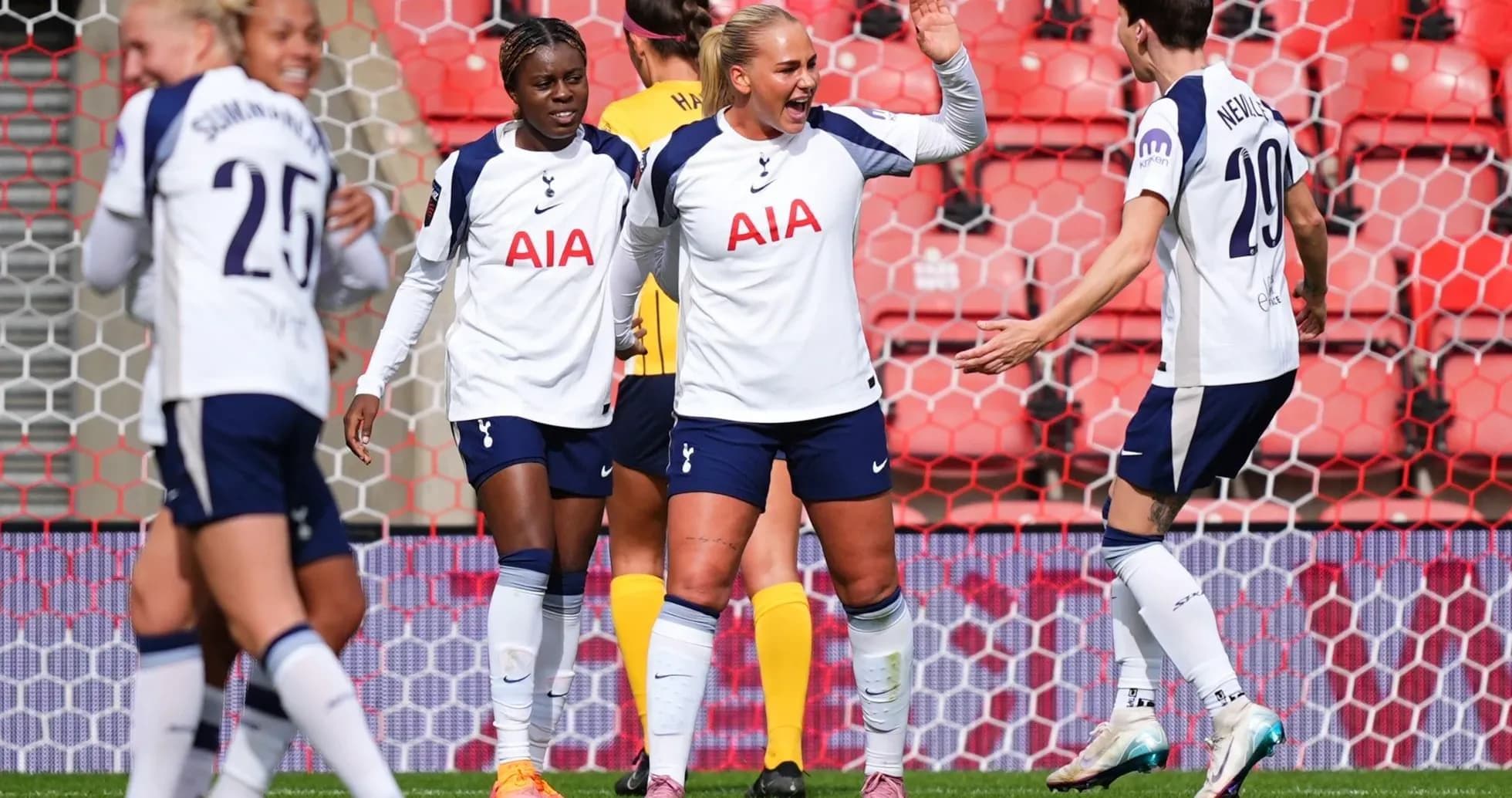
Brighton vs Tottenham: FA WSL Season Finale Insights
Under a grey Brighton sky at the Amex Stadium, the FA WSL season closed with a result that neatly captured the contrasting identities of these two sides. Following this result, Brighton W’s 1-2 home defeat to Tottenham Hotspur W left the Seagulls marooned in mid-table at 7th with 26 points, while Spurs, already shaping themselves as upwardly mobile, cemented 5th place on 36 points.
The league table tells a nuanced story. Overall, Brighton’s goal difference of -1 is the product of 27 goals for and 28 against, a side forever hovering on the knife-edge between control and collapse. Tottenham’s own profile is even wilder: a goal difference of -3 from 35 scored and 38 conceded, a team that leans into chaos but has learned to harness it better than most.
At home this campaign, Brighton scored 17 and conceded 15, an average of 1.5 goals for and 1.4 against per match. They are competitive at the Amex, but rarely dominant. On their travels, Tottenham have been one of the division’s great entertainers: 24 goals scored and 26 conceded in 11 away games, averaging 2.2 goals for and 2.4 against. This is a side that brings volatility with them wherever they go, and the 2-1 away win felt entirely in keeping with that attacking-first DNA.
Tactical Voids and Disciplinary Undercurrents
Neither squad sheet flagged obvious absences; both coaches were able to lean on their core identities. For Brighton, Dario Vidosic’s selection of S. Baggaley behind a back line featuring C. Rule, C. Hayes, M. Minami and M. Vanegas hinted at continuity rather than experimentation. The midfield spine of M. Symonds and J. Cankovic, flanked by the dynamism of K. Seike and M. Olislagers, was designed to feed the creative instincts of F. Kirby and the penalty-box craft of M. Haley.
Tottenham, under Martin Ho, mirrored that sense of familiarity. L. Kop anchored a back four built around E. Morris, T. Koga, A. Nildén and the adventurous J. Blakstad. Ahead of them, D. Spence and S. Gaupset patrolled central zones, with M. Hamano, O. Holdt and M. Vinberg operating between the lines behind C. Tandberg.
The disciplinary backdrop framed the contest’s edge. Across the season, Brighton’s yellow-card distribution shows a team that increasingly lives on the brink as games wear on: 26.32% of their cautions arriving between 31-45 minutes and another 21.05% in the 76-90 window. Tottenham are even more combustible late on, with 30.56% of their yellows coming in the final 15 minutes and 25.00% between 46-60. The visitors also carry genuine red-card jeopardy: D. Spence has already seen red once this season, and Tottenham’s only red in the league came in the 91-105 minute band, underlining how fine their emotional control can be in high-pressure endings.
In that light, the match always threatened to tilt on discipline as much as structure. Brighton’s own leading offenders, like C. Rule and M. Haley with 4 yellows each, embody a team that fights hard in duels but risks inviting pressure through fouls and stoppages.
Key Matchups – Hunter vs Shield, and the Engine Room
The decisive battlegrounds were always going to be defined by Tottenham’s attacking “hunters” and Brighton’s fragile “shields”.
In the final third, Spurs arrived with a spread of threats. B. England, with 5 goals in total this campaign, is their headline scorer, a late-game weapon from the bench or starter who can turn half-chances into decisive moments. Alongside her seasonal output, C. Tandberg’s 4 goals and penalty prowess (1 scored, 0 missed) gave Spurs a second cutting edge, particularly in transition. O. Holdt, also on 4 goals with 3 assists, operates as the creative fulcrum: 16 key passes and 57 dribble attempts (25 successful) mark her as the player who stitches chaos into coherent attacking patterns.
Brighton’s shield against that came from a back line that has conceded 15 at home, and from the wide work of C. Rule and M. Minami. Rule’s 16 tackles, 2 blocked shots and 10 interceptions this season underscore her as a proactive defender, but against a Tottenham side averaging 2.2 away goals, the margin for error was minuscule. M. Vanegas and C. Hayes were tasked with holding the central lane against Tandberg’s movement and Hamano’s drifting runs, while Baggaley’s command of the box had to withstand a side that thrives on volume and variety of attacks.
Further forward, Brighton’s own “hunter” was K. Seike. With 4 goals, 1 assist and 19 key passes in total, she is both finisher and creator, especially dangerous when breaking from midfield. Her duel with A. Nildén down that flank was a fascinating clash of profiles: Nildén, one of the league’s most carded players with 7 yellows, has 27 tackles and 6 blocked shots to her name, a defender who steps in rather than drops off. That aggression can suffocate wingers, but it also courts danger when facing someone as direct and technically sharp as Seike.
In the engine room, the confrontation between J. Cankovic and Tottenham’s double pivot of Spence and Gaupset was central to the narrative. Spence, with 522 passes at 86% accuracy and 19 tackles, is the metronome-enforcer hybrid, while Gaupset’s energy complements her. Their task was to disrupt Brighton’s attempts to feed Kirby between the lines and to stop Haley from receiving early to feet or running channels. For Brighton, Cankovic and Symonds had to screen against Holdt’s drifting into pockets and Hamano’s vertical surges.
Statistical Prognosis and Tactical Verdict
Following this result, the numbers reaffirm Tottenham’s identity as a high-variance but increasingly effective away side. On their travels they finish with 5 wins, 1 draw and 5 defeats, scoring 24 and conceding 26. The 2-1 scoreline at the Amex fits almost perfectly into those season-long averages: Spurs scored slightly below their away average of 2.2, but tightened just enough at the back compared to their 2.4 conceded.
Brighton’s home campaign closes with 4 wins, 3 draws and 4 losses, 17 scored and 15 conceded. The 1-2 defeat nudges them towards the more fragile version of themselves: still able to find a goal at home, but not consistently able to suppress higher-powered attacks like Tottenham’s.
From an Expected Goals perspective, even without raw xG values, the structural tendencies point to Tottenham edging the underlying chances. Their away profile – more goals, more chaos, more shots – combined with the attacking output of England, Holdt, Tandberg and Vinberg suggests a side that habitually generates higher-quality opportunities than Brighton, whose total scoring rate of 1.2 goals per match overall is modest.
Defensively, neither side is watertight, but Tottenham’s ability to ride out storms and then strike – supported by Kop’s presence in goal and a back line capable of both blocking (Nildén’s 6 blocks, Hunt’s 12) and building – gives them a slight edge in tight games like this. Brighton’s reliance on Seike and Haley to both press and create leaves them stretched when transitions break against them, and their card profile, particularly late-game yellows, hints at tired, last-ditch defending rather than controlled resistance.
In narrative terms, this match felt like the season in miniature. Brighton, brave and inventive in moments, could not quite reconcile their attacking ambition with defensive control. Tottenham, flawed but fearless, leaned again into their attacking strength on their travels and emerged with a narrow win that the season’s numbers had been forecasting all along.