Barcelona's Summer Rebuild: The Search for a No 9
Barcelona’s summer rebuild has looked ruthless, targeted and expensive. And yet, as La Liga looms into view, one glaring hole remains right down the middle.
A heavyweight midfield, frightening wings… and no No 9
The Spanish champions have spent the off-season reinforcing almost every line of Hansi Flick’s squad.
Rodri’s arrival from Manchester City is the headline move: a Ballon d'Or winner and World Cup-winning captain dropped into a midfield already overflowing with technique and control. It is the sort of signing that changes a dressing room the moment he walks through the door.
Out wide, Barcelona have gone for pace and chaos. Anthony Gordon brings direct running and relentlessness, Karim Adeyemi adds raw speed and penetration, and 18-year-old Belgian winger Jesse Bisiwu has been brought in as a long-term project, a bet on what he might become rather than what he is now.
On paper, it looks complete. Until you look at the centre of the attack.
With the first La Liga fixture away at Elche on Sunday, 23 August, Barcelona are staring at the real possibility of going into the season without an orthodox number nine if a striker does not arrive before the window closes on 1 September.
Robert Lewandowski is gone, his contract up and his next chapter unfolding at Chicago Fire in Major League Soccer. At 37, his exit was predictable. The numbers he leaves behind are not easily replaced.
Ferran Torres has gone too, sold to Paris St-Germain for about 50m euros (£42.7m). He struck 21 goals in 49 appearances last season and often operated as Lewandowski’s understudy through the middle. Not a classic centre-forward, but a reliable one.
Remove both from the squad and the picture is stark: Barcelona do not have a single established senior striker in the first-team group.
The Alvarez dream – and a hard ‘no’ from Atletico
Inside the club, the preferred solution has been clear for some time. Barcelona want Julian Alvarez from Atletico Madrid.
The 26-year-old Argentina international openly spoke during the World Cup about seeking a move away, a comment that alerted Europe’s elite and sharpened the interest of both Barcelona and Real Madrid.
Atletico’s response was blunt. Chief executive Miguel Angel Gil Marin shut the door firmly, insisting the club would not sell Alvarez, “not even for 200m euros” (£170.8m). For now, that route is blocked.
So Flick has to live in the present, balancing what he wants with what he actually has.
“We know we have to do something,” the German said this month, while name-checking the internal solutions already at his disposal. He highlighted Lamine Yamal’s ability to operate as a false nine and the positional flexibility of Gordon and Adeyemi.
Lamine Yamal: focal point, but not a fixed one
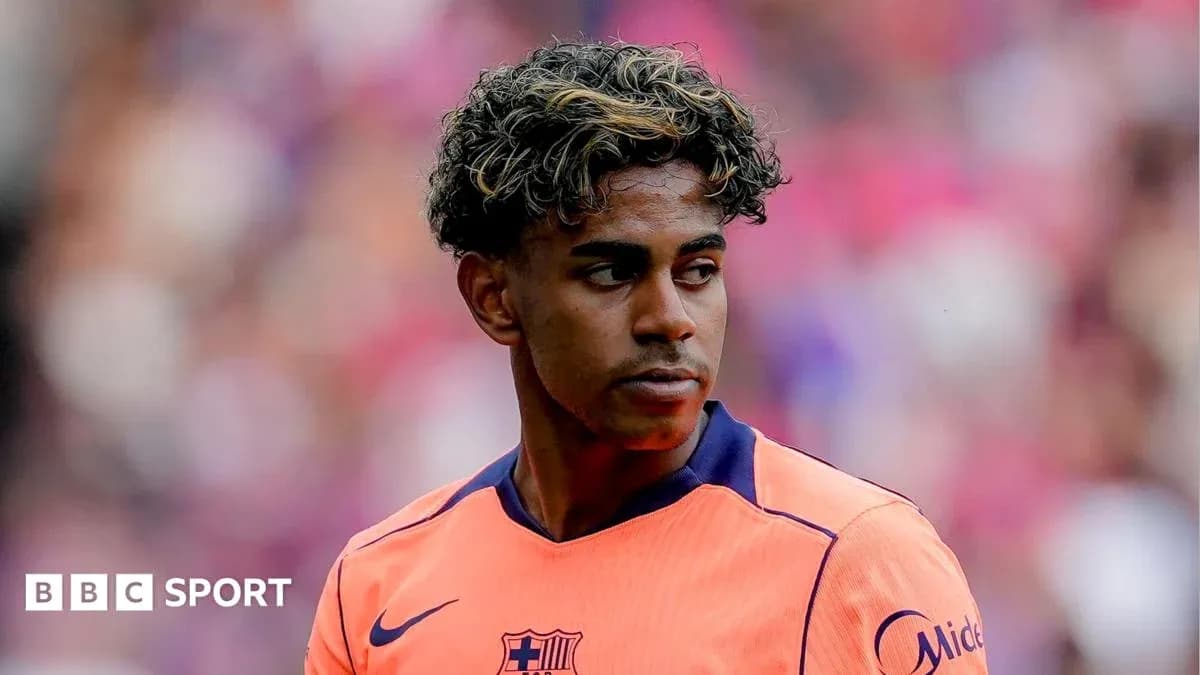
At just 17, Lamine Yamal has already become the attacking reference point of this Barcelona side. He is coming off a season in which he scored 24 goals and lifted the World Cup with Spain, numbers and honours that would be career-defining for most players twice his age.
Yet his most devastating weapon is not his finishing. It is the way he isolates a full-back on the right, squares him up, then cuts inside to conjure chances from positions that look closed. One-on-one, he bends games to his will.
Flick, understandably, prefers to keep that threat coming from the right wing, where Lamine Yamal can stretch, torment and dictate. Moving him permanently into the middle would solve one problem and create another.
So the coach looks elsewhere too.
Dani Olmo can drop in as a false nine, knitting play and dragging centre-backs into uncomfortable areas. Raphinha has been used centrally by Flick as well, a different profile but another body who can occupy defenders. Fermin Lopez is another option in advanced zones and has said he feels comfortable playing that false-nine role.
Gordon and Adeyemi, meanwhile, give Barcelona searing speed and verticality. They can run in behind, they can press, they can break open tired defences. What they are not is classic penalty-box forwards who live between the posts.
A fluid front line – solution or stopgap?
One route is obvious: embrace the chaos.
Barcelona could lean fully into a fluid front line, with attackers constantly rotating, drifting wide, dropping deep, swapping zones instead of one striker staying pinned between opposition centre-backs. Marking assignments become blurred, defensive lines get pulled apart, and the team’s technical quality takes over in the final third.
On their day, that kind of shape could be a nightmare to defend. Midfielders flooding the box, wingers arriving late, no clear reference point for centre-backs to lock on to.
But even inside that vision of movement and freedom, the same question keeps resurfacing.
Who scores the ugly goals when the game is tight? Who stands in the six-yard box in the 88th minute away at Elche and turns a scrappy cross into three points?
For all the tactical creativity on offer, Barcelona’s preference is unchanged. They want a specialised striker who fits the profile, someone to finish the moves Rodri starts and Lamine Yamal creates.
Time is running down on the window. The squad looks powerful almost everywhere. The season may yet hinge on whether Barcelona can find a number nine to match the rest of their ambition.