Arsenal's Title Charge: Lewis-Skelly's Journey from Frustration to Impact
At the London Stadium, the noise stopped before the whistle did.
Chris Kavanagh put a finger to his ear, the game deep into the 95th minute, West Ham celebrating what they thought was a lifeline and Arsenal staring at a punch to the gut. Callum Wilson’s equaliser had gone in, the home crowd roaring, Arsenal players frozen. Season-defining moments rarely arrive with this much theatre.
Then came the words over the referee’s mic: Pablo had fouled David Raya. “Final decision, direct free-kick.”
For Arsenal, it felt like deliverance. For West Ham, it was a trapdoor.
On Sky Sports, Ian Wright was asked whether those were the sweetest words he had ever heard. Wright, never one to underplay a feeling, went straight for the big stage: “The sweetest words since Martin Luther King’s ‘I have a dream’.”
Hyperbole? Of course. But it captured the mood. Arsenal had survived. And with that, their title charge stayed on course.
They walked off the pitch five points clear of Manchester City with two games left – Burnley at home, Crystal Palace away. City still have a game in hand and three to play: Palace at home, Bournemouth away, Aston Villa at home. The margins are thin, the nerves thinner.
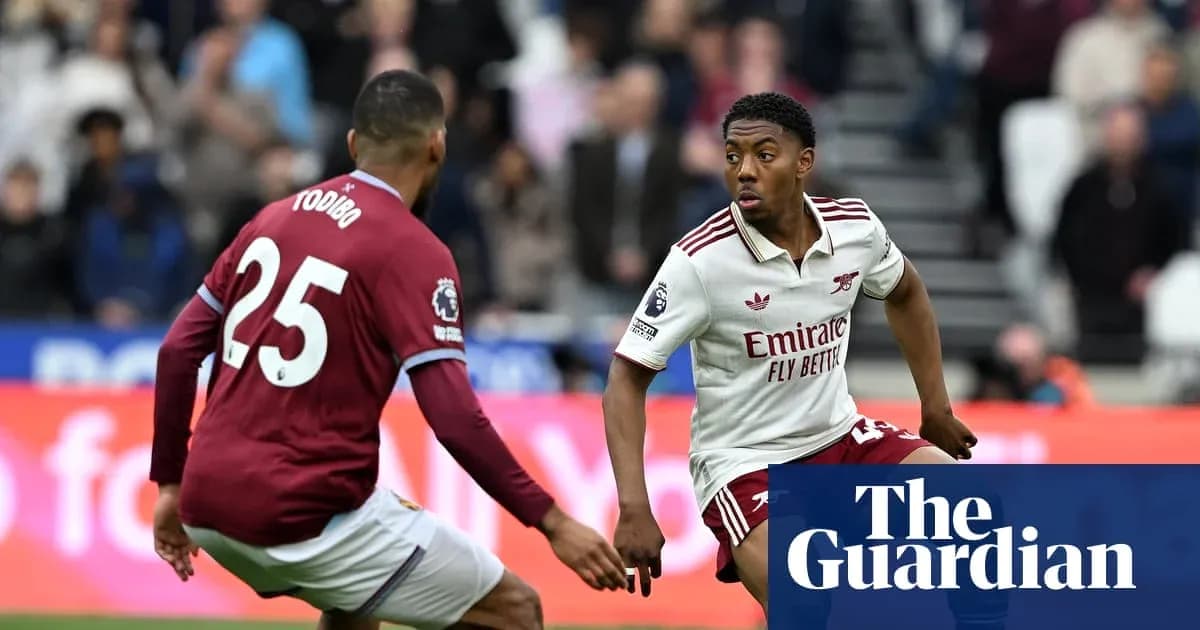
Inside the away dressing room, Myles Lewis-Skelly tried to make sense of it.
“It is just a huge sense of relief,” he said, before the words started to tumble. “Joy, excitement, fulfilment – everything you can describe. We are buzzing, but we know that the job is not done. We have got two more finals left.”
The VAR call had taken an age. The stadium held its breath, then cracked. West Ham sank deeper into trouble; Arsenal clung to belief. Asked how he had lived that moment, Lewis-Skelly did not pretend to be calm.
“I don’t even know … it was just God on our side,” he said. “We are so grateful.”
For him, that line fits more than just one decision. His season has felt like a crisis narrowly avoided, a test of faith that threatened to break him before it suddenly turned.
From prodigy to proving ground
Up until the Saturday before last, this campaign had been about frustration. Last year, Lewis-Skelly burst into the first team like a player who had been waiting his whole life for the curtain to lift. Fifteen Premier League starts. A first Arsenal goal in a 5-1 demolition of Manchester City, followed by a cheeky nod to Erling Haaland’s “Zen” celebration. It was the sort of thing that tells you a teenager is not cowed by the stage.
He carried that swagger into England duty, scoring 20 minutes into his debut against Albania. At the Bernabéu, in a Champions League quarter-final against Real Madrid, his performance left some of the old royalty in the posh seats asking the same question: “Who is this kid?”
Then the music stopped.
This season, his league minutes dried up. His place in the England squad went with them. On 11 April, when Mikel Arteta finally handed him only his second Premier League start of the campaign, at home to Bournemouth, Arsenal collapsed. They lost badly. For a 19-year-old, it became the sort of night that lingers, the kind that can twist a promising career off its axis.
Arteta has since admitted he has been hard on him. It has felt like a deliberate sharpening, a manager pushing a talent to see what remains when the easy moments disappear.
The answer arrived nine days ago.
Arteta went with a gut call against Fulham, naming Lewis-Skelly in midfield for the first time. It was the role he grew up playing in the academy, even if he had broken into the senior side as a left-back. The response was emphatic. He drove Arsenal through a 3-0 win, rediscovering the rhythm and daring that had first turned heads.
The performance changed the conversation. Arteta kept him in the side for the 1-0 Champions League semi-final second leg against Atlético Madrid, a night that booked a showdown with Paris Saint-Germain. Then he trusted him again at West Ham.
From the fringes to the heart of a title and European push, in the space of a fortnight.
“It was tough for me initially,” Lewis-Skelly admitted of this season. “But I pride myself on having mental strength. Sport is not one pathway because there are ups and downs. It’s how you bounce back from that, how you are in those moments when you face adversity. That is what defines you.”
He shut out the noise, on purpose.
“I spoke with my family and friends. I just told them: ‘I don’t want to hear all the noise that is coming from social media. Let me stay in this moment, let me continue to face this adversity and let me come out the other side of it.’”
So he trained like a starter, even when he was nowhere near the XI.
“It is always being prepared, always feeling like I prepare as a starter because you never know when your time will come. Luckily enough, it came against Fulham. I took my opportunity and helped the team out as much as I can.”
A new midfield, a new hierarchy
The shift has been dramatic. Almost overnight, Lewis-Skelly has moved ahead of Martín Zubimendi in the midfield pecking order. That is not a small statement from Arteta. This is a manager who obsesses over control in that area of the pitch, and he has decided a 19-year-old is ready to carry some of that weight.
The competition around him is serious. Martin Ødegaard, the captain and creative heartbeat, came off the bench on 67 minutes at West Ham and changed the feel of the game, injecting urgency and precision where Arsenal had started to drift. Lewis-Skelly slid back to left-back when Ødegaard came on, a reminder that his versatility remains part of his value.
But he knows where he wants to be.
“It feels so natural for me to be there [in midfield],” he said. “I have been training there a lot so [against Fulham] I felt comfortable. The boss told me: ‘You are going to play midfield, so go for it.’ That is what I did. I had to be bold and play with courage because that is what this league demands.”
Bold is the word. This is not a player hiding in safe passes or square positions. He drives with the ball, breaks lines, plays as if the game is there to be grabbed rather than managed. It is risky, but it is also what has jolted Arsenal at a time when legs and minds are heavy.
His future has been a talking point all season. When his minutes vanished, the market logic started to swirl around him: “pure profit,” the phrase that haunts every academy graduate in the era of balance sheets and squad refreshes. Sell one of your own and the books look better.
Right now, that noise can wait.
“I am focused on the games we have got coming up,” he said. “And bringing this club back to glory.”
Two league matches, a Champions League final on the horizon, a title race that could be decided by a single decision like the one that saved them in stoppage time at West Ham.
For Lewis-Skelly, the season that threatened to slip away has suddenly become one that might define his career. The question now is simple: having fought his way back into the centre of it all, how far can he drag Arsenal with him?