Arsenal's Hunger Test and City's New Era: Community Shield Insights
Arsenal have finally climbed the mountain. Now comes the harder question: do they still feel like climbing?
After 22 years without a league title, three straight seasons of finishing second and all the emotional strain that came with that pursuit, Mikel Arteta’s side reached the summit in May. The cost was obvious. Declan Rice ran himself into the ground, Bukayo Saka flickered rather than burned at the World Cup, and William Saliba left that tournament with a back injury. The legs were heavy. The minds, maybe even more so.
The start of any season after a World Cup tends to be ragged, but this one already feels unusually unstable. Nine of the 20 Premier League clubs have changed manager. For the first time in four decades, none of the defining dugout figures of the modern era – Sir Alex Ferguson, Arsène Wenger, José Mourinho, Jürgen Klopp or Pep Guardiola – will be on the touchline. The league has lost its old lodestars.
Even at the champions, the picture is not entirely clear. Arteta is now the longest-serving manager in the division, yet nobody would blink if Arsenal opened up a little sluggishly, still digesting the scale of what they did and what it took to get there.
City’s new era, familiar face
At the other end of the emotional spectrum stand Manchester City, a club whose last two seasons were judged disappointing by their own warped standards. Now they move into life after Guardiola, a phrase that has hung over the Etihad for a decade and always felt theoretical. It is real now.
Enzo Maresca walks into that vacuum carrying both pedigree and doubt. He resembles Guardiola on the touchline and his football often looks like a remix of his former boss’s ideas, especially from the period when he served as assistant. His CV reads well enough: promotion with Leicester, a Europa Conference League and a Club World Cup with Chelsea. Yet those fanbases never fully warmed to the way his teams played. Chelsea’s squad had obvious flaws and collapsed further after he left, but there was still a sense that Maresca hadn’t quite squeezed everything out of what he had.
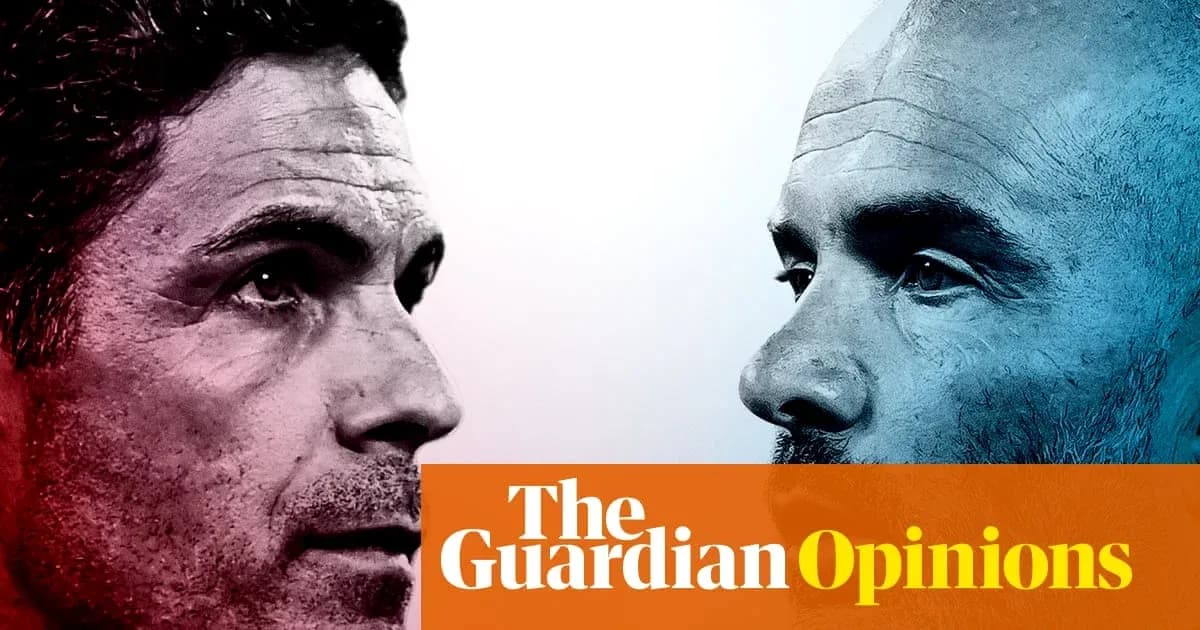
That is the backdrop to Sunday’s Community Shield: a champion whose hunger needs checking, and a superclub trying to work out what it is without the manager who defined it.
A trophy that rarely predicts the title
The temptation is always to overreact to this game. It is the first real look at something that matters, after weeks of fitness runs and half-paced friendlies. But the Shield has become a strange kind of compass. Not since 2018 has the winner gone on to lift the Premier League. In that sense, it points away from the title rather than towards it.
Where it can be useful is in revealing weaknesses, not crowning strengths. The cracks that show up at Wembley in August have a habit of widening by November.
It probably won’t be as dramatic as 1974, when Kevin Keegan and Billy Bremner’s fight laid bare Liverpool’s unease at Bill Shankly’s retirement and, more importantly, the collapse of morale at Leeds under Brian Clough after Don Revie. Often, the Shield only makes sense months later.
Think of 2015. José Mourinho turned up for Chelsea against Wenger’s Arsenal looking oddly dishevelled – unshaven, in tracksuit bottoms and a baggy T‑shirt – and lost to his old rival for the first time. It felt like an odd day. Few realised it was the opening act of a season that would unravel so badly he was sacked in December.
Last year’s warning signs
Last season’s game, a 2-2 draw followed by Crystal Palace winning on penalties against Liverpool, offered its own clues, particularly about Arne Slot’s side. Mohamed Salah looked disconnected from those around him in attack. The back line wobbled constantly. Twice Liverpool coughed up equalisers.
Were those issues obvious on the day? Perhaps not. That is always the puzzle: are we watching a team still short of fitness and cohesion, or are we seeing problems that will still be there in October?
Arsenal’s midfield puzzle and a new left flank
This year’s edition arrives with fewer clear questions and fewer obvious answers. Arsenal used Wednesday’s friendly against Como to ease Bruno Guimarães into the picture, and he could feature at Wembley, likely alongside Myles Lewis-Skelly. The 19-year-old has been one of the stories of Arsenal’s pre-season, stepping up while Rice, Martín Zubimendi and Martin Ødegaard enjoyed extended breaks after the World Cup.
Yet his future is not guaranteed. He has been linked with a move, which made his reaction after scoring against Como stand out: a heart sign to the fans, a tap of the badge. It looked like a statement, or at least a plea to be allowed to make one.
Out wide, Arsenal’s left flank has been stripped and rebuilt. Leandro Trossard has gone, Morgan Rogers is at Chelsea, Vinícius Júnior remains at Real Madrid. Arteta’s answer, for now, is Christos Tzolis, the 24-year-old Greece international signed from Club Brugge. Sunday offers a first serious look at how he meshes with the rest of the attack and whether Arsenal still need one more weapon on that side.
City’s midfield in flux, Rodri in limbo
Across the halfway line, City’s biggest headache sits in the middle of the pitch. Rodri’s proposed move to Barcelona has yet to materialise, leaving the club in an awkward holding pattern over his replacement. Enzo Fernández is the preferred option, but there is a genuine tactical question: can his slighter frame cope with the demands of playing as the deepest midfielder in a Premier League side that spends so much time exposed in transition, even with the added muscle of Elliot Anderson now in the squad?
The reshaping of City’s midfield is already under way. Tijjani Reijnders, who started friendlies against Inter and Atlético, is heading to Al-Qadsiah. Bernardo Silva has joined Real Madrid. Two major technical pillars are gone.
Where that leaves Phil Foden is unclear. Since being named player of the year in 2024, his form has dipped. Maresca started him against Inter and Atlético, a sign of trust or a test of patience. With others still working back from World Cup exertions, the next few weeks hand Foden a window to reclaim the role he once seemed destined to own.
Leadership void at the back
At the back, John Stones has departed. On paper, his exit should not be seismic; he started only 11 games across the past two seasons. But dressing rooms run on more than minutes. Stones was a voice, a presence, a standard-setter. Lose him, lose Silva, lose Guardiola, and the character of the squad inevitably shifts. The hierarchy changes. New leaders have to emerge, or the group drifts.
A glimpse, not a verdict
So Sunday becomes a kind of mirror. On one side, the new City, stripped of the man who built them and several of the lieutenants who enforced his standards. On the other, Arsenal, finally champions again, trying to prove that the climb has not dulled their appetite.
It is still only the Community Shield, a ceremonial curtain-raiser dressed up as a trophy. Any sweeping verdict drawn from it deserves suspicion.
But for two clubs standing at such different crossroads, even the smallest glimpse could say a lot about where this season is heading.