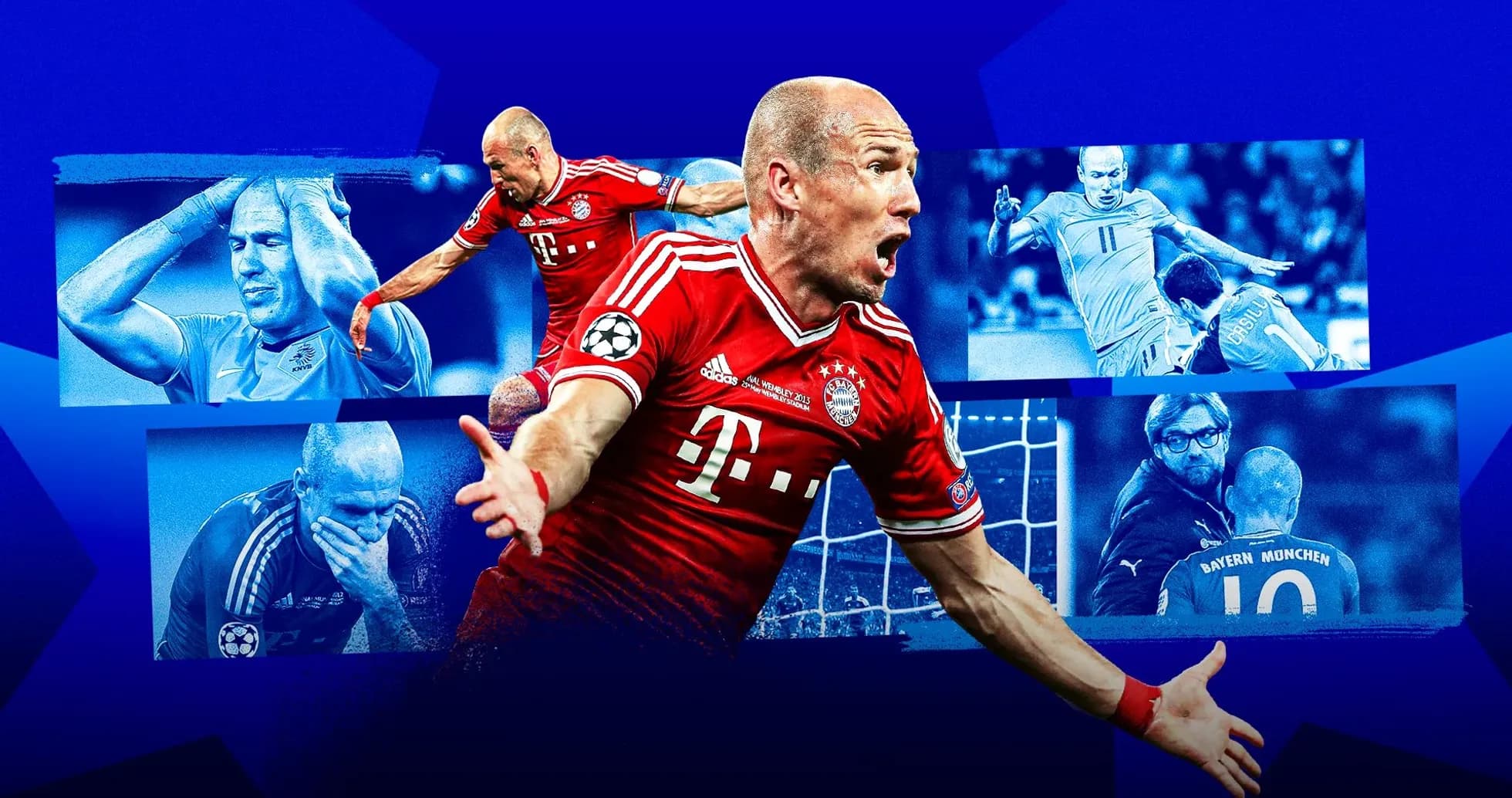
Arjen Robben: The Winger Who Redefined European Football
Arjen Robben always cut inside. Everyone knew it was coming. Nobody could do a thing about it.
Before the labels, before the memes and the “bottler” tag, he was terror in fluorescent boots. A winger who reduced elite full-backs to training cones, gliding down the right, feinting once, then whipping that left-footed arc into the far corner. Predictable on the chalkboard, unstoppable on the pitch.
He left scars across Europe. Manchester United, Barcelona, Borussia Dortmund – all victims under the Champions League lights. At home, he hoarded titles: PSV, Chelsea, Real Madrid, Bayern Munich. By 2010, it felt inevitable. This Bayern side – Mario Gomez, Thomas Müller, Franck Ribéry, Bastian Schweinsteiger, guided by Louis van Gaal – looked built for the throne.
They swept the Bundesliga and the DFB-Pokal that season. Europe, though, made them sweat.
The one-man rescue act
Bayern stumbled through the Champions League group and into a last-16 tie with Fiorentina that threatened to swallow them. Robben had scored a penalty in a 2-1 first-leg win in Munich, but in Florence, Bayern were 3-1 down and slipping out.
Then came the 65th minute.
Robben picked up the ball in the middle of Fiorentina’s half, drove into space and unleashed one of the purest strikes of his career, a vicious, curling thunderbolt from distance. Aggregate 4-4, Bayern through on away goals. One swing of his left boot, season saved.
The pattern repeated in the quarter-final against Manchester United. Robben missed the first leg through injury as Bayern eked out a 2-1 win. At Old Trafford, they were 3-0 down on the night, 4-2 behind overall, drowning in red shirts and noise.
Then a corner from Ribéry dropped to the edge of the box. Robben watched it all the way and side-footed a volley so precise it seemed to stun even him. Old Trafford fell silent. Bayern advanced again on away goals.
He wasn’t finished. In the semi-final against Lyon, he stepped up with another long-range missile in a 1-0 first-leg win, a shot that gave Hugo Lloris no chance. Robben was dragging Bayern to the final almost by force of will.
At the Santiago Bernabéu against Jose Mourinho’s Inter, the magic faded. Ribéry was suspended, Bayern started with Ivica Olić and Müller up front, and the Germans never really ignited. Robben roamed, searched, tried to pry the game open, but Inter were ruthless and disciplined. A 2-0 defeat, and the dream was gone.
That summer, another stage, another chance. Another scar.
Johannesburg: the toe that changed everything
By the 2010 World Cup, Robben had already acquired the unwanted nickname “Man of Glass”. Hamstring issues delayed his tournament, but once he arrived, he transformed the Netherlands.
He opened the scoring against Slovakia in the last 16. He played a crucial role in the 2-1 comeback win over Brazil in the quarter-finals, setting up a key goal. Against Uruguay in the semi-final, he headed in what proved to be the winner. Oranje marched into the final.
Spain awaited in Johannesburg. The match turned brutal. Nine Dutch players booked. Nigel de Jong’s chest-high assault on Xabi Alonso became the enduring image of their approach. Yet the defining moment belonged to Robben and Iker Casillas.
Just after the hour, Wesley Sneijder slid a pass through the heart of Spain’s defence. Robben burst clear, alone, the World Cup at his feet. He sized up Casillas, waited, waited a fraction more. As he tried to roll the ball to his left, Casillas flung out a leg. A toe diverted destiny wide.
Dutch media named it “The toe of Casillas”. It stuck.
Casillas later admitted that as Robben charged toward him, one thought looped in his head: stay on your feet. He finally dived, expecting Robben to skip past. Instead, the Dutchman chose the one option that allowed the keeper to intervene. “Of all the options he had, Robben chose exactly the wrong one,” Casillas reflected. He was blunt: if that goes in, the final probably ends very differently.
It never did for the Netherlands. Andrés Iniesta scored in extra-time. Spain were champions. Robben was left with a miss that would stalk him for years.
“It hurts to miss such a chance,” he said four years later. “It will be part of me and part of my career for all of my life.”
There were more snapshots to come.
Penalties, pressure and a narrative hardening
Robben limped through 2010-11 but still produced savage numbers: 12 goals and eight assists in just 14 Bundesliga games. When he stayed fit the following season, he helped Bayern charge back to another Champions League final.
The route there brought him face-to-face again with Real Madrid and Casillas at the Bernabéu. Bayern were 2-0 down inside 14 minutes in the semi-final second leg, 3-2 behind on aggregate. The tie was slipping.
Then, in the 27th minute, Bayern won a penalty.
Robben stepped up against his former club, staring down Casillas two years on from Johannesburg. This time, no toe, no miracle. Casillas got a fingertip to it but couldn’t keep it out. All square on aggregate. Bayern held their nerve in the shootout and reached the final.
It felt like redemption. In reality, it was rehearsal for another nightmare.
At the Allianz Arena, in the 2012 final against Chelsea, Bayern’s story twisted again. The game went to extra-time at 1-1. Didier Drogba clipped Ribéry in the box. Penalty. Destiny, neatly placed on the spot.
Robben took it. Low, towards the corner. Petr Cech guessed correctly and smothered the ball. The stadium froze. Penalties followed. Bayern lost in their own fortress.
It came just weeks after he had missed a title-deciding penalty against Borussia Dortmund in the Bundesliga. The verdict seemed written: brilliant, but unreliable when it mattered most.
“I can't describe how I feel with words, but it's been a terrible night,” Robben admitted. “Two or three times, you feel you have the cup in your hands but at the end you stand with nothing.
“It wasn't a good penalty. I wanted to shoot the ball hard and high in the goal, but the ball didn't go high enough. It was a terrible penalty kick.”
He tried to play on, tried to reset. The story, though, was out of his hands now. Injuries piled up again. The 2012-13 season threatened to drift past him.
From fragile to feared again
Bayern stormed through the Bundesliga without needing Robben every week. He played only 16 league games. Yet when the Champions League knockout rounds arrived, his body finally held. Bayern needed him now.
The semi-final against Barcelona turned into a demolition. Over two legs, Bayern won 7-0 on aggregate, with Robben front and centre. In Munich, he tormented Jordi Alba, running at him relentlessly and curling in a superb third goal in a 4-0 win.
At Camp Nou, he delivered the quintessential Robben moment. Early in the second half, a long diagonal ball arced to him on the right. One razor touch, one cut inside Adriano, and the space opened as if scripted. He whipped a gorgeous shot into the top corner. Barca, broken.
Years later, he called that 4-0 his best game at the Allianz Arena, against a great team, capped by a goal that even he described as “uncharacteristic” – a stepover, a tight angle, a curling finish.
He still had one more scene to rewrite.
Wembley: the weight of every miss
The 2013 Champions League final at Wembley pitched Bayern against Jürgen Klopp’s Borussia Dortmund, a side that played at full volume. Dortmund dominated the first half. Bayern wobbled.
Robben, though, found his moment. Early in the second half he slipped a pass across goal for Mario Mandzukic to tap in. Dortmund hit back with a penalty eight minutes later. Tension choked the game.
Then came the flashback. Robben broke through and seemed destined to score, only for Neven Subotić to produce a stunning recovery block on the line. The old doubts resurfaced. Another final, another miss. Was the curse back?
Not this time.
As the clock ticked toward extra-time, a long ball dropped near the edge of the Dortmund box. Ribéry wrestled for it and, almost instinctively, flicked a delicate backheel into the crowd of yellow shirts. The ball squirmed through. Robben burst onto it.
Roman Weidenfeller stood in front of him. Mats Hummels to one side, Subotić to the other. Johannesburg, Munich, all of it pressed down on his shoulders in that split second.
He didn’t lash at it. He didn’t freeze. He glided past, nudged the ball delicately, almost lazily, sending it trickling across the turf, beyond Weidenfeller’s reach, into the net.
“When I got the ball, I was free,” Robben said afterwards. He had read Ribéry’s intention, seen the gap. “My first choice was actually to go past [Weidenfeller] on the left side but then he made a move and I could put it to the other side. He was on the wrong leg.”
Bayern were champions of Europe again. Robben’s curse was broken in the most poetic way possible: with a finish that defied the chaos around it.
“To finally win this Champions League, that's a dream come true,” he said. The emotion poured out. “Especially because you know what it is like to lose. I think you can enjoy it even more when you win the title.”
He referenced 2010, 2012, the World Cup. “That's three finals and you don't want the stamp of a loser. At last we did it today, and we can forget about the other things a bit. It was a sense of ‘finally’.”
In 2025, Bayern fans voted that goal – that slow, rolling exorcism at Wembley – as the greatest in the club’s 125-year history. Second place? Robben’s volley against Manchester United at Old Trafford.
The story had flipped.
Brazil and the rebirth of a legend
By the time the 2014 World Cup rolled around, Robben was 30 and unshackled. The fear seemed gone. He played like a man who had made peace with his scars.
Netherlands opened against Spain in a rematch of the 2010 final. This time, they tore La Roja apart 5-1. Robben was electric. He plucked a long ball out of the sky, left Sergio Ramos for dead and finished with ice-cold precision.
His second goal that night bordered on outrageous. He sprinted from halfway, burning past Ramos, collecting another long pass, dragging Casillas to the turf and then, with the goalkeeper scrambling on his knees, rifling the ball into the net. It was vengeance, not in words, but in acceleration and timing.
Under Van Gaal, a Netherlands side that many thought overmatched punched their way to the third-place play-off. Robben was their spear, their outlet, their chaos.
By then, the narrative had been rewritten. He was no longer just the man who missed in Johannesburg or faltered from the spot in Munich. He was the phenomenon who had come back from all of it.
From whistles to worship
Robben’s decade in Bavaria became one of the most decorated in the club’s history. Eight Bundesliga titles. Five DFB-Pokals. A Champions League, countless deep runs – four more semi-finals under Pep Guardiola, even if the European crown never returned.
His numbers were ruthless: 144 goals and 101 assists in 307 Bayern appearances. Behind those stats lay something harder to quantify – a winger who, when fit, bent games to his will.
He had been whistled by his own supporters after those missed penalties. He left them in tears of a different kind in 2019, lifting his final league title, serenaded as a legend.
The tragic figure had vanished. In his place stood a forward who had stared down the weight of failure on the grandest stages, carried the scars, and still carved his name into football history with that same, inevitable move:
Cut inside. Left foot. Net.