Anderlecht's Tactical Comeback: 3-1 Victory Over Hammarby FF
Anderlecht’s 3-1 turnaround against Hammarby FF at Lotto Park was built on clear territorial dominance, structural tweaks at half-time, and a bench that decisively shifted the game. From a 0-1 deficit at the break to a three-goal second half, Vitor Bruno’s side used their 4-4-2 as an aggressive, front-foot platform against Kalle Karlsson’s more conservative 4-2-3-1, reflected starkly in the shooting volume: 21 total shots for Anderlecht to Hammarby’s 6, and a 10-0 corner count.
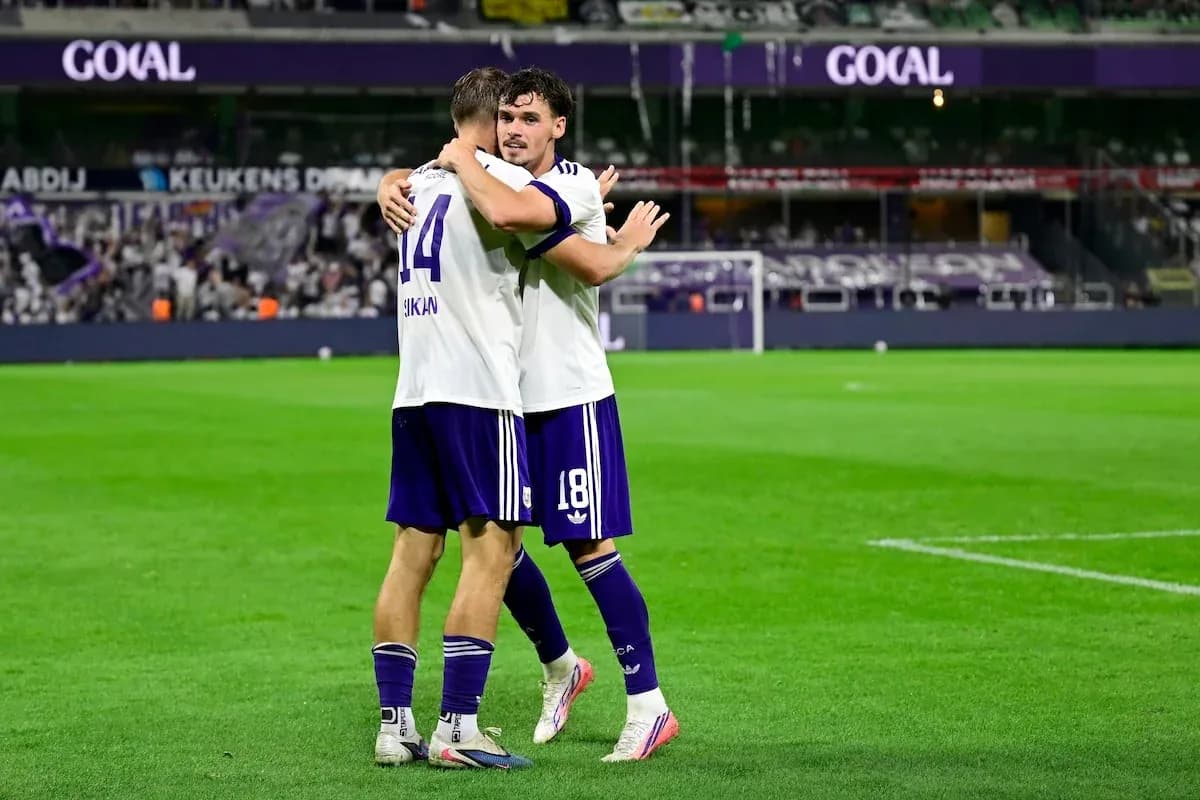
Structurally, Anderlecht’s 4-4-2 was narrow and vertical. C. Coosemans in goal sat behind a back four of L. Augustinsson, G. Biancone, L. Petrot and A. Maamar. In possession, Augustinsson and Maamar pushed high, effectively forming a 2-4-4, with E. Llansana and M. Kana holding the central lane while K. Nga and L. Ambros stepped inside to overload the half-spaces. J. Onia Seke operated as a second striker underneath D. Sikan, giving Anderlecht two central reference points against Hammarby’s centre-backs.
Hammarby’s 4-2-3-1, with W. Hahn in goal and a back four of N. Persson, F. Winther, V. Eriksson and H. Skoglund, was set up to absorb and spring. The double pivot of T. Tekie and M. Karlsson sat deep, with M. Madjed and O. Johansson flanking V. Lind behind lone forward P. Abraham. Early on, this structure worked perfectly: at 2', Abraham exploited Anderlecht’s advanced full-backs to score on Hammarby’s first real attack, one of only 6 shots they would manage all night. The visitors’ plan was clearly to stay compact, deny central progression, and counter through Abraham and the wide three.
Turning Point
The turning point came at half-time. Trailing 0-1 and having dominated territory but not the scoreline, Anderlecht made a double change at 46': M. N’Diaye (IN) came on for L. Augustinsson (OUT), and M. Cvetkovic (IN) came on for K. Nga (OUT). N’Diaye gave the left side more defensive security and athleticism to control transitions, while Cvetkovic added a more direct, penalty-box-oriented presence higher up. Immediately, the shape tilted: Anderlecht’s left side became both more secure against counters and more aggressive in attacking the half-space.
The impact was almost instantaneous. At 47', D. Sikan finished from an A. Maamar assist to level at 1-1, a goal that underlined Anderlecht’s full-backs as key attacking outlets. With Maamar pushing high, Anderlecht consistently pinned Hammarby’s wide players back, forcing the visitors into a low 4-5-1 block and reducing their ability to counter.
Shot Profile
From there, the shot profile tells the tactical story. Anderlecht finished with 21 total shots, 6 on target and 3 blocked, compared to Hammarby’s 6 shots and 3 on target with none blocked. The hosts’ ability to sustain pressure was reinforced by a 10-0 edge in corners, indicating how often they forced play into the final third and kept Hammarby defending their box. Anderlecht’s fouls (12 to Hammarby’s 10) show a willingness to counter-press aggressively and stop transitions at source, especially after the interval.
The bench continued to tilt the game. At 66', A. Bertaccini (IN) replaced J. Onia Seke (OUT), giving Anderlecht fresh legs between the lines and another runner attacking the box. On the other side, Hammarby’s changes at 66' — A. Boudri (IN) for P. Abraham (OUT) and N. Besara (IN) for M. Madjed (OUT) — signalled a shift towards more control and less direct pace up front. Later, V. Lind (OUT) for I. Fofana (IN) and O. Johansson (OUT) for E. Kabore (IN) at 76' further rebalanced the side, but also removed some of the original attacking thrust that had threatened in transition.
Goals
Anderlecht’s second and third goals were both emblematic of their tactical arc and the influence of substitutes. At 81', Cvetkovic, introduced at the break, struck to make it 2-1, capitalising on the sustained territorial dominance and Hammarby’s deepening block. At 84', T. Degreef (IN) came on for Sikan (OUT), and at 89' Degreef himself added the third goal for 3-1, underlining how Anderlecht’s bench not only maintained intensity but directly delivered end product.
Discipline
Discipline further reflects the tactical tension. Hammarby collected three yellow cards — P. Abraham for “Foul” at 27', V. Eriksson for “Handling” at 55', and M. Karlsson for “Holding” at 73' — consistent with a side under pressure, often forced into last-ditch or cynical interventions. Anderlecht’s two bookings, to Cvetkovic for “Roughing” at 65' and Onia Seke for “Unsportsmanlike conduct” at 66', came as they pushed the tempo and intensity in the comeback phase.
Goalkeepers
In goal, C. Coosemans (Anderlecht) made 2 saves, while W. Hahn (Hammarby FF) registered 3 saves. Given the shot volumes, Coosemans had a relatively quiet but efficient evening behind a dominant side, while Hahn was repeatedly exposed by the volume of pressure rather than by isolated high-quality chances alone. Neither team’s passing metrics or possession shares are available, but the disparity in shots and corners, combined with Anderlecht’s three second-half goals, point to a match where the home side imposed their structure and tempo for long stretches.
Overall, this was a tactical contest where Anderlecht’s aggressive 4-4-2, smart half-time adjustments, and impactful substitutions overcame Hammarby’s initially effective but ultimately overrun 4-2-3-1. The 3-1 scoreline, from 0-1 down at half-time, aligns closely with the underlying pattern: sustained Anderlecht pressure, limited Hammarby attacking output, and a decisive second-half shift in both structure and mentality.