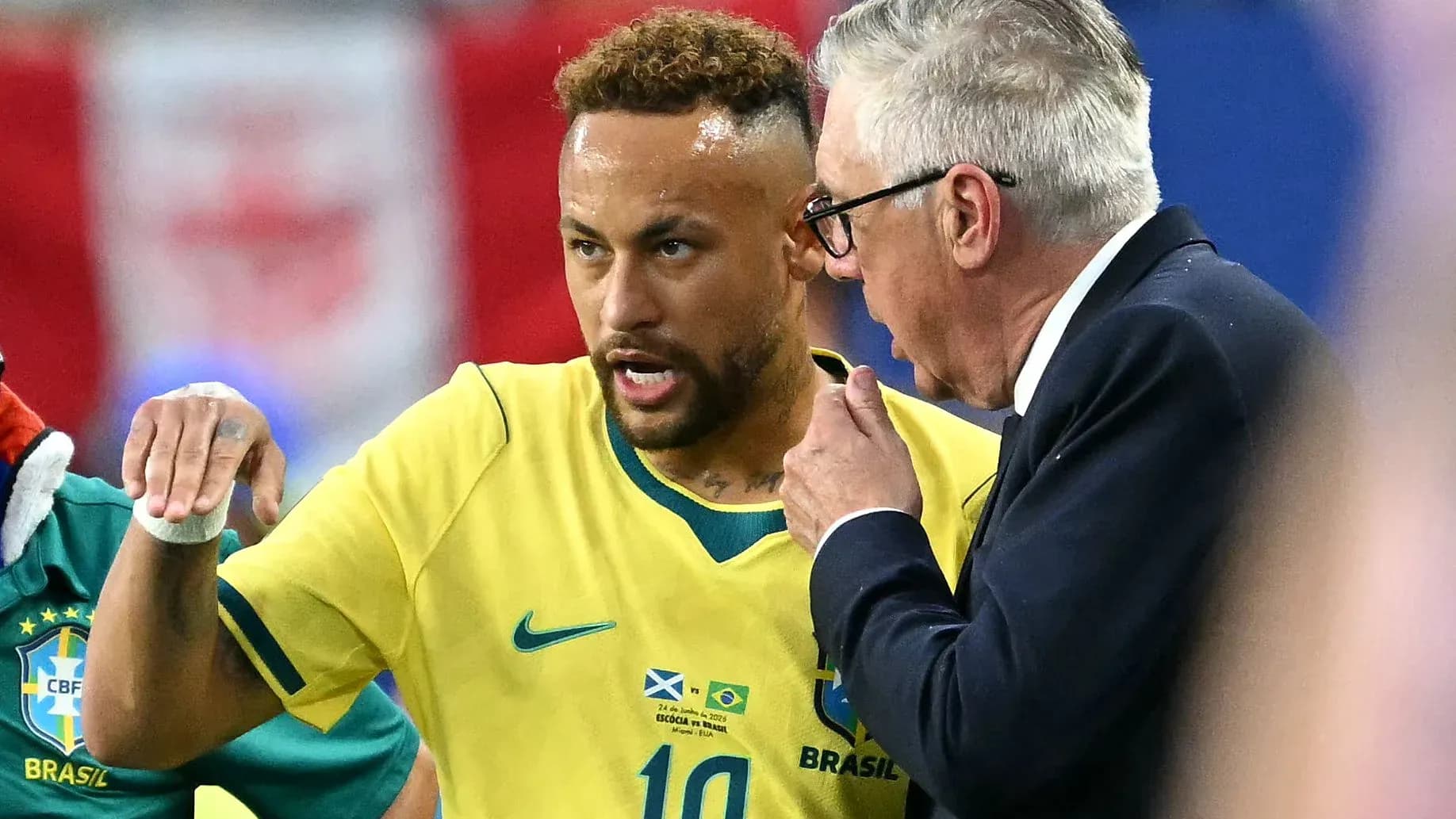
Ancelotti Addresses Neymar's Role in Brazil's Transition
Carlo Ancelotti did not dodge the Neymar question. He walked straight through it.
The Italian, never one for theatrics, laid out the reality of Brazil’s No. 10 with the same clarity he uses to set up a midfield. Neymar, he said, arrived at the tournament short of what was needed – not in talent, but in condition.
A grade 2 calf strain had already ruled the forward out of the opening group games against Morocco and Haiti. Match fitness was a problem, rhythm was missing, and Ancelotti admitted the technical impact simply wasn’t there.
"I think he didn’t contribute on a technical level as it was hoped he could, because he couldn’t," Ancelotti told ESPN. The key word was “couldn’t,” not “wouldn’t.” Physically, Neymar was behind the curve.
Yet inside the camp, the story was different. The coach leaned heavily on Neymar’s presence, leadership, and professionalism in a dressing room caught between eras.
"In terms of attitude, it was a very positive attitude. I have a lot of affection for him, I thanked him for his attitude, for his behavior, and I think it was the right decision to include him on the 26-man roster."
The message was clear: Neymar the player was diminished; Neymar the leader still mattered.
But Ancelotti did not gloss over what bothered him. The veteran coach, who has managed some of the game’s biggest egos, made it plain that preparation, not desire, was the issue.
"The only thing that bothered me is that Neymar could have prepared himself better during that lead-up period," he added. "He could have been ready for game one instead of game four. That was the only disappointing part."
Those words cut to the heart of Brazil’s transition. For years, Neymar has been the symbol, the reference point, the unavoidable name on the team sheet. Now, Ancelotti is preparing for a Brazil that no longer revolves around him.
With his talismanic No. 10 stepping away from the international stage, the coach is already looking toward a full-scale rebuild aimed squarely at the 2030 World Cup. This is not just a change of players; it is a shift in philosophy. Brazil is moving away from the last glow of the 2010s icons and into a new, untested generation.
"I think that players like Neymar, who already commented yesterday, and with all due respect to his decision. I believe that in history, one generation ends and another has to come, and it has to be better than the last one," the former Real Madrid boss said.
The line was respectful, but ruthless in its logic. No one, not even Neymar, stands outside the cycle of renewal.
And he is not alone on that exit ramp.
Ancelotti hinted that several pillars of the Seleção are approaching the same junction. Asked specifically about Casemiro, Danilo, and Alex Sandro, he did not hide behind clichés about “competition” and “options.” He spoke like a coach who knows that time, not tactics, is now his biggest opponent.
"I think so. It is a period that is coming to an end. Obviously, we have to thank all of them, and I have a lot of affection for all of them. But I think the idea that a player over 30 is done means that we have to think about the future.... Some of these players will be there, obviously. Marquinhos, for example. Alisson, we’ll see."
There was nuance in that final line. This is not a mass purge. It is a recalibration. Marquinhos is pencilled into the next cycle; Alisson’s role will be judged with time. Others, though, are drifting toward the past tense of Brazilian football.
So Brazil stands at a familiar crossroads, but with unfamiliar stakes. Neymar’s body has started to say no, even as his talent still screams yes. Ancelotti has chosen to listen to the calendar instead of the nostalgia.
The next question is no longer what Neymar can still give Brazil.
It is who, in this new generation, will dare to take his place.