
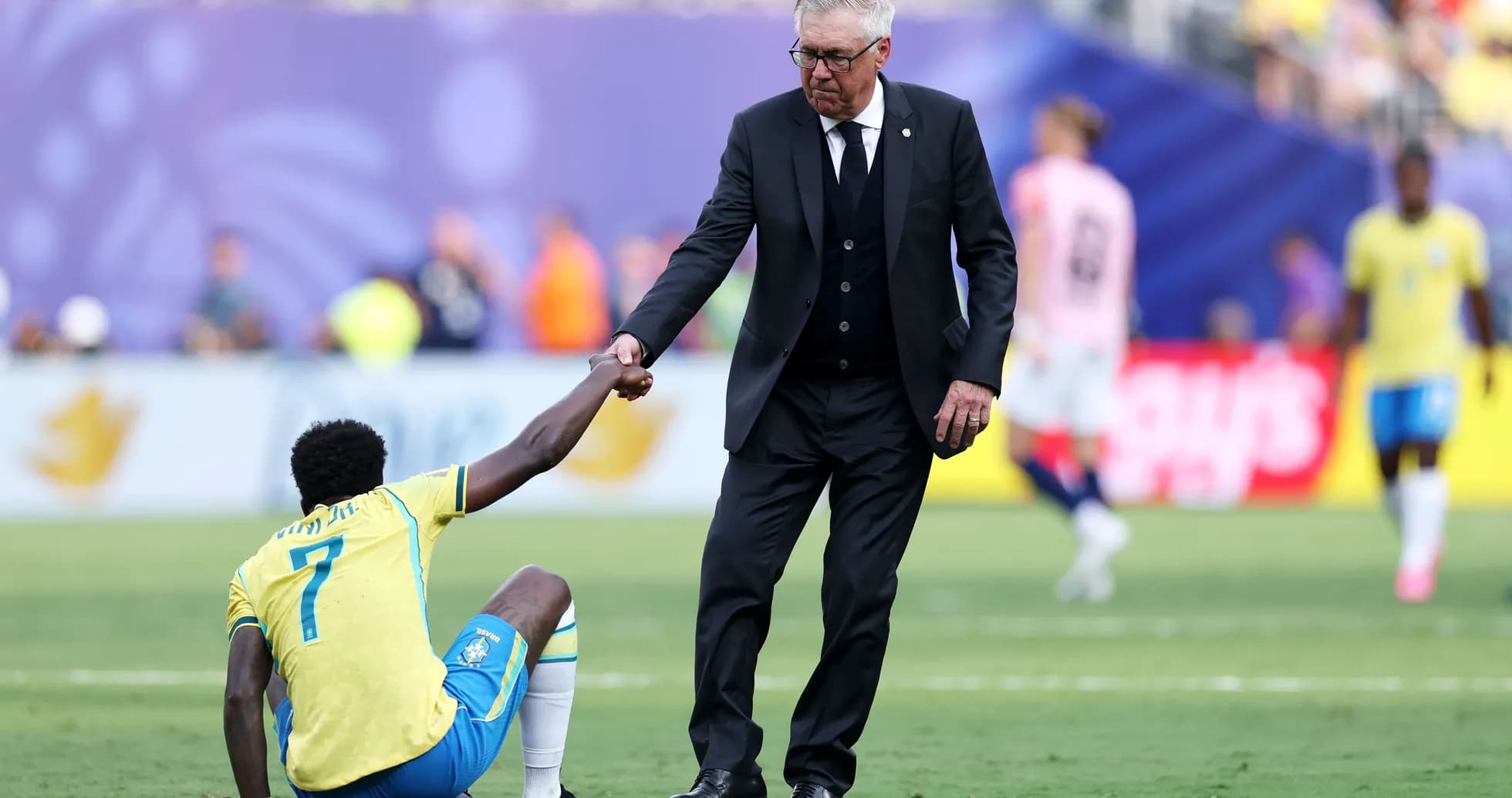
Carlo Ancelotti Reflects on Brazil's 2026 World Cup Exit
Carlo Ancelotti has lived enough nights in football to know that tournaments are rarely decided by a single moment. Yet when he looks back at Brazil’s 2026 World Cup exit, his mind goes straight to one: a water break against Norway.
Brazil fell 2-1 in the round of 16, another World Cup slipping through the country’s fingers, the wait for a sixth title stretching back to 2002. For Ancelotti, the turning point was not a wonder goal or a refereeing controversy. It was his own read of the game as his team paused for drinks in the second half.
“I think we lost the World Cup during the water break against Norway,” he admitted, speaking to ESPN. Until then, he felt Brazil had the match where they wanted it. The rhythm, the control, the emotional temperature — all in yellow and green.
Then doubt crept in.
The moment that changed his mind
Norway were seeing plenty of the ball, but largely in their own half. It was a pattern they had already shown against England, circulating possession, dragging opponents into uncomfortable positions, waiting for their moment.
Ancelotti saw that and feared the tide had turned.
“Perhaps my mistake was here, when I thought the team had lost control of the match when that was not the case,” he reflected. Convinced Brazil were slipping, he moved to change his line-up. The changes opened the door, and Erling Haaland walked straight through it.
Once Haaland struck in the 75th minute, Brazil were staring at elimination. “In the World Cup, when they score a goal against you in the thirtieth minute of the second half, it is very difficult to recover,” Ancelotti said. They still carved out a chance to respond, but the damage was done.
A year’s work, bent by injuries
Ancelotti was keen to stress that the defeat did not erase the body of work that had gone into building this Brazil side.
“In general, I think the work done over a year was excellent,” he said. The logistics, he insisted, were spotless: hotel, stadium, training ground, all at the level a World Cup demands. He praised the squad’s consistency over the year and stood firmly behind his selections. “I also think the 26 players who were called up were the most suitable to be there.”
The problem was that the plan he had drawn up months earlier did not survive contact with reality.
Injuries ripped through his core. Éder Militão, Rodrygo, Estêvão, Wesley — all hit in the months between March and the tournament. During the World Cup itself, Raphinha joined the casualty list. “So the plan changed a little,” he admitted. It was more than a little. It forced constant recalibration, new combinations, new solutions under tournament pressure.
Yet for all the disruption, Ancelotti kept returning to that water break. That was the moment he felt he blinked.
Neymar, the gamble under fire
If the water break was the turning point, the substitution that followed became the lightning rod.
Ancelotti’s decision to introduce Neymar late on drew fierce criticism in Brazil, with many arguing the move “upset the balance” of the team. The Italian, who has weathered storms at Milan, Chelsea, Paris Saint-Germain and Real Madrid, did not flinch.
No,” he said when asked if he regretted the call. He explained the thinking with the calm of a man used to justifying big decisions. Ryan came off, Endrick shifted to the right wing, Neymar stepped in as the man to unlock a stubborn defence.
He believed Neymar could “create a goal, or show his skills at that moment, in the 70th minute.” It was not a desperate roll of the dice, he insisted, but a repeat of a plan he had already mapped out for another knockout match.
Against Japan, the script had been different. Brazil were in total control, Japan living off counter-attacks. In that game, Gabriel Martinelli came on instead. The idea was to hold Neymar back for extra time, to unleash a fresh superstar against tiring legs rather than chase a game in chaos.
Norway changed that equation. “I brought Neymar on a little early to regain control of the match,” Ancelotti said. Control, not panic — that was the aim. Yet with every substitution at that level comes risk. Change one piece, the whole puzzle shifts.
The weight of the touchline
Ancelotti did not hide from the pressure of those moments. He referenced Thomas Tuchel, another coach who has spoken publicly about the intensity and backlash that accompany big-game decisions.
“I heard Tuchel say he came in for heavy criticism, and the truth is that you have to make a very difficult decision,” Ancelotti said. “It is a moment full of tension, and you do not always get it right.”
That is as close as he came to a confession. Not that Neymar should have stayed on the bench, but that the structure around him should not have been disturbed.
“I think Neymar should have been brought on, he had to come on at that moment because he was performing well, trained well, and prepared well. I liked his sporting spirit. I think he helped the team. But, with him coming on, there was no need to change the structure of the team.”
That final line lingers. A tiny tactical adjustment, a misread during a water break, a reshuffle that did not need to happen. For a nation that measures its football history in World Cups, those are the margins Brazil now live with.
The question is simple, and brutal: how many more tournaments can this generation afford to learn its lessons the hard way?




