
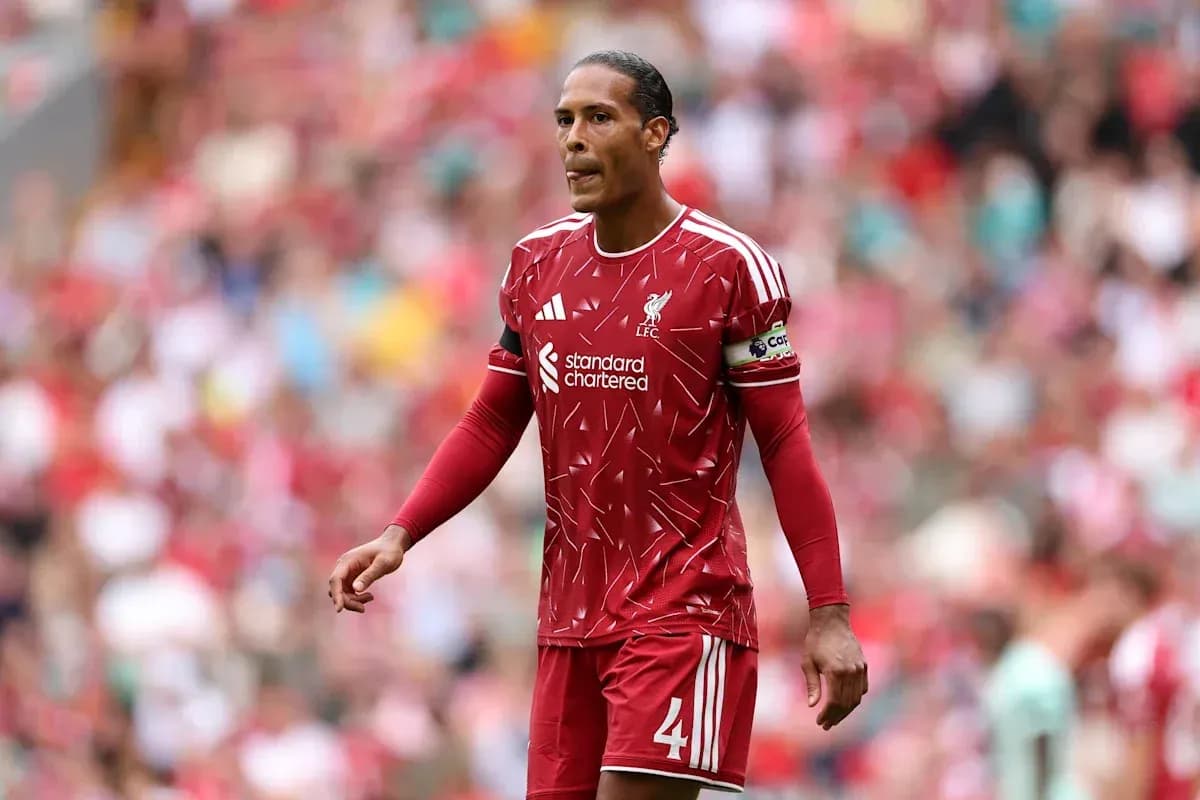
Virgil van Dijk on Liverpool's Transition: A New Era Ahead
Virgil van Dijk has lived through enough Liverpool cycles to recognise one when he sees it. Titles, rebuilds, near-misses, emotional farewells – he has worn them all. This one feels different, though. And he is not pretending otherwise.
The captain calls it what it is: a transition.
A new Liverpool, a new manager, a new reality
Only two years have passed since Liverpool were crowned Premier League champions under Arne Slot. That side looked built to last. Yet a poor campaign last season, the kind that strips away certainty and exposes fault lines, cost Slot his job and forced the club into another reset.
Andoni Iraola is now the man in charge, tasked with reshaping a squad that has lost not just quality, but identity pieces.
Mo Salah has gone. So has Andy Robertson, a full-back who defined an era on that left flank. Between them, they carried years of dressing-room influence and countless high-stakes minutes. Their absence leaves a vacuum that cannot be filled overnight.
Van Dijk feels that shift every day.
"It definitely feels like a bit of a transition, for sure," he said, cutting through any notion that Liverpool are simply tweaking at the edges. For him, the responsibility is shared. "It's down to everyone associated with Liverpool to make sure that we're building something that will be successful for the years to come."
That line matters. He is not talking about a holding pattern or a write-off season. The demands remain.
"This year we want to be successful," he added, "but there's a lot of work to be done still, and we all know how difficult it is to be playing in the Premier League, League Cup, FA Cup, Champions League, so we need everyone at their best."
The schedule will not show mercy just because Liverpool are evolving. The standard will not drop simply because the faces have changed.
The 35-year-old who refuses to slow down
With so much change swirling around him, Van Dijk himself has become a storyline. At 35, a centre-back in the Premier League is usually being gently phased out, minutes managed, legs protected.
He has no intention of accepting that script.
Asked whether he can still go week in, week out, his response was instant and sharp: "Yes. What, are you going to say I'm 35 years old and I can't do it?"
That edge has always been there. It now fuels a different kind of battle – not against a rival forward, but against time and perception.
"At the end of the day you have to look after yourself," he said. "I won't say I'm lucky, but you have to do everything in your power, and that's the bare minimum for me, because I feel the responsibility to be ready each and every game."
Every three days, he goes again. Not just on the pitch, but in the quiet work that supporters never see.
"Every three days I'm doing everything in my power at home, at the training ground, to be ready to play a game. So, for me, I feel good. I'm also a late bloomer, so maybe… It is what it is, I feel fine, and I want to be part of a successful Liverpool team."
There is no hint of nostalgia in that. He is not reminiscing about what he once was. He is staking a claim in what Liverpool still need him to be.
Wearing the shirt, carrying the weight
Strip away the tactics, the formations, the transition talk, and Van Dijk comes back to something simple: the shirt and what it represents.
"I want to make all the fans proud all over the world that support us wherever we go," he said. Pride, for him, is measurable. It is not about effort alone. It is about results and standards.
"That's by winning games, that's by showing what it means to wear that shirt every time, and that's for me the bare minimum anyway, so I will keep going."
That is where this Liverpool story now sits. A new manager on the touchline. Major figures gone. A captain in his mid-thirties refusing to budge, insisting he can still anchor a team that must compete on four fronts.
Transition or not, Van Dijk has made his stance clear: Liverpool may be changing, but they are not allowed to drift.




