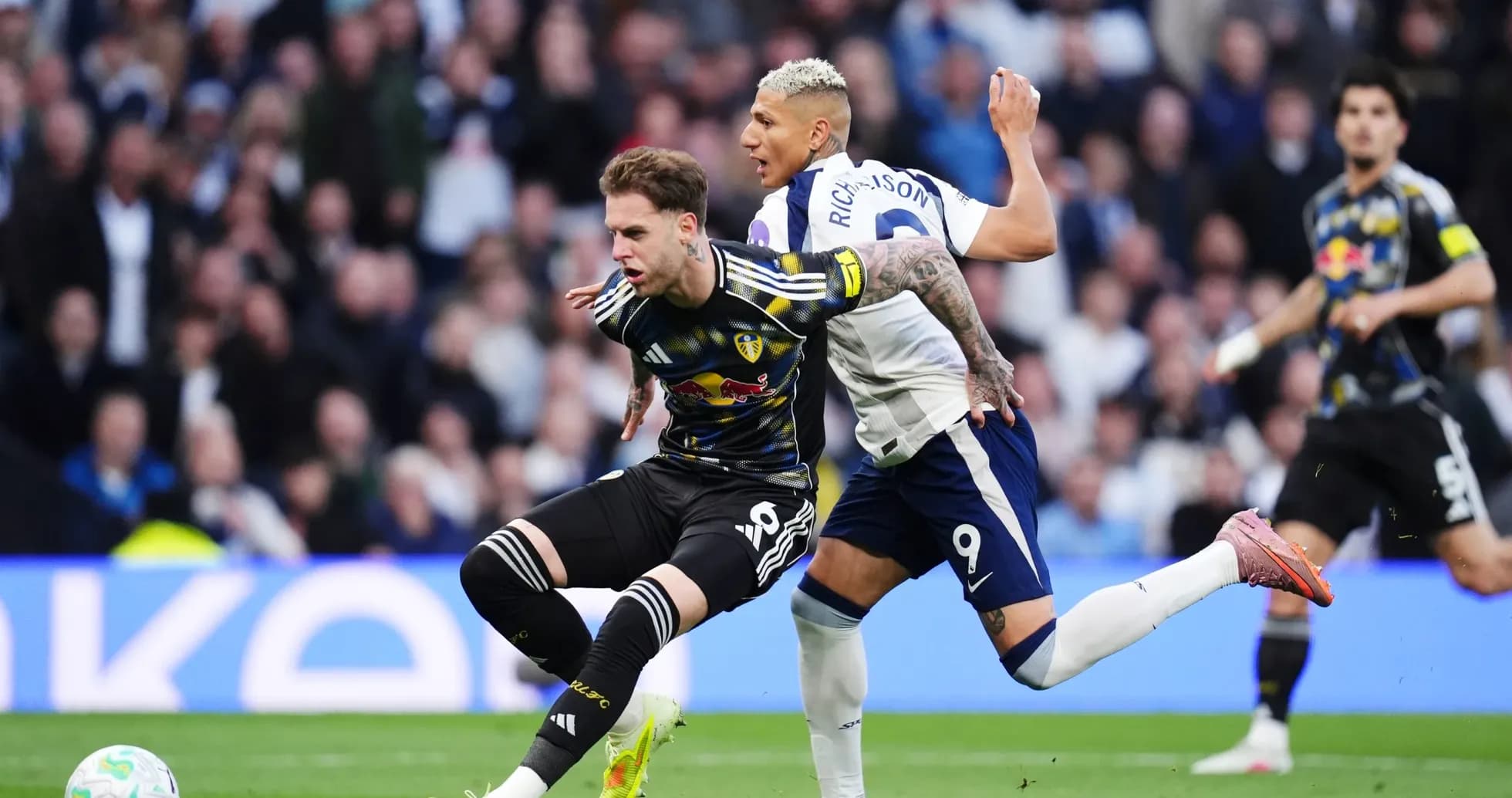
Tottenham and Leeds Share Spoils in Premier League Clash
Under the lights of Tottenham Hotspur Stadium, this was a meeting of two sides carrying very different emotional baggage into Round 36 of the Premier League season. Tottenham, 17th heading into this game with 38 points and a goal difference of -9 (46 scored, 55 conceded overall), were still glancing nervously over their shoulder. Leeds arrived in north London 14th, on 44 points with a goal difference of -5 (48 for, 53 against overall), their recent form steadier and their football more assured.
The 1-1 full-time scoreline felt like a fair reflection of the balance of power, but the way each team reached that point told a deeper story about structure, absences and identity.
Tottenham lined up in Roberto De Zerbi’s preferred 4-2-3-1, but this was a version stripped of some of its intended stardust. A long list of absentees shaped the squad more than any chalkboard could: B. Davies (ankle), M. Kudus (muscle), D. Kulusevski (knee), W. Odobert (knee), C. Romero (knee), X. Simons (knee), D. Solanke (muscle) and G. Vicario (groin) were all missing. That is a spine and a creative core ripped out, leaving a team already fragile at home – just 2 wins from 18, with 21 goals for and 31 against at this stadium – to improvise its way through a high‑pressure evening.
The improvisation began in goal, where A. Kinsky stood in for Vicario. In front of him, M. van de Ven and K. Danso formed a centre-back pairing that had to combine Van de Ven’s recovery pace with Danso’s more orthodox penalty-box defending. On the flanks, P. Porro and D. Udogie were asked to be full-backs and playmakers at once, vital in a side whose season-long attacking pattern leans on width and underlaps more than central craft.
The double pivot of J. Palhinha and R. Bentancur told you what De Zerbi feared: Leeds’ ability to spring quickly through the middle. Palhinha’s role was clear – screen, break, disrupt – while Bentancur tried to be the first passer out of pressure. Ahead of them, a fluid band of three – R. Kolo Muani to the right, C. Gallagher centrally, M. Tel from the left – were tasked with feeding Richarlison, Tottenham’s leading scorer with 10 league goals and 4 assists in total.
Yet the numbers hovering over this Tottenham side before kick-off were not kind. Overall they had scored 46 and conceded 55, averaging 1.3 goals for and 1.5 against per game. At home, they averaged 1.2 goals scored and 1.7 conceded, a profile that speaks of a team that opens up to play but bleeds space in transition. The card distribution underlined their tendency to lose control as games wear on: 25.26% of their yellows arriving between 61-75 minutes, and another 15.79% from 76-90, a late-game volatility that has often turned draws into defeats.
Leeds, by contrast, arrived with a clear structural identity under Daniel Farke. The 3-5-2 at Tottenham Hotspur Stadium was not an experiment; it was one of the systems that has underpinned a season of stubborn competitiveness. Their season-long away numbers – 20 goals scored and 32 conceded on their travels, an average of 1.1 for and 1.8 against – show a side that suffers defensively but usually offers a punch in return.
The back three of J. Rodon, J. Bijol and P. Struijk was built for aerial duels and penalty-box defence, but also for stepping out to compress space on Tottenham’s No.10 zone. Ahead of them, the five-man midfield was a carefully calibrated engine. E. Ampadu, one of the league’s top card collectors with 9 yellows in total, anchored the centre, his 78 tackles and 50 interceptions this campaign speaking to a player who lives at the collision point of games. Either side, A. Stach and A. Tanaka provided legs and passing lanes, while the width came from D. James and J. Justin, both nominally listed as midfielders but functioning as wing-backs.
Up front, the partnership of D. Calvert-Lewin and B. Aaronson offered a neat “Hunter vs Shield” narrative. Calvert-Lewin, with 13 league goals and 64 shots in total, is Leeds’ primary finisher, a penalty-box presence who has also won 444 duels overall, thriving on contact. Aaronson, officially a midfielder but used here as a second forward, arrived with 5 assists and 4 goals, plus 32 key passes and 80 attempted dribbles. He is Leeds’ top creative outlet, a roving 10 who links midfield to attack and draws fouls (50 in total) in dangerous pockets.
The absences on the Leeds side – J. Bogle, F. Buonanotte, I. Gruev, G. Gudmundsson and N. Okafor – trimmed Farke’s rotation options, particularly in wide and creative roles, but did not disfigure the core of his starting XI. That continuity showed in their season-long discipline pattern: yellow cards are spread but spike between 61-75 minutes at 23.33%, with a secondary rise from 76-90 at 16.67%. Like Tottenham, they can become ragged as legs tire, but Ampadu’s presence usually ensures they do not lose their central shape.
In the “Engine Room” duel, Palhinha and Bentancur against Ampadu and Stach was the game’s true hinge. Tottenham needed Palhinha’s tackling to prevent quick service into Calvert-Lewin, whose penalty record – 4 scored, 1 missed – makes any box contact a danger. Leeds, meanwhile, relied on Ampadu’s reading of play to step into passing lanes aimed at Gallagher and Richarlison between the lines. Every Tottenham attack that stalled in that crowded middle third was a small Leeds victory.
From a statistical prognosis perspective, this always looked like a contest between a fragile home side and a robust, if flawed, traveller. Tottenham’s home defensive average of 1.7 goals conceded per game collided with Leeds’ away defensive average of 1.8, suggesting space and chances for both. With no penalties missed by Tottenham this season (and none taken), but Leeds perfect from the spot overall with 6 scored and 0 missed, any marginal xG edge from spot-kicks was tilted towards the visitors.
Following this result, the 1-1 draw fits the underlying numbers: Tottenham once again could not turn territorial phases into a decisive home win, while Leeds extended a pattern of drawing more away games than they win or lose. In xG terms, the matchup was always likely to be narrow – Tottenham’s attacking structure blunted by injuries, Leeds’ away defence leaky but protected by a disciplined midfield screen. The final verdict is of two squads whose statistical identities were faithfully translated onto the pitch: Tottenham, expansive but brittle; Leeds, organised, industrious and just dangerous enough to leave London with a point.