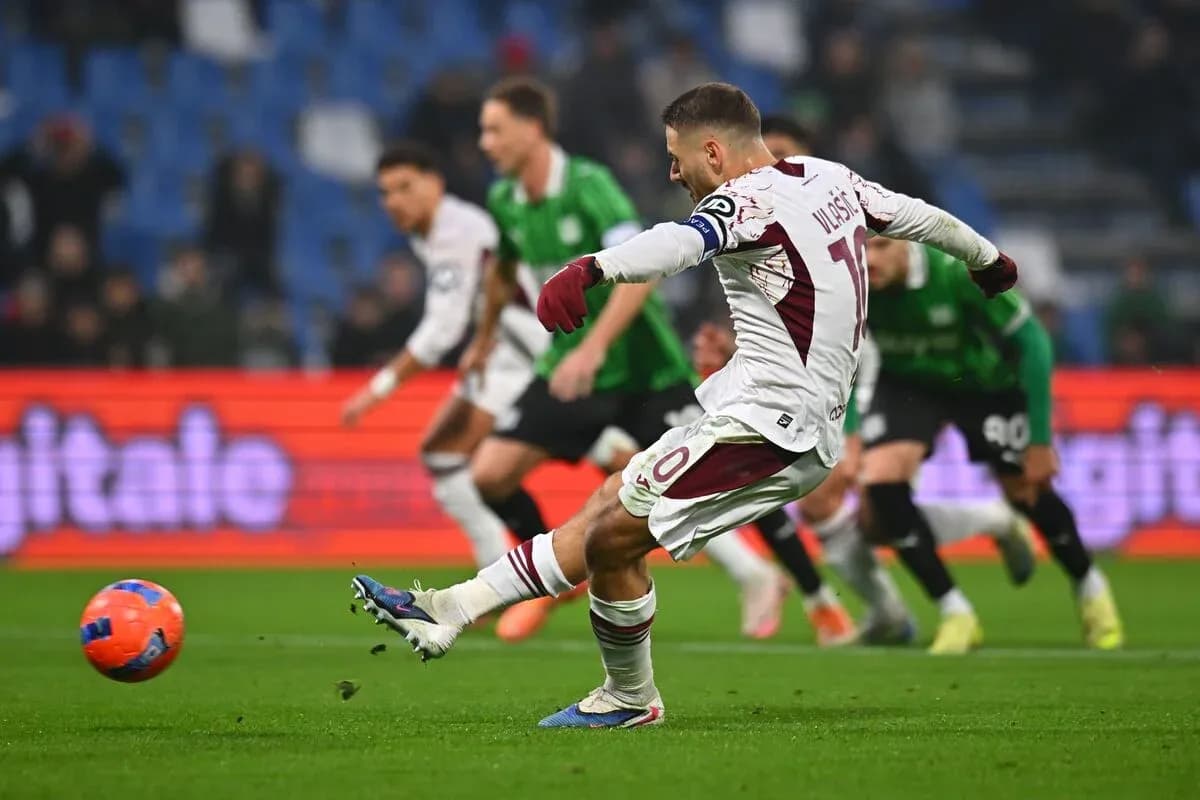
Torino's Tactical Turnaround in 2–1 Victory Over Sassuolo
Torino’s 2–1 comeback win over Sassuolo at Stadio Olimpico Grande Torino unfolded as a classic Serie A tactical swing: Sassuolo’s structured 4-3-3 controlled territory and possession early, but Torino’s 3-4-2-1, once adjusted, leveraged wing-backs, direct runs and bench depth to flip both the scoreline and the momentum in the second half. The match, in Round 36 of the 2025 Serie A season, was ultimately defined by Torino’s superior chance quality (2.82 xG to 2.1) and their capacity to turn territorial parity into more dangerous final-third occupation.
Disciplinary Log
- 38' Luca Lipani (Sassuolo) — Foul
- 51' Luca Marianucci (Torino) — Foul
- 63' Matteo Prati (Torino) — Foul
- 86' Kristian Thorstvedt (Sassuolo) — Foul
- 89' Niels Nkounkou (Torino) — Foul
- 90+3' Gvidas Gineitis (Torino) — Foul
Totals: Torino 4 yellow cards, Sassuolo 2 yellow cards, Total 6.
The first half, goalless at 0–0, reflected Sassuolo’s preference for controlled buildup from Fabio Grosso’s 4-3-3. With L. Lipani, N. Matic and K. Thorstvedt forming the midfield triangle ahead of a back four anchored by S. Walukiewicz and T. Muharemovic, Sassuolo used their 52% possession and 480 passes (87% accuracy) to progress methodically. Josh Doig and W. Coulibaly provided width, allowing the front three of C. Volpato, A. Pinamonti and A. Lauriente to occupy Torino’s back three and pin wing-backs deep.
Torino, under Leonardo Colucci, set up in a 3-4-2-1 with A. Paleari behind a trio of E. Ebosse, S. Coco and Luca Marianucci. The wing-backs V. Lazaro and R. Obrador often had to drop into a back five to cope with Sassuolo’s wide overloads. In central midfield, M. Prati and Gvidas Gineitis were initially outnumbered in the half-spaces by Thorstvedt’s advanced positioning. Torino’s attacking trident of N. Vlasic, A. Njie and G. Simeone found limited space between Sassuolo’s lines, which explains Torino’s need to rely on direct balls and transitional moments rather than sustained possession.
Sassuolo’s first booking at 38' — Luca Lipani for “Foul” — came as Torino tried to break the press through midfield, underlining how aggressively Sassuolo’s midfield stepped in to prevent counters. At this stage, Sassuolo’s shot profile (eventually 14 total shots, 11 inside the box) was already trending toward central penetration, while Torino’s 18 total shots were more distributed but with a heavy bias toward penalty-area activity (13 inside the box).
The game’s tactical hinge arrived just after the break. At 51', Luca Marianucci’s yellow card for “Foul” highlighted Torino’s struggle to contain Sassuolo’s rotations on the left. From that same phase of momentum, K. Thorstvedt struck at 51' for Sassuolo, assisted by L. Lipani. The goal rewarded Sassuolo’s midfield superiority: Thorstvedt’s late run from the left interior channel exploited the space between Torino’s wide center-back and wing-back, a recurring problem in Colucci’s initial structure.
Colucci’s response was immediate and decisive. At 59', he reshaped the attack with a double substitution: D. Zapata (IN) came on for A. Njie (OUT), and M. Pedersen (IN) came on for V. Lazaro (OUT). Zapata offered a more physical reference point than Njie, allowing Torino to play earlier into the striker and push Sassuolo’s back line deeper. Pedersen, operating from the wing-back lane, provided more direct running and crossing threat than Lazaro, crucial to pinning back Doig and Coulibaly.
The intensity of Torino’s press and counter-press rose, and with it, their disciplinary load. Matteo Prati’s yellow at 63' — “Foul” — reflected Torino’s attempt to disrupt Sassuolo’s buildup higher up the pitch. Grosso answered with his own structural tweaks at 63': D. Berardi (IN) for C. Volpato (OUT) and I. Kone (IN) for L. Lipani (OUT). On paper, this injected creativity and ball-carrying, but it also slightly loosened Sassuolo’s central compactness, as Berardi tends to drift into pockets rather than maintain strict shape.
Torino capitalized almost immediately. At 66', G. Simeone equalized, assisted by E. Ebosse. The move encapsulated Torino’s adjusted plan: a more aggressive wide center-back (Ebosse) stepping into advanced zones to combine and deliver into the box, with Simeone attacking the near-post space against a back line now occupied by both Simeone and Zapata. Sassuolo’s 4-3-3 struggled to track these dual central threats while also covering the width.
Colucci continued to refine the midfield balance at 67', with E. Ilkhan (IN) replacing M. Prati (OUT). Ilkhan’s introduction gave Torino fresher legs and more vertical passing from the pivot, helping them sustain pressure rather than simply react. The reward came at 70', when M. Pedersen scored the winner, assisted by D. Zapata. This second goal was a direct consequence of Torino’s new attacking dynamics: Zapata’s ability to receive and lay off under pressure created the platform, while Pedersen’s advanced wing-back positioning exploited Sassuolo’s full-backs, who were caught between stepping to the wing-back and tucking in to protect the box.
Grosso sought to restore width and energy with three further changes: at 75', U. Garcia (IN) for J. Doig (OUT); at 76', M. Nzola (IN) for A. Pinamonti (OUT); and at 84', D. Bakola (IN) for N. Matic (OUT). These substitutions aimed to increase vertical threat and second-line runs, but they also reduced the stabilizing influence of Matic in front of the defense. As Sassuolo chased the game, their structure became more stretched, and Torino were able to manage space rather than dominate the ball.
The closing stages were scrappy and card-heavy, reflecting Torino’s game management. At 86', Kristian Thorstvedt received a yellow card — “Foul” — as Sassuolo pushed urgently. In the same minute, Colucci rotated his front line and left flank: S. Kulenovic (IN) for G. Simeone (OUT) and N. Nkounkou (IN) for R. Obrador (OUT), preserving energy and adding defensive legs in wide areas. Nkounkou himself was booked at 89' — “Foul” — as Torino committed to breaking up Sassuolo’s rhythm. Finally, at 90+3', Gvidas Gineitis’ yellow — “Foul” — underlined Torino’s willingness to absorb pressure with tactical fouling to protect the 2–1 lead.
From a statistical standpoint, the match validates Torino’s approach. Despite having slightly less of the ball (48% possession, 439 passes at 85% accuracy), they generated higher-quality chances: 18 shots to Sassuolo’s 14, with 13 of those inside the box, and an xG of 2.82 versus Sassuolo’s 2.1. Both goalkeepers posted the same goals-prevented figure (-0.25), but the context differs: A. Muric made only 2 saves behind a defense increasingly exposed by late chasing, while A. Paleari had to produce 5 saves to keep Sassuolo’s 7 shots on target from turning the game. Torino’s higher foul count (13 to 9) and four yellows to Sassuolo’s two underline a deliberate tactical edge: once in front, they accepted defensive risk and disciplinary cost to compress space, disrupt Sassuolo’s possession game, and see out a structurally hard-fought home victory.