
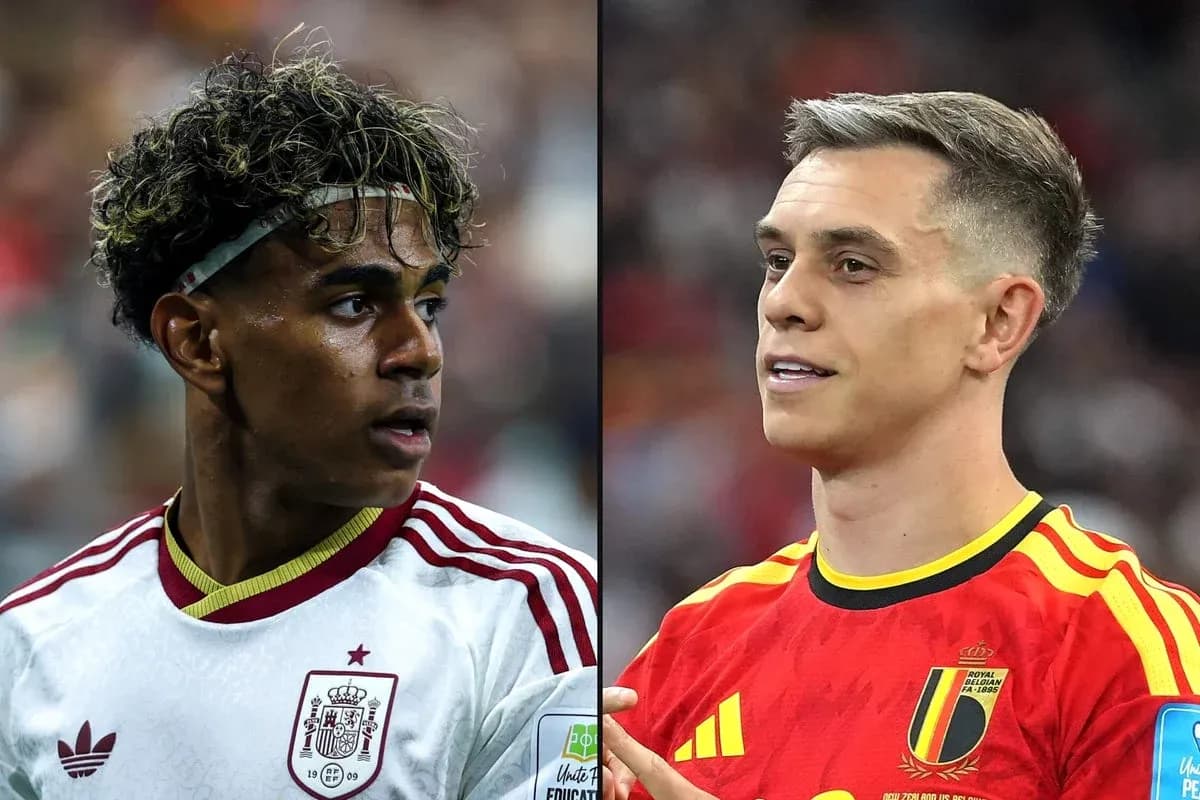
Spain vs Belgium: Quarter-Final Clash for Elite Status
The World Cup has reached the stage where reputations either harden into legend or crack under the lights. At SoFi Stadium in Inglewood, Spain — the European champions, immaculate yet oddly understated so far — run into a Belgium side that has stumbled, reinvented itself and suddenly looks dangerous.
The winner gets France in the semi-finals. That alone sharpens the edges of this tie.
Spain: perfect at the back, patchy up front
Spain arrive with numbers that look almost arrogant. Five games, no goals conceded. Unai Simon has not been beaten in 609 minutes of World Cup football, a record stretching back to 2022. Aymeric Laporte and Pau Cubarsi have turned the centre of Spain’s defence into a no-go zone, protected by a team that presses high, wins the ball back early and starves opponents of territory.
They have not needed to be spectacular. Luis de la Fuente’s side eased through Group H, drawing with Cape Verde before brushing aside Saudi Arabia 4-0 and edging Uruguay 1-0. Austria were handled 3-0 in the round of 32. Portugal, more awkward and more stubborn, were finally broken by Mikel Merino’s stoppage-time header in the last 16.
The pattern is clear. Spain grip games by the throat with possession, then suffocate opponents without the ball. No team has drawn more offsides in this tournament — 18 — and no team has won more possessions in the final third, with 36. They push high, they hold their line, they dare you to get it right under pressure. Most teams don’t.
Yet something has been missing. The goals have come in bursts rather than waves. Mikel Oyarzabal’s doubles against Saudi Arabia and Austria showcased a ruthless finisher, but across the wins over Uruguay and Portugal, Spain’s attack often felt like a sketch that never quite became a painting.
The intrigue lies in the players who might yet catch fire. Lamine Yamal, 18 and already a Barcelona star, has flickered rather than blazed. Nuno Mendes and then Nelson Semedo kept him quiet against Portugal, but the threat is always there: one touch, one shimmy, and the game can tilt. On the opposite flank, Alex Baena has been tidy and intelligent, dovetailing with Marc Cucurella to overload wide areas and open lanes in behind.
De la Fuente’s biggest decision sits in the No 10 role. Dani Olmo has offered movement and invention, one of the few to truly trouble Portugal. Merino, though, changed that game from the bench and delivered the decisive goal. Pedri, usually the heartbeat of this side, has not reached his best level; Fabian Ruiz lurks as an option if the coach wants more control and physical presence in midfield.
Spain have moved through the rounds with the calm of a team that knows it has another gear. Belgium will try to force them to use it.
Belgium: chaos, reset and a new identity
Belgium’s path has been anything but smooth. They topped Group G with five points, but looked like a side still arguing with its own reflection: draws with Egypt and Iran, then a 5-1 thrashing of New Zealand that felt like an outlier more than a blueprint.
The real turning point came against Senegal in the round of 32. Two goals down with five minutes of normal time left, Rudi Garcia tore up his plan — and, crucially, his hierarchy. Jeremy Doku went off. Kevin De Bruyne went off. On came Dodi Lukebakio from Benfica and Nicolas Raskin from Rangers, a winger and a ball-winner rather than a classic creator.
On paper, it seemed conservative. On the pitch, it unlocked something. Romelu Lukaku and Youri Tielemans dragged Belgium level, Tielemans then buried a late extra-time penalty, and a team that had looked slow and disjointed suddenly ran with purpose and cohesion.
That reset has defined Belgium’s knockout run. They dismantled co-hosts the United States 4-1 in the last 16, with the same new core and the big names waiting their turn. Garcia left De Bruyne and Doku on the bench from the start and kept them there until the game opened up. De Bruyne did not play a minute.
It was a bold call, and he knows it. “If someone had told me I’d do that before the tournament started, even I wouldn’t have believed it,” he admitted. But Belgium had become too individualistic, too static to press, too loose between the lines. The new version is more modest, more balanced, and far more effective.
There has been a cost. Amadou Onana, who finally earned a start against the U.S., saw his tournament cut short by an anterior cruciate ligament injury after just 21 minutes. Hans Vanaken stepped in and Belgium did not lose their grip on the game, a small but telling sign of their growing structure.
Garcia is expected to keep faith with the same basic shape against Spain. Leandro Trossard, the tournament’s leading chance creator with 17, has become a quiet star, knitting attacks together. Tielemans drives from midfield, timing his box runs with the confidence of a player who knows his role. Lukaku and Doku remain lethal weapons off the bench, especially when tired defenders leave space to attack.
Belgium’s flaw is just as stark as their strength. They shoot often — 107 attempts so far — but rarely cleanly. Thirty-two of those shots have been blocked, more than any other team. Only 14 have been clear looks at goal, with zero or one defender in the way. The upside? They are ruthless when they do get a sight: 13 goals from those 14 clear efforts, a conversion rate even sharper than France, England or Spain.
Give them one chance too many and they punish you. Deny them space and they can look blunt.
The duel on the flanks
Strip away the noise and this game may hinge on the wings.
Spain’s right side offers pure jeopardy. Yamal’s one-on-one threat is among the most feared in the tournament, and his partnership with Pedro Porro has shown flashes of real menace. When Yamal drifts inside, Porro surges beyond. When he holds the touchline, Porro underlaps into the half-space. One misstep from Belgium’s left and Spain can carve out the sort of low cross they thrive on.
On the other flank, Cucurella and Baena have quietly become one of Spain’s most effective combinations. Their constant overlapping and underlapping runs stretch defences horizontally, creating those diagonal sprints into the channels that Austria simply could not track.
Belgium answer with their own wide patterns. Under Garcia, the full-backs are encouraged to run beyond the wingers off the ball, dragging markers and creating angles for cut-backs and whipped deliveries. It is not subtle, but it is relentless. Their 5-1 demolition of New Zealand was built on those repeated surges into the corners and the first-time shots that followed.
Both sides love the low cross. Both rank joint-top in the tournament for chances created from those cut-backs, with three each. Belgium lead all teams in first-time shots with 58; Spain sit third with 46. The ball will flash across the six-yard box again and again. The question is who arrives on the end of it with composure.
Control versus chaos
Out of possession, the contrast sharpens.
Spain are ruthless the moment they lose the ball. They swarm, they trap, they counter-press with a collective understanding that has carried over from their European Championship triumph. It is not just about flair in possession; their dominance rests on how quickly they smother counter-attacks before they even start.
Belgium have not been as secure. Six errors have directly led to shots against them, a figure bettered only by the United States and Brazil. They have allowed 53 shots in total, almost double Spain’s 29. Teams have found it too easy at times to bypass their midfield and run at their back line.
That is where this quarter-final might tilt. If Spain’s press pins Belgium back, Garcia’s team could spend long stretches chasing shadows, waiting for the rare moment when a clearance falls to Trossard or Tielemans in space. If Belgium can break that first wave and hit the channels early, the game opens up for Lukaku and Doku later on.
History offers its own sub-plot. These nations first met at the 1920 Olympics, where Belgium, on home soil in Antwerp, won 3-1. Their most famous clash came in the 1986 World Cup quarter-final in Mexico: Jan Ceulemans’ diving header, Juan Senor’s late 30-yard equaliser, and a penalty shoot-out decided by Jean-Marie Pfaff’s save from Eloy Olaya. Spain have since endured a miserable record in World Cup shootouts — just one win in five.
Spain took their revenge in Italia 1990 with a 2-1 group-stage victory that sent them through as group winners and Belgium as runners-up. Since the turn of the century, though, the fixture has been one-way traffic: five Spanish wins from five, including a 5-0 qualifier in La Coruna on the road to their 2010 World Cup triumph. The most recent meeting, a 2-0 friendly win for Spain in Brussels in 2016, featured Thibaut Courtois, Lukaku, Thomas Meunier and De Bruyne.
Those ghosts will not decide this game. But they linger.
Predictions and the weight of expectation
The experts are almost unanimous. Spain by two, say Stuart James, Dermot Corrigan, Pol Ballús, Anantaajith Raghuraman and Phil Hay — all tipping a 2-0 win. Tomás Hill López-Menchero sees something wilder: Belgium striking first, Spain responding with three, and Yamal finally igniting his World Cup with goals.
The logic is simple enough. Spain’s defence has been unbreached, their midfield built to suffocate, their attack still with room to grow. Belgium, for all their resurgence, have already pushed beyond what many expected. Their win over the United States felt like a high point; this is a higher mountain.
But quarter-finals have a habit of ignoring logic. Belgium know that one clear sight of goal can flip the narrative. Spain know that perfection at the back counts for nothing if one lapse invites the kind of clinical finishing Belgium have shown from their rare clean looks.
So it comes down to this: can Spain’s control smother Belgium’s new-found chaos, or will Garcia’s reshaped side drag the European champions into the kind of game they have carefully avoided all tournament?
France wait in Arlington. Only one of these teams will get the chance to find out if they truly belong on that stage.




