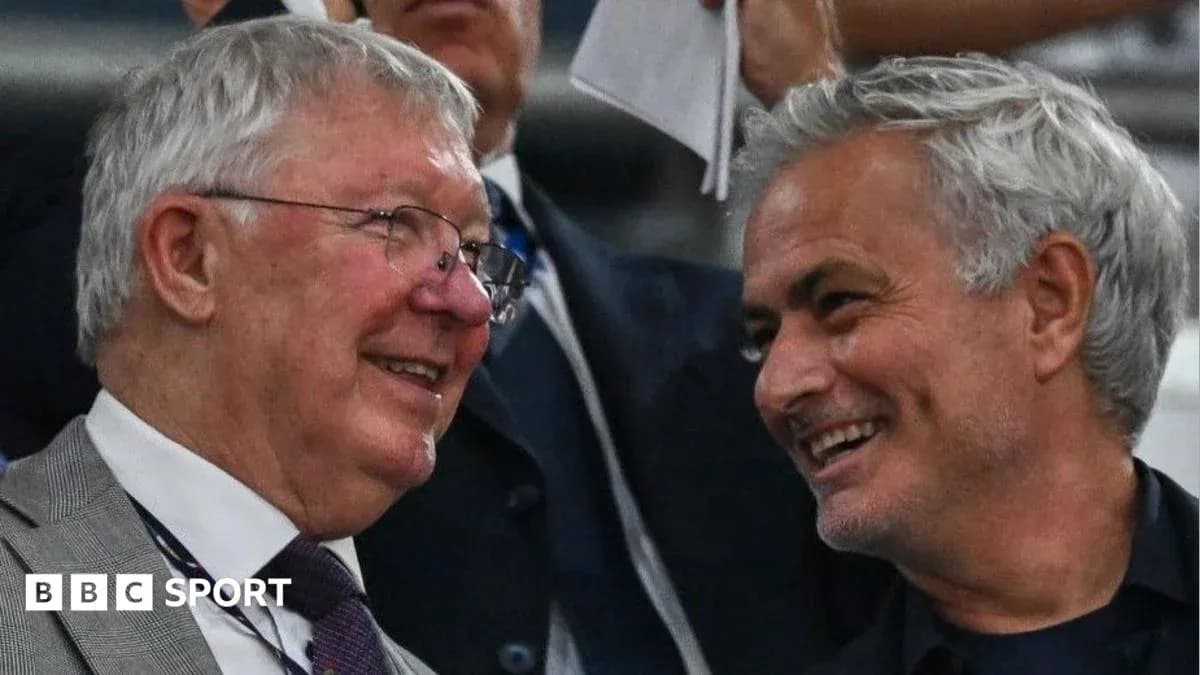
The Sliding Doors Moment in Manchester United’s History
There is a moment in Manchester United’s modern history that never actually happened, yet still shapes everything that came after.
Inside Old Trafford they call it a “sliding doors” day. The moment Jose Mourinho said no.
The deal that was done – until it wasn’t
In 2013, as Sir Alex Ferguson prepared to step away from the dugout he had ruled for 26 years, United believed they had secured the one manager with the ego, the edge and the experience to walk straight into the void.
Mourinho.
This wasn’t some vague flirtation. It was advanced. It was real.
Meetings took place in Madrid and London. Ferguson, who had long admired Mourinho’s charisma and ferocity, stunned the Portuguese by revealing he would retire at the end of the 2012-13 season. The conversation quickly moved from shock to succession. From emotion to terms.
Negotiations accelerated. Agreement was reached. The club thought it was done.
Then, within days, it wasn’t.
Ferguson recalls the pivotal phone call in the new Netflix documentary on Mourinho’s career, released on 11 August. One night, Mourinho rang him in tears.
“Alex, I can’t take it. I’ve given my word to Chelsea and I’m not going to break my word.”
In that instant, United’s future bent in a different direction.
Family, Abramovich and lingering doubts
Mourinho cited family reasons. He had a home in London. He had promised, when he was first sacked by Chelsea in 2007, that he would return. His children were settled. Life was there, not in Manchester.
He also enjoyed a strong relationship with Roman Abramovich. Stamford Bridge was familiar ground, a place where he knew the politics, the corridors, the power lines.
Some inside United remain unconvinced family was the whole story. But the outcome was the same. The man they believed would carry the Ferguson era into something new walked away.
Inside the club, it is still viewed as a turning point.
A giant leaves, and the wrong successor follows
Ferguson did not leave alone. Chief executive David Gill, hugely respected and deeply embedded in the club’s football and commercial operations, departed in the same summer.
United were not simply replacing a manager. They were dismantling an entire power structure built around one man who controlled almost everything on the football side. Scouting, contracts, dressing-room authority, long-term planning – all of it had run through Ferguson.
Senior figures felt they needed a new model, a different structure, and they needed to introduce it while still winning.
Mourinho, with his broad shoulders and proven record of handling big clubs and big egos, was seen as the ideal bridge between eras. A man who would not be intimidated by Ferguson’s shadow, but would challenge it.
When he pulled out, the plan collapsed.
With Mourinho gone and Pep Guardiola already committed to Bayern Munich, United pivoted to David Moyes.
Moyes shared some of Ferguson’s traits – hard-working, detail-driven, a builder of teams. But he had never operated at the elite level. He arrived from Everton, not Real Madrid or Inter. United announced him as “The Chosen One”.
He just wasn’t.
The fall from champions to seventh the following season was brutal, unexpected and, for many of the players involved, still difficult to fully explain.
When Mourinho finally came – too late
Mourinho did eventually walk through the doors at Old Trafford, but by then the landscape had changed.
In 2016 he replaced Louis van Gaal, who was dismissed 48 hours after winning the FA Cup against Crystal Palace. On paper, United were getting the man they had wanted three years earlier. In reality, both Mourinho and the club were different.
Of the 18 players who had started 10 or more Premier League games in Ferguson’s 2012-13 title-winning side, only six did so in Mourinho’s first season: David de Gea, Phil Jones, Wayne Rooney, Chris Smalling, Michael Carrick and Antonio Valencia.
The dressing room that Mourinho inherited bore little resemblance to the hardened, title-winning group Ferguson left behind. The spine had aged, moved on, or lost its edge.
Mourinho himself had shifted too. He had returned to Chelsea and won another Premier League title, only to depart in December 2015 with the club 16th in the table, one point above the relegation zone, his reign ending amid acrimony and exhaustion.
At United, his time still divides opinion.
On one hand, he delivered the Europa League and EFL Cup in his first season, and twice secured Champions League qualification. He points to finishing second in 2017-18 – 19 points behind Manchester City – as one of the “best achievements” of his career. The 81 points United collected that season remain, by a distance, their highest total in the post-Ferguson Premier League years.
On the other hand, the mood turned toxic. He clashed with players, most notably record signing Paul Pogba. He publicly questioned the club’s ambition and recruitment, furious that the hierarchy would not back his wish to sell Anthony Martial. The football grew turgid. The atmosphere soured. He left a club that felt fractured.
The great what if
Inside United, a belief has hardened: Mourinho would have been far more effective had he taken over directly from Ferguson.
For a start, his personality. He would have walked into that office believing he could improve on Ferguson, not just survive him. That mindset matters when you’re inheriting a champion.
In the transfer market, where Moyes hesitated, Mourinho would have driven. Hard.
Sources insist Thiago Alcantara’s agreed move from Barcelona would have gone through under Mourinho. The midfielder, then one of Europe’s most coveted young players, slipped away in the confusion of the summer of 2013.
The Marouane Fellaini saga would not have happened either. United ended up paying £27.5m for the Belgian on deadline day, after failing to trigger a lower release clause earlier in the window. Those close to the situation are adamant: under Mourinho, Fellaini simply would not have been signed.
Mourinho had already given United his views on a range of potential recruits, including Italy midfielder Daniele de Rossi. The sense is not just that he would have brought in his own men, but that he would have extracted more from the experienced core he was inheriting.
No-one could have squeezed more from Ferguson’s final title-winning squad than Ferguson himself; most accept that now. They overperformed. But the sudden collapse to seventh was still startling.
Many of those players have struggled to pinpoint exactly why standards slipped so dramatically. The enduring belief at Old Trafford is that Mourinho’s presence – his intensity, his demands, his sheer force of will – would have kept them sharper, longer.
Tears, regret and a lingering wound
In the documentary, Ferguson speaks with clarity about Mourinho’s phone call, about the tears and the explanation. You can hear, even now, the weight of that moment.
For a brief window in 2013, Manchester United thought they had their man. The manager to lead them out of the Ferguson era without flinching.
He chose Chelsea.
The consequences of that decision still echo around Old Trafford. The club has cycled through managers, philosophies and sporting structures, searching for a new identity that once seemed guaranteed.
The sliding door closed that night on Ferguson’s phone. The question, more than a decade on, is whether United have ever truly found another one to walk through.