Sabah FA vs Hapoel Beer Sheva: Champions League Play-offs Showdown
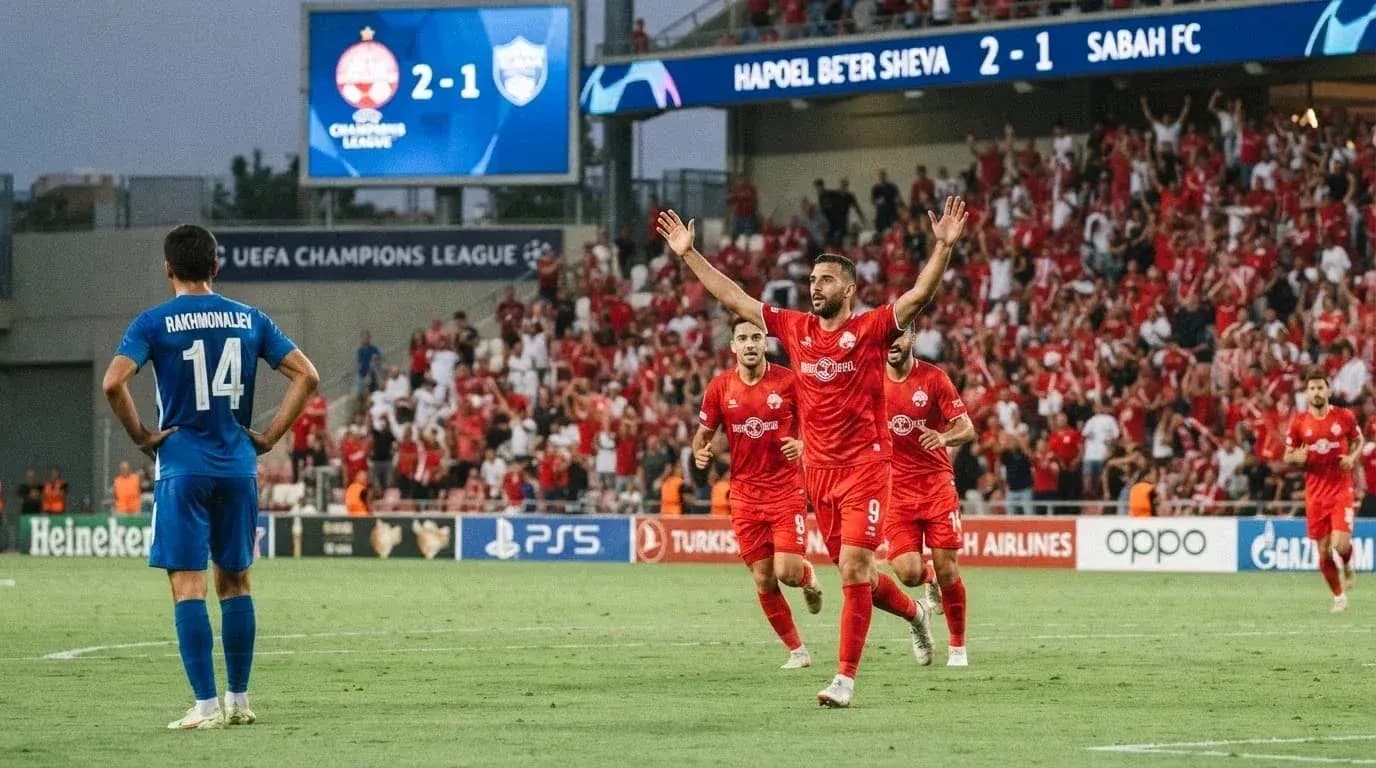
Sabah FA host Hapoel Beer Sheva at the Tofiq Bahramov Stadium in Baku in a UEFA Champions League Play-offs tie that will heavily shape both clubs’ seasons: progression here opens the door to the main competition and its financial and sporting uplift, while elimination would immediately reset ambitions down to secondary European targets.
Head-to-Head Tactical Summary
The only recent meeting came in the first leg of this Play-offs tie on 19 August 2026 at the Superbet Arena - Giulesti in Bucharest, where Hapoel Beer Sheva, as the home side, beat Sabah FA 2-1. The half-time score was 1-1 before Hapoel Beer Sheva edged the second half to take a one-goal aggregate advantage into this return match in Baku.
Global Season Picture
- League Phase Performance: There is no standings data available for either side in the current Champions League cycle, so their league-phase goals for, goals against and points cannot be quantified from the snapshot.
- Season Metrics: In the league phase, Sabah FA have played 7 matches, winning 5 and losing 2, with 13 goals scored and 5 conceded. They are strong at home, with 7 goals scored and none conceded across 3 home games, and they have yet to fail to score in any match. Their preferred setups are 4-2-3-1 (used 6 times) and 4-3-3 (once). Discipline-wise, their yellow cards are spread through the middle phases of games, and they have received a late red card once in added time. Hapoel Beer Sheva have played 5 matches, winning 4 and losing 1, scoring 8 and conceding 3. They are efficient at home (5 scored, 1 conceded in 3 games) and solid away (3 scored, 2 conceded in 2 games), also scoring in every outing. They consistently line up in a 4-3-3 and have a relatively clean defensive record, though they have had one red card in the mid-second-half window.
- Form Trajectory: Sabah FA’s form string of WWWWLWL indicates a strong opening run of four straight wins, followed by a loss, another win, and then a further loss, suggesting high ceiling but some volatility under pressure. Hapoel Beer Sheva’s form of LWWWW shows a poor start followed by a four-match winning streak, pointing to a team that has corrected early issues and is now on an upward trajectory coming into this decisive Play-offs leg.
Tactical Efficiency
Sabah FA’s attacking profile in this Champions League campaign is assertive: 13 goals in 7 matches (1.9 per game) and no games without scoring underline a front line that consistently creates and converts chances, particularly at home where they average 2.3 goals and have yet to concede. Defensively, conceding only 5 in 7 (0.7 per game) and keeping 4 clean sheets shows good structural balance, though both defeats have come away, where they are more vulnerable.
Hapoel Beer Sheva, with 8 goals in 5 matches (1.6 per game), are slightly less prolific but comparably efficient; they maintain scoring output both home and away and have 3 clean sheets, conceding just 3 goals overall (0.6 per game). Their single defeat came away from home, indicating that while their defensive block travels reasonably well, it is not entirely risk-free under pressure.
In comparative terms, Sabah FA’s attacking efficiency is built on volume and dominance in home fixtures, while Hapoel Beer Sheva rely on a more controlled, balanced approach, leveraging a compact defence and a stable 4-3-3 structure. With Sabah needing to overturn a 2-1 deficit, the home side are likely to push their high-output attacking game, which will test Hapoel Beer Sheva’s ability to maintain their low-concession trend under sustained pressure.
The Verdict: Seasonal Impact
This Play-offs second leg is season-defining for both clubs. For Sabah FA, overturning the 2-1 first-leg deficit in Baku would elevate them into the Champions League proper, massively boosting revenue, visibility, and their ability to attract higher-calibre players; failure would likely confine their European season to a lower-tier competition and reframe the campaign as one of domestic consolidation rather than continental breakthrough. For Hapoel Beer Sheva, protecting or extending their narrow advantage would confirm their recent form surge and secure another group-stage appearance, reinforcing their status as a regular European presence. A collapse, by contrast, would turn a promising run of wins into a missed opportunity, forcing them to reset expectations toward domestic honours and potentially a secondary European route. The aggregate outcome here will therefore act as a hard pivot point for both clubs’ 2026 trajectories, determining whether this season is remembered for a Champions League step forward or for a near-miss at the final qualifying hurdle.