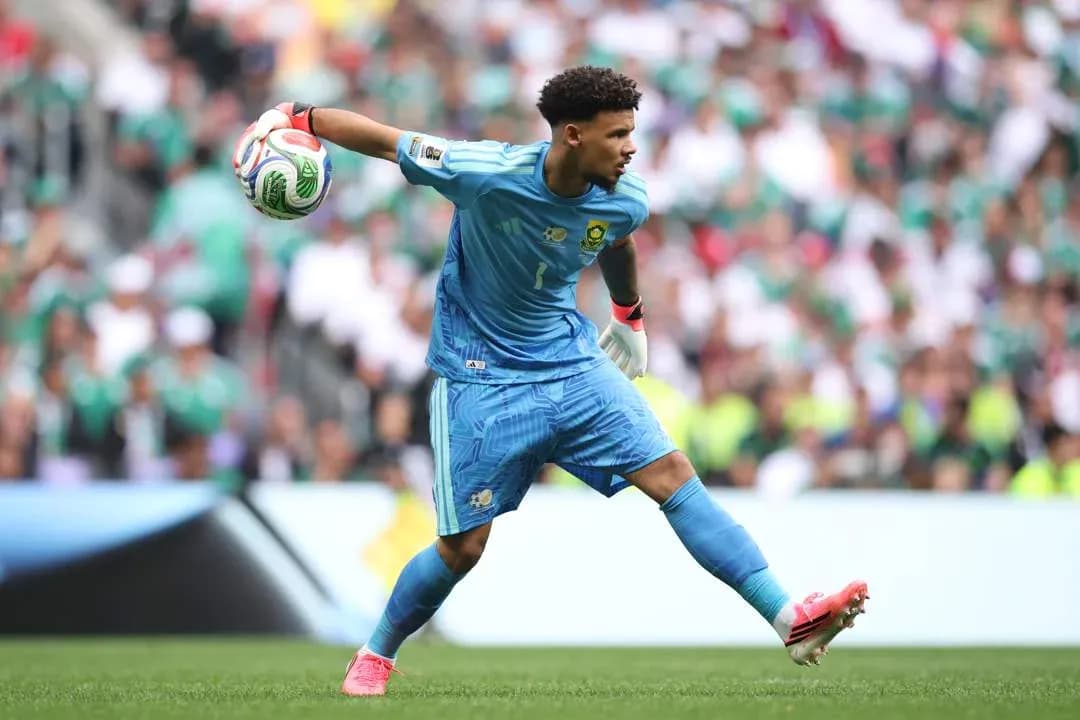
Ronwen Williams Faces Online Abuse Ahead of World Cup Clash
Ronwen Williams stands in the eye of the storm, and he knows exactly where the blows are coming from.
Not from Mexico. Not from Czechia. From home – and from a continent wrestling with South Africa’s politics while its national team tries to chase a World Cup dream.
A captain under fire
On the eve of Bafana Bafana’s crucial 2026 FIFA World Cup Group A clash against Czechia in Atlanta, Williams cut a calm but wounded figure as he spoke about the torrent of online abuse that has followed him and his teammates since the tournament began.
“We know how difficult it is now on social media, where everyone is attacking you,” he said. “Sometimes it’s (because of) false information.”
The criticism after the 2-0 defeat to Mexico at Azteca Stadium was expected. The hatred that followed was not.
FIFA’s social media protection service has flagged unprecedented levels of abuse directed at Bafana players since the opening week of the tournament. The number of incidents logged at this World Cup has already passed the total recorded in Qatar four years ago – and the group stage is barely underway.
Williams has become one of the main targets, a lightning rod for anger from two directions: South Africans furious with the team’s poor start, and Africans across the continent enraged by South Africa’s hardening anti-immigrant posture.
Politics at Bafana’s doorstep
This World Cup was supposed to be a full-circle moment for a generation that watched the 2010 showpiece on home soil as kids. Instead, their campaign has been dragged into the middle of a national political fight.
The rise of the vigilante group March and March – which brands itself “a grassroots citizen movement” against undocumented immigration – has poured fuel on an already volatile issue. Their rhetoric has grown so loud that President Cyril Ramaphosa felt compelled to address the nation on border control, while the group set 30 June as a deadline for undocumented migrants to leave the country.
They have not spelled out what comes after that date, but the tone and imagery from their marches have stoked fears of violence.
The backlash has not stopped at South Africa’s borders. Across the continent, some supporters are “hate watching” Bafana, cheering on their opponents as a form of protest. Governments have opened facilities for voluntary repatriations. Online, the anger has curdled into abuse aimed at the national team.
Then came the fake quote.
A fabricated statement, falsely attributed to Williams and picked up by reputable publications, claimed he had criticised Africans who backed Mexico over Bafana and said the team had “almost shed a tear” over that support. It was pure invention – but it spread fast.
“I have been a target over the last few days over things I didn’t say,” Williams explained. “I didn’t say anything about Africa, or people supporting Mexico. I have always said that as Africa, we are one. We support each other in good and bad moments.”
The damage, though, was already done.
Old wounds, new stage
This is not the first time South Africa’s politics have bled into Bafana’s world.
In 2019, xenophobic attacks in the country led Madagascar and Zambia to pull out of planned friendlies against Bafana. Coach Molefi Ntseki, newly appointed after Stuart Baxter’s departure, was left to start the 2021 Africa Cup of Nations qualifying campaign without proper preparation. Bafana failed to qualify, finishing third in a group with Ghana, Sudan, and São Tomé and Príncipe.
Six years on, the pattern has returned in a different form. The target is no longer the fixtures list. It is the players themselves.
“Players are human beings as well. We go through it. Sometimes it gets a lot,” Williams said. “You want to focus on doing your job, which is being a footballer, but then you get involved in politics even though you don’t want to get into that space.”
The timing is cruel. On Thursday, Bafana face Czechia at Atlanta Stadium in a match that could shape the entire complexion of Group A. The top two in each group go straight through to the last 32, while eight of the best third-placed teams from 12 groups will also advance. Every point, every goal, every moment now matters.
And all of it unfolds on the International Day for Countering Hate Speech, a bitterly ironic backdrop given what Bafana have endured online.
Blocking out the noise
Inside the camp, the players have confronted the abuse head-on. Meetings have been held. Strategies discussed. Acceptance, Williams admitted, has become a coping mechanism.
“As sad as this sounds, players have accepted it (the online abuse), that that’s how things are in the world now,” he said.
The anchor in the chaos is coach Hugo Broos.
“You have an experienced coach in coach Hugo, who says that the most important thing is to analyse the game,” Williams added. “That is the most important thing, to block out the noise, focus on how we can do better, learn from our mistakes and just stick together as a team.”
The message is simple: listen to the man in charge, not the millions on their phones.
“If you are going to listen to a million people’s opinions, then you will lose your mind,” Williams said. “At this moment, the most important comment and the person to listen to is our coach and technical team. He knows us, and we know him. He knows our strengths and weaknesses.”
Football’s fragile sanctuary
For a few hours in Atlanta, football still offers a kind of refuge.
“We are in Atlanta now, and I see so many Africans... so many South Africans and people from Mexico, in one room. That’s the beauty of sport. That’s the beauty of football,” Williams reflected.
It is a reminder of what this was all supposed to be about: a continent converging on a global stage, a generation of South African players finally stepping into the tournament they once watched as starry-eyed kids.
Williams is not asking for immunity from criticism. He is asking for a line.
“Criticise [us] for what happens on the field, but off the field things – we can’t deal with that, and it has nothing to do with us,” he said. “As Africans, let’s unite and keep going because we are all in this together.”
The reality, though, is stark. The path Bafana take from here – whether they claw their way into the knockouts or limp out early – will depend not only on tactics and finishing, but on how this squad absorbs the hatred hurled at them from the stands, from timelines, from home.
Inside the dressing room, Williams insists the bond is holding.
“We are there for one another. We came here together, and we will leave here together. So, let us stick together as a team and keep the focus.”
On Thursday in Atlanta, the noise will be deafening again. The question is whether Bafana Bafana can finally make the loudest answer come from their football.