
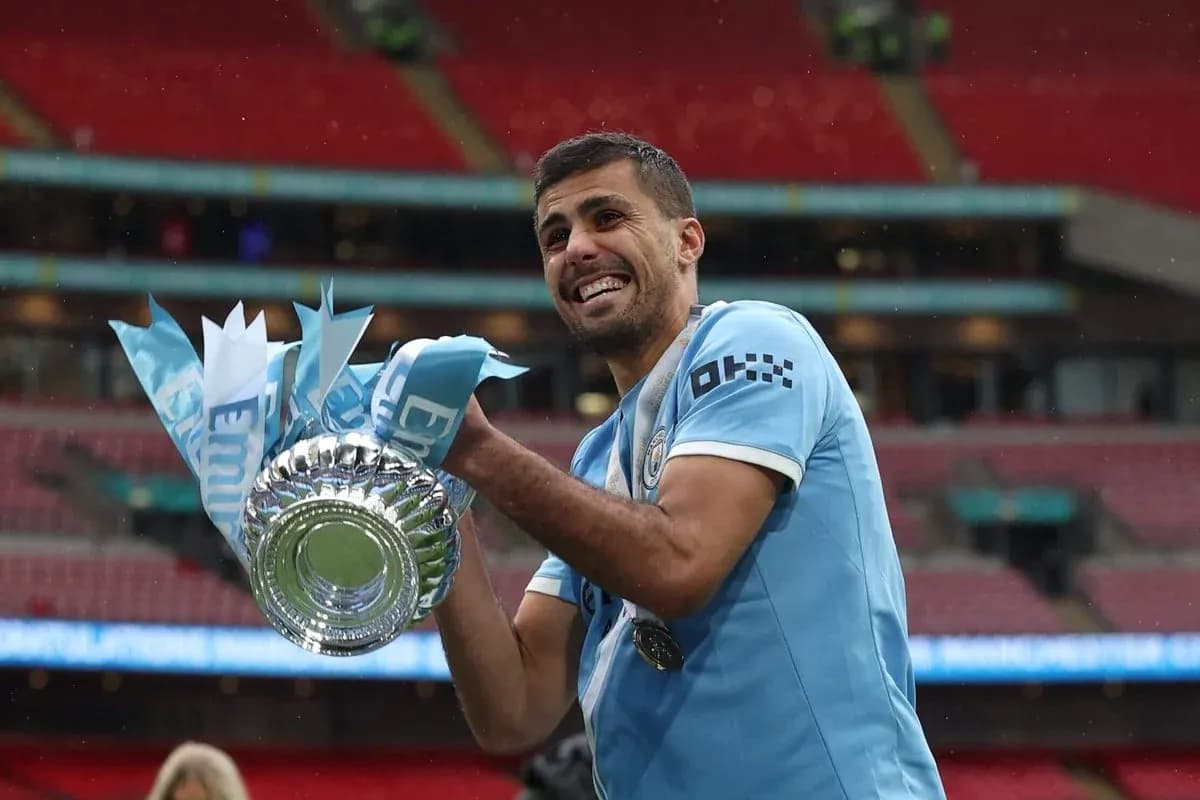
Real Madrid's Bold Move for Rodri: A High-Stakes Gamble
Real Madrid have set their sights on Manchester City’s metronome. Rodri, the heartbeat of City’s greatest side and Spain’s World Cup-winning captain, is now at the centre of a bold, late-prime move that could reshape two dressing rooms at once.
There are no club-to-club talks yet. No fee agreed. No dramatic breakthrough meeting. But in Madrid, the working assumption is simple: Rodri will be a Real Madrid player this summer.
Inside the Bernabéu, that represents a sharp U-turn. All summer, senior figures at the club had insisted Rodri was not on the agenda. Age profile, injury history, cost – the usual red flags. His name was parked.
Then came the World Cup.
Rodri owned the tournament. He started and captained Spain in all eight games, drove Luis de la Fuente’s side to a second straight major title after Euro 2024, and walked away with the Golden Ball after beating Argentina in the final. For Madrid’s hierarchy, that was the tipping point. The doubts over his physical level eased; the lure of signing the world’s standout midfielder hardened.
Now they are operating as if the deal will happen.
Madrid break their own rules
For Florentino Pérez and José Ángel Sánchez, Rodri is precisely the kind of signing they have spent the last decade avoiding: a 30-year-old, hugely expensive, with a significant recent injury record.
He missed most of the 2024-25 season with an ACL injury, then endured hamstring and groin problems during 2025-26. He still managed 33 appearances across competitions, but the clean, relentless availability that once defined him has gone.
Madrid know all of this. They are pushing on anyway.
The upside is obvious. They would be landing the 2024 Ballon d’Or winner, a four-time Premier League champion, the scorer of the goal that delivered City’s first Champions League in 2023, and the central figure in Spain’s back-to-back triumphs. A midfielder with 298 City appearances, 28 goals and 32 assists, who has spent seven years dictating the rhythm of one of the world’s most sophisticated sides.
He would walk into a Real Madrid squad that has been crying out for exactly his profile: a deep-lying organiser who offers balance, security and a sense of control in games that tilt towards chaos.
Even José Mourinho, who has not explicitly demanded Rodri, has long pushed for another high-level midfielder. Slotting Rodri into that structure is easy to imagine. The ball would move cleaner. The spaces would feel smaller for opponents. The team would gain a calmer pulse.
And then there is the dressing room.
For two seasons, Madrid’s internal atmosphere has been a concern. Friction, egos, and a sense that the collective edge has dulled. Rodri arrives with the reputation of a grown-up: serious, driven, and steeped in elite standards. His leadership for Spain, his consistency for City, and his work ethic all point to a player who would carry weight the moment he walks through the door.
For the fans, this is the signing they have been shouting for. They wanted the world’s best pivot. They wanted the World Cup’s standout player. They wanted a statement that Madrid still take the very best from England’s elite. Rodri ticks every box.
It is not risk-free. But Madrid have decided the reward is worth testing their own transfer principles.
A dream long in the making
For Rodri, this is not a sudden twist. It is the route he has quietly been plotting for years.
He has never hidden his desire to return to Spain during his career, or the particular pull of Madrid. During the March international break, he laid it out plainly.
“Would I like to play in Spain again, in La Liga, in Madrid? I would like to return, yes, obviously,” he said. “Having played for Atletico before would not prevent me from playing for Real Madrid … there are other players who have done that before. Maybe not direct transfers, but eventually. “You can’t turn down one of the world’s best clubs.”
The Atletico past, then, is no barrier in his mind. Nor is the emotional weight of leaving a City side he has helped to define. The idea of finishing his peak years in white, at the Bernabéu, has been a long-term aim.
There is one complication: his body.
Rodri is about to undergo back surgery, with no firm date for his return. City’s new head coach Enzo Maresca, speaking at his first press conference, tried to play down the noise.
“Around big players there is always speculation. I’m not worried about that. I think it’s normal,” he said. “Also because they won the World Cup, he was the best player or one of the best players. Every manager wants to have Rodri because he’s a top player.
“But now surgery on I think Monday. He needs holiday. He needs to rest. He needs to recover and then he will be back here with us.”
Madrid, clearly, are betting that “back here with us” will soon mean Valdebebas, not Manchester.
City lose their reference point
For Manchester City, the prospect of losing Rodri is nothing short of a structural problem.
The club have been trying to extend his contract for more than a year. They never wanted to reach this point: the final year of a deal that runs to 2027, with their most important outfield player unconvinced about committing his prime to a post-Pep project.
His reluctance to sign fresh terms has been a warning light. Those inside the club knew a move this summer was possible. They just hoped the Madrid door would stay closed.
It has not. And now, with Pep Guardiola gone after a decade and Maresca stepping in, City face the real possibility of losing the man who has been their on-pitch compass.
John Stones and Bernardo Silva have already departed at the end of their contracts, with Bernardo also heading to Madrid. The spine that carried City through so many title races is being stripped away, piece by piece.
Rodri’s absence hits differently. When he plays, City are smoother, braver, more secure. That has remained true even since his ACL layoff, when he was still short of his old level. When he does not, the entire shape of the team changes.
City have tried to get ahead of the problem. Elliot Anderson has arrived from Nottingham Forest in a £116million deal, a huge show of faith in a young midfielder. They are also pushing to sign 18-year-old Morocco international Ayyoub Bouaddi from Lille, who impressed at the World Cup.
Those are moves for the future. Rodri is the present.
Nico Gonzalez’s emergence late in 2025 offered a glimpse of life after him, with City finding form without their usual anchor. But Nico’s own future is uncertain after being gradually overlooked by Guardiola. Maresca must now solve a puzzle that even his predecessor struggled to crack: how to keep City’s dominance intact without the player who knits everything together.
A split in Manchester, a surge in Madrid
Among City supporters, the reaction is already divided.
Some accept that a player who has given seven outstanding years, won everything, and dreamed of Madrid has earned the right to go. They will be disappointed, but they will wish him well.
Others will see it as a betrayal layered on top of an old grievance. Madrid’s reaction to Rodri winning the 2024 Ballon d’Or ahead of Vinícius Júnior – and the noise around that decision – has not been forgotten. To then lose Rodri to the same club will sting.
Those arguments will rage on long after the ink dries, if it ever does.
In Madrid, the mood is very different. After years of building around youth, of waiting for the perfect opportunity, they are on the verge of landing a ready-made leader in the position that defines modern football. A player who has just conquered the world with Spain, who has long wanted this move, who brings both medals and scars.
It is a gamble on mileage, on medical reports, on the idea that one more big engine can be bolted into a squad already packed with stars.
If it comes off, Real Madrid will have stolen the pivot of the Premier League’s era-defining team and dropped him into their own. If it doesn’t, they will be left holding a costly symbol of a risk that went against their own rules.
Either way, the next phase of Rodri’s career is about to tell us something important: not just about him, but about where the balance of power in European football truly lies.




