
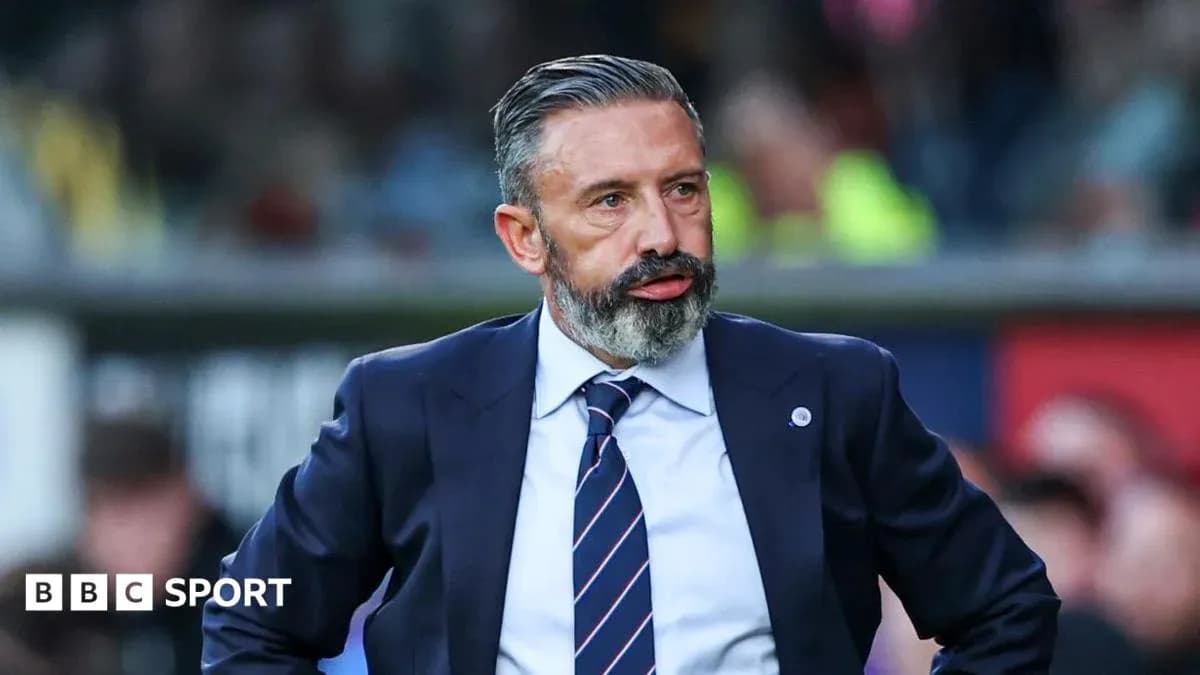
Rangers' Stuttering Start Under Derek McInnes
Derek McInnes walked into Tannadice knowing all about the weight of an opening day. He has lived them, won them, lost them. This one, his first as Rangers manager, ended with a familiar scoreline and a very different mood.
A year ago, Russell Martin tore into his Rangers side after a draw at Motherwell. On Friday night, McInnes kept his voice level after a 1-1 stalemate with Dundee United. The frustration was obvious, but so was the message: this is going to take time.
A stuttering start to a new era
Rangers were second best for long spells in the first half. Disjointed, stretched, lacking control. The kind of performance that tells you more about what a team is missing than what it already has.
Lachlan Rose punished them. Dundee United’s forward struck in the first half, and the goal felt like the natural conclusion to a period where the home side played with more cohesion and bite. Rangers’ back line, with debutant Ivor Pandur behind them and Ben Godfrey at its heart, never looked settled.
McInnes’ side did improve after the break. They had to. The tempo lifted, the passes sharpened, and Thelo Aasgaard dragged them level with a well-taken equaliser that briefly hinted at a turnaround. For a spell, Rangers pinned Dundee United back and began to look like a side with serious ambitions again.
The pressure should have turned into a winner. It didn’t.
Instead, Rangers almost lost it at the death, spared only when Jesse Randall’s dinked finish lacked conviction and fell straight into Pandur’s grateful gloves. On another night, that goes in and the post-match tone is far more severe.
McInnes did not sugarcoat it.
"It's disappointing - we've dropped a couple of points, but we weren't good enough to get all three," he said. One game in, and already there was a clear demand: do the basics better, trust the process, stay at the task.
Early judgments kept in check
If the wider support will not be patient forever, some of those watching urged calm.
Former Rangers striker Steven Thompson echoed McInnes’ measured stance, pointing to the venue and the timing. A point away from home at a difficult ground, he argued, is not a crisis in August. Other sides will suffer here. This is not the night to make sweeping calls on a manager who has barely had time to learn everyone’s names, never mind reshape a squad.
Andy Halliday, though, cut to the heart of the tactical issue. Shape. Distance. Compactness.
"No matter how many defenders you play with, the main fundamental is being compact, and I thought Rangers were the furthest thing from compact," he said. It was a blunt assessment, and hard to argue with. Dundee United’s best players, Halliday felt, outshone Rangers’ — Aasgaard aside.
That line will sting at Ibrox. It should.
A glimpse of the rebuild
This was not just a first game; it was a first look at McInnes’ version of Rangers.
Pandur in goal. Godfrey at centre-back. Cammy Devlin snapping into midfield challenges. Lawrence Shankland leading the line. All starting. All charged with setting a new tone. Off the bench came Dan Neil and Ross McCrorie, more fresh pieces in a squad being retooled on the fly.
There were flashes of what this team might become: more aggressive, more direct, more willing to press high and commit bodies forward. But those flashes were buried inside long, uneven stretches where the structure frayed and Dundee United found too much space.
To make matters worse, Godfrey departed with a hamstring issue, adding another problem to a defensive department already under scrutiny. There is also uncertainty over whether Olwethu Makhanya will receive his visa in time for Thursday’s Europa League qualifier away to Jagiellonia Bialystok.
Rangers need defenders. They know it. Yet McInnes’ priority lies elsewhere.
Width wanted, urgently
The manager’s most pointed comments were about his wide players. Or lack of them.
Djeidi Gassama started on the left but lasted only 45 minutes. By the end, Mohamed Diomande and Aasgaard were operating in narrower roles, leaving Rangers without a natural winger to attack space on the flanks.
"I thought second half as the game got stretched, we had opportunities to play in the spaces and we need people with the ability to go past [defenders]," McInnes said. That was not a passing remark. It was a shopping list item spoken out loud.
"We still would like a winger to go get at people, make a difference and get people on the back foot. We never quite had that and we're working hard to bring those types of players to the club. Our strikers are all dependant on service. We're working hard and we know what we want."
The message is clear: Rangers’ forwards will not carry this team on their own. They need supply, pace, and directness from wide areas. Until that arrives, nights like this — where territory and possession don’t translate into enough clear chances — will remain a risk.
Work in progress, with no time to drift
Strip away the context and it is a flat start: a draw, a patchy performance, questions about fitness, structure and depth. Look a little closer and it is exactly what a “work in progress” looks like in real time.
New signings still bedding in. A manager trying to impose a different mentality and shape. A squad that, by his own admission, is not yet complete.
McInnes insisted he is “not really interested in what’s happened previously,” but he knows where he has walked into. At Rangers, patience is thin, expectation is heavy, and even early-season teething problems are examined under floodlights.
One game will not define his tenure. The next few weeks might.
Europa League qualifiers, transfer deadlines, domestic fixtures stacking up — the margin for error is already narrow. If this was the first glimpse of the new Rangers, the obvious question now is not whether they will improve.
It is how quickly they can turn those promises of evolution into results that match the demands of the badge.




