Rangers Fans Issue Warning to New Owners Amid Football Crisis
The warning landed long before the latest blow on the pitch.
At a recent Rangers shareholder meeting, one supporter stood up, took the microphone and cut straight through the corporate gloss. His message to the new US ownership was blunt.
Be careful. Loyalty has limits.
"If this rot continues, the atmosphere in the crowd will lead to people not turning up and buying what you're selling us," he told them, before handing the mic back. Around 800 fellow shareholders answered with loud applause. It was not a fringe view. It was the room.
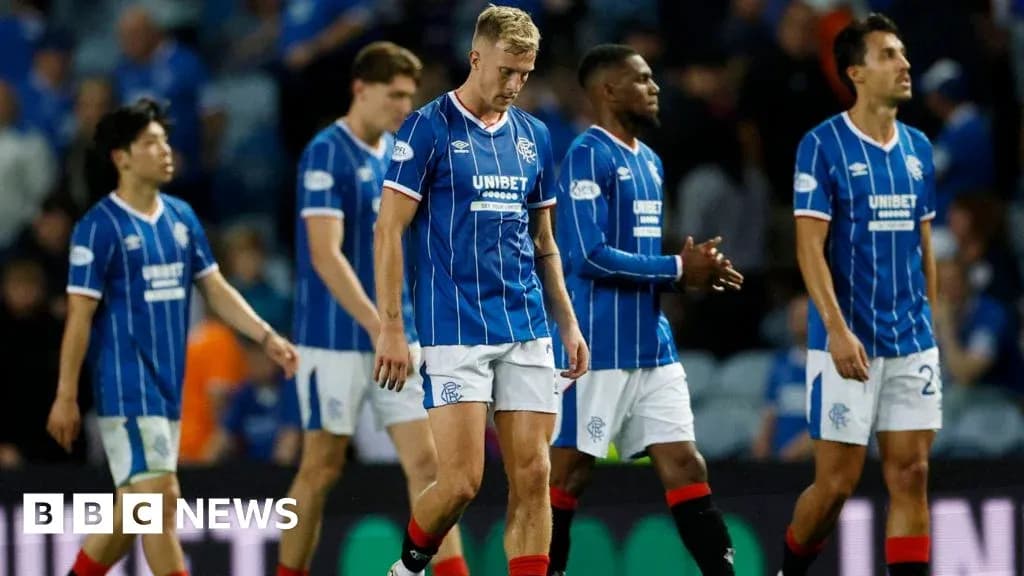
Four days later, those same fans watched Rangers stumble out of the Europa League with a 1-1 draw against Jagiellonia Bialystok at Ibrox. A draw that felt like a defeat. A night that crystallised a grim start under Derek McInnes.
Four games. Two draws. Two defeats. No momentum, no spark, no sense of a project catching light.
McInnes, the former Hearts manager, now has to solve the football side of the crisis. But in the background, the board has a different problem: keeping that shareholder’s warning from becoming reality.
Because if Rangers fans stop buying what this new consortium is selling, the numbers stop adding up very quickly.
Football failure, financial risk
The equation is brutally simple. A failing team drains belief. Drained belief hits attendance, merchandise, hospitality, everything. And in a Scottish football landscape where margins are already tight, that can be fatal to ambition.
Rangers know this story. Previous regimes discovered, at huge cost, how quickly confidence can collapse and how hard it is to win it back. The current owners cannot claim ignorance.
Winning breeds confidence. Confidence brings cash. Strip away the emotion and the business model for Scotland’s biggest clubs leans heavily on two pillars: European participation and player trading.
Over the past five years, Rangers have banked roughly £18m from European competition alone, excluding matchday income. In their last accounts, that was about 19% of total turnover. A huge slice of the pie.
To get close to that kind of European money this season, they would now have to win the Europa Conference League. That’s the scale of the hit.
Kieran Maguire from the Price of Football website spells out the hierarchy. For every pound a club earns in the Conference League, they can make £2 in the Europa League and £7 in the Champions League. The gulf is vast.
There’s also the blunt reality of fewer home games. Three in the Conference League group stage instead of four in the Europa League. That’s one less Ibrox night, one less gate, one less round of hospitality. One more dent in the budget.
The one crumb of comfort? At Conference League level, progression should, in theory, be more attainable. But Rangers have to get there first.
They must still get past Czech side Jablonec over two legs to even reach the league phase. Only then can they start talking about going deep into the tournament.
Even if they do, the club could still face a shortfall of around £8m in European income compared with recent seasons. For a mid-table Premier League side, that might be manageable. For Rangers, operating in the financial ecosystem of Scottish football, it bites hard.
Transfer market misfires
One obvious way to plug that gap is to sell players well. That has been a recurring weakness.
Reports suggest Rangers recently knocked back an offer in the region of £22m for striker Youssef Chermiti. Soon after, he suffered a serious injury that could keep him out for the rest of the season. A fee of that size would have gone a long way towards easing the pressure after the Europa League exit. Now it sits in the realm of what-might-have-been.
Behind Chermiti, Nico Raskin is widely seen as the next major asset. The Belgian midfielder carries an estimated value of around £14.5m, according to Transfermarkt. Cashing in on him would help the balance sheet, but it would also open a fresh footballing problem: finding a replacement of similar quality in a market where Rangers have already burned through significant sums.
That is where the recruitment question bites hardest. Over the past 12 months, more than twenty players have come through the door. The squad has been churned, retooled, reshaped. Yet the team on the pitch looks anything but stronger.
Supporters were told the recent £16m raised via a share issue would be used to make the team more competitive. Instead, they see a side that has crashed out of Europe early, looks disjointed and lacks identity. The disconnect between promise and product is growing.
Owners under scrutiny
Off the field, the spending plans keep stacking up. The club has laid out intentions to refurbish Ibrox and upgrade the training ground. Both projects carry significant cost and both will be judged against what fans see on the pitch every week.
The new consortium, many of whose members remain unnamed, put in an initial £20m when they took over a year ago. That injection bought time and optimism. It did not buy immunity from criticism.
Given the current trajectory, it looks increasingly likely those investors will have to reach into their pockets again before the year is out. Whether they are willing to do so, and on what terms, is now a live question.
Before any fresh money comes in, though, the club must convince its own support that the direction of travel is correct. That is the hard sell.
Inside Ibrox, the line is that recent poor results have not altered the long-term financial outlook or the commitment to “winning sustainably”. The strategy, they insist, remains intact.
But that shareholder’s warning still hangs in the air.
Yes, the owners have admitted to mistakes. They have apologised. Yet apologies only matter if they are followed by clear lessons and visible change. Fans are no longer content with statements; they want evidence.
Chris Jack of the Rangers Review summed up the mood to BBC Scotland News. The loyalty of Rangers fans, he said, is beyond question. It has been proven over decades, through crisis and recovery. But even that loyalty has a limit.
Every fan base has a breaking point.
There comes a day when a supporter looks at the fixture list and thinks: not this afternoon. Not like this. On that day, it is up to the club, the players and the manager to have already given them a reason to turn up.
Anger used to be the dominant emotion around Ibrox when things went wrong. Anger meant people still cared enough to shout. Now, in some corners, that anger is starting to slide into something more dangerous.
Apathy.
In football, apathy is not just a mood. It is a cost. A cost Rangers’ hierarchy, staring at lost European revenue, shaky transfer returns and rising bills, can no longer afford to ignore.