Olympiakos Piraeus vs NEC Nijmegen: Tactical Stalemate in UEFA Champions League
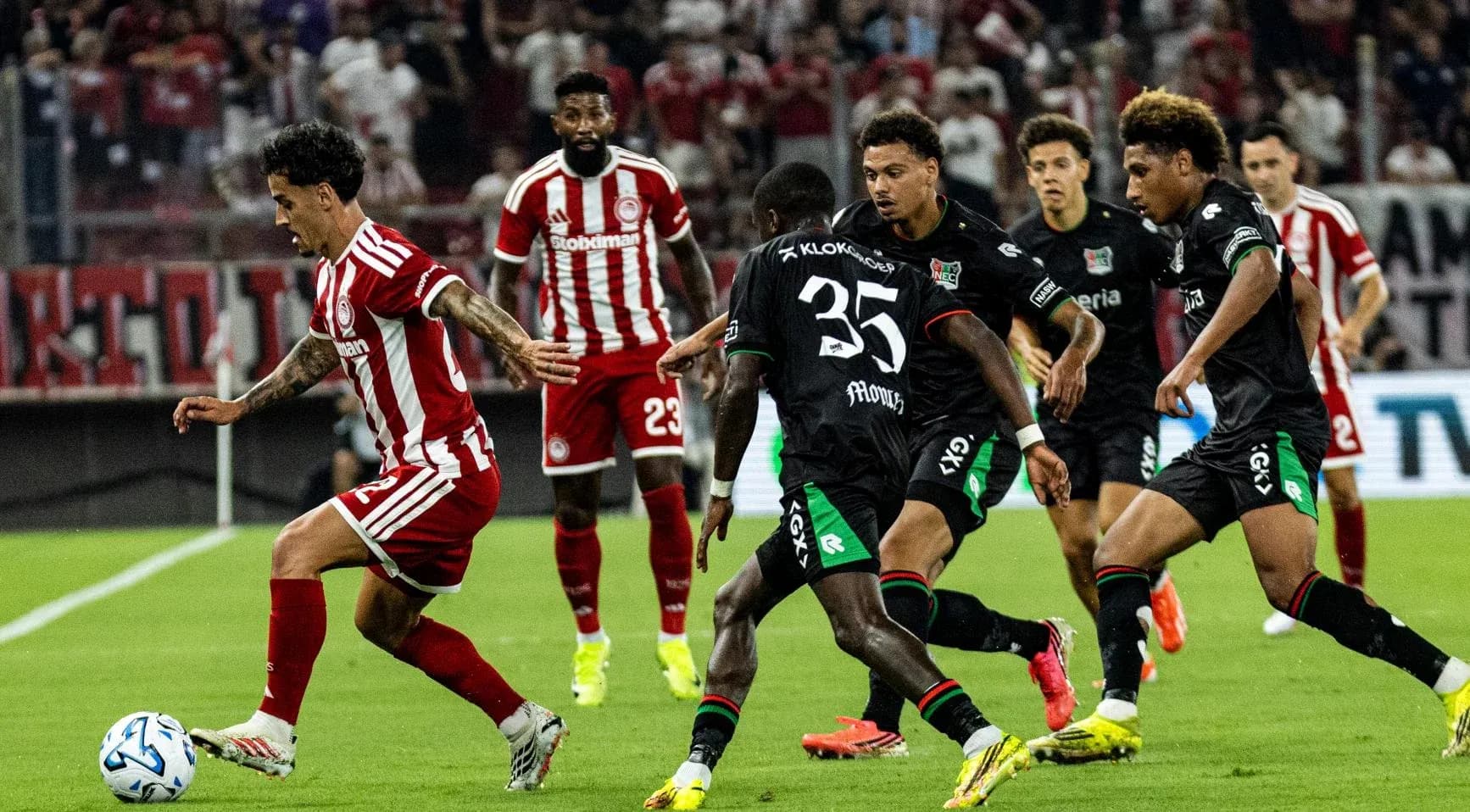
Olympiakos Piraeus and NEC Nijmegen produced a goalless but tactically dense contest at Georgios Karaiskakis Stadium in the 3rd Qualifying Round of the UEFA Champions League, finishing 0-0 after 90 minutes. Olympiakos had a slight edge in initiative and territory, reflected in their 54% possession and marginal shot advantage (12 total shots to 13, but 5 shots on goal to 4). NEC, in a 3-4-2-1, absorbed pressure with a compact back three and looked to break through their front line and wing-backs. Both teams’ structures were clear and stable; the stalemate came more from strong defensive organisation than attacking inefficiency.
Olympiakos lined up in a 4-2-3-1 under Luis Mendilibar Jose, with B. Popovic in goal behind a back four of M. Saliakas, P. Retsos, D. Carmo and B. Onyemaechi. The double pivot of D. Garcia and C. Mouzakitis provided the platform for a narrow, technically oriented band of three — Rodinei, Chiquinho and J. Roca — supporting lone striker A. El Kaabi. This shape aimed to dominate central spaces and half-spaces, using overlapping full-backs and the No. 10 zone to create overloads.
In contrast, Dick Schreuder’s NEC Nijmegen deployed a 3-4-2-1 with G. Crettaz in goal and a back three of T. Storm, P. Sandler and D. Fonville. The midfield four of S. Ouaissa, J. Monteiro, D. Nejasmic and C. Bischoff was tasked with both screening central areas and providing width, while N. Lebreton and B. Linssen operated as dual attacking midfielders behind T. Chery. This gave NEC strong central cover and the ability to quickly transition through the inside channels.
Olympiakos’ slight possession edge (54%) was built on a clear passing structure from the back. They completed 264 accurate passes from 394 attempts (67%), indicating a willingness to circulate under pressure but also some forced, higher-risk progression against NEC’s mid-block. The double pivot was crucial: D. Garcia, who later received a yellow card for “Foul”, anchored the circulation and provided cover when full-backs advanced. C. Mouzakitis offered vertical support, stepping into higher lines to connect with Chiquinho and J. Roca between the lines.
The 4-2-3-1 morphed into a 2-3-5 in sustained possession: both Saliakas and Onyemaechi pushed high, Rodinei often tucked inside from the right to create a three-man midfield with Garcia and Mouzakitis, while Roca and Chiquinho occupied the half-spaces. This helped Olympiakos generate 5 shots inside the box from their 12 attempts, but NEC’s central trio and back three blocked lanes effectively, limiting clear-cut chances and forcing 7 shots from outside the box.
NEC’s 3-4-2-1 was primarily about control of central zones and compactness. With 46% possession and 348 total passes (254 accurate, 73%), they were more efficient than Olympiakos in ball retention when they had it, but chose their moments carefully. The wing-backs, especially S. Ouaissa before his substitution, provided width, while D. Nejasmic and J. Monteiro formed a tight central screen in front of the back three. This structure allowed NEC to concede only 5 shots on goal despite spending more time without the ball.
In transition, NEC were dangerous enough to match and slightly surpass Olympiakos in total attempts (13 shots, with 7 inside the box). That inside-box figure points to a clear tactical pattern: NEC looked to break quickly into advanced central spaces once they had bypassed the first press, often through vertical passes into T. Chery or the two attacking midfielders. However, Olympiakos’ centre-backs, particularly D. Carmo before his substitution, were generally well-positioned to contest those entries, contributing to 4 of NEC’s shots being blocked.
The substitution pattern from Olympiakos underlined a desire to refresh the attacking line and maintain intensity rather than change the base structure. At 46', G. Martins (IN) came on for J. Roca (OUT), adding creativity and ball-carrying from advanced midfield zones. At 56', Jota Silva (IN) came on for Chiquinho (OUT), injecting more direct running, while L. Pirola (IN) came on for D. Carmo (OUT), a like-for-like change at left centre-back that preserved the back-four shape. One minute later, at 57', P. Maffeo (IN) came on for M. Saliakas (OUT), offering fresh legs and potentially more aggressive overlapping on the right. At 64', Z. Smajlovic (IN) came on for P. Retsos (OUT), again maintaining structural continuity in central defence.
NEC’s substitutions were similarly conservative in structural terms, focused on energy and profiles rather than system shifts. At 70', E. Mor (IN) came on for S. Ouaissa (OUT), bringing more dribbling threat and one‑v‑one ability from wide areas while keeping the wing-back line intact. Simultaneously, B. Pereira (IN) came on for T. Storm (OUT), a direct swap in the back three. At 74', D. Tadic (IN) came on for B. Linssen (OUT), refreshing one of the attacking midfield roles, and I. Hansen-Aaroen (IN) came on for P. Sandler (OUT), which required a redistribution in the back line and midfield but kept the 3-4-2-1 principles. Late on, at 90', W. T. Willumsson (IN) came on for J. Monteiro (OUT), adding a new central presence just as NEC looked to manage the final moments and potentially steal a late transition.
Discipline played a subtle tactical role. Olympiakos picked up two yellow cards, both for “Foul”: at 11', David Carmo (Olympiakos Piraeus) — Foul; and at 67', Dani García (Olympiakos Piraeus) — Foul. These early and mid-second-half cautions constrained their ability to defend aggressively in central zones, especially in transition, and may have influenced Mendilibar’s decision to replace Carmo at 56'. NEC received one booking: at 90+1', Willum Thor Willumsson (NEC Nijmegen) — Foul, reflecting a late-game intervention to break play and protect the draw.
Defensively, both goalkeepers were decisive within their frameworks. B. Popovic (Olympiakos Piraeus) made 4 saves, underpinning a back line that allowed 13 shots but kept most at manageable quality through good positioning and blocking (2 blocked shots by Olympiakos, 4 by NEC). G. Crettaz (NEC Nijmegen) made 5 saves, matching Olympiakos’ on‑target volume and justifying NEC’s compact, risk-averse approach away from home.
Statistically, the contest was finely balanced. Olympiakos’ higher volume of corners (5 to 2) reflected their territorial pressure and time spent in NEC’s third, but NEC’s superior passing accuracy and slightly higher shot count indicated that their transitions were efficient when they did break. Fouls were 11 for Olympiakos and 16 for NEC, consistent with NEC’s more reactive, disruptive role without the ball.
With expected goals and goals prevented data absent, the clearest verdict is territorial versus transitional balance. Olympiakos’ 4-2-3-1 provided control and sustained pressure but could not convert structural superiority into a breakthrough. NEC’s 3-4-2-1, with disciplined spacing and well-timed substitutions, successfully prioritised defensive stability and selective counter-attacks, making the 0-0 a fair tactical outcome and leaving the tie finely poised for the return leg.