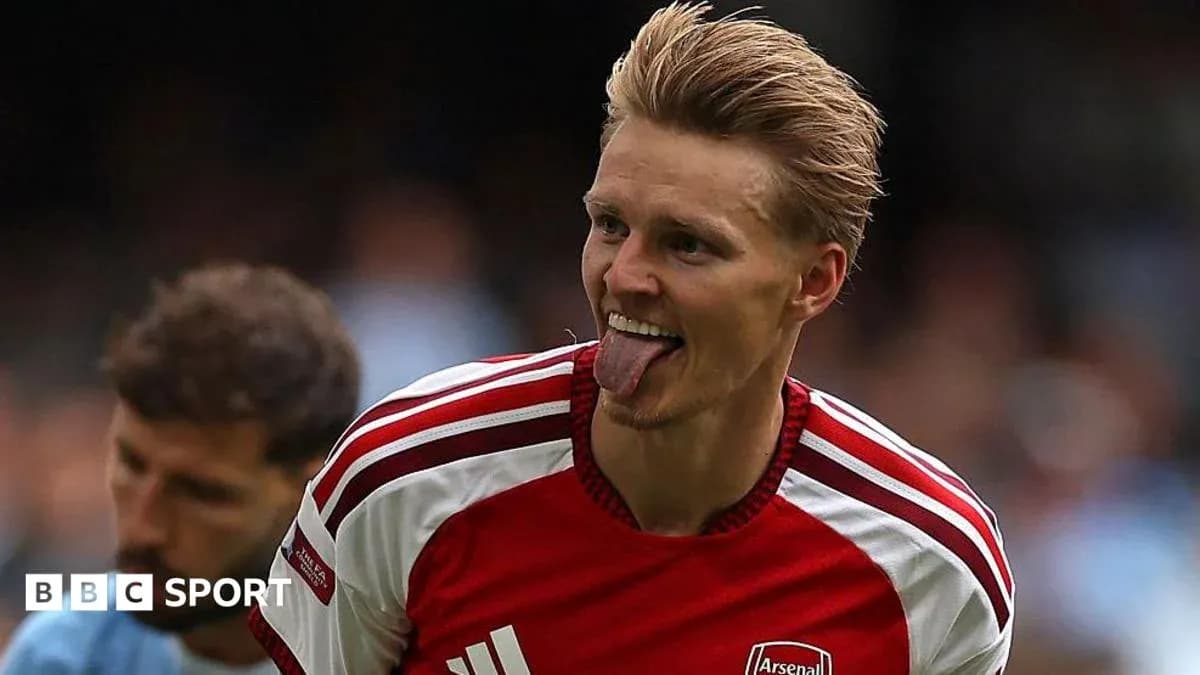
Martin Odegaard Shines in Community Shield Victory for Arsenal
Martin Odegaard walked off in Cardiff with the trophy in his hands and the man-of-the-match award to his name, but what really lingered was the feeling that Arsenal had just welcomed back an old star in something close to a new skin.
This 3-0 dismantling of Manchester City in the Community Shield was billed as a curtain-raiser. For Odegaard, it felt more like a re‑opening night.
Odegaard back on centre stage
Last season hurt him. Arsenal finally climbed the mountain and won the Premier League for the first time in 22 years, yet their Norwegian playmaker spent too much of it watching from the wrong side of the white line.
Knee problems. Shoulder issues. Stop-start, then stop again.
He started only 16 league games. One goal. Seven assists. For a player who arrived permanently from Real Madrid in 2021-22 and instantly became the side’s creative heartbeat, those were jarringly low numbers. His quietest campaign in an Arsenal shirt, right when the club roared the loudest.
On Sunday, he looked like a man intent on redressing that balance.
He knitted Arsenal’s play together, pressed relentlessly, demanded the ball in tight spaces and then, when the game was already leaning heavily Arsenal’s way, he produced the moment everyone will remember: a ruthless, almost cruel, third goal.
A feint, a dummy, Gianluigi Donnarumma sliding to the turf, the net bulging. City’s goalkeeper was left on the floor; Odegaard was back in the spotlight.
The captain under scrutiny
For all the admiration of his technique, last season raised awkward questions. The injuries denied him rhythm, but the inconsistency also sparked debate. Former players wondered aloud if he should be the captain of a side with such fierce ambitions.
Performances like this one in Cardiff are how you silence that kind of noise.
Among all Arsenal players on the pitch, Odegaard completed the most passes – 55 out of 58 – and did it with a calm authority that set the tempo. He completed all three of his dribbles. He won the ball back nine times, more than any of his team-mates.
Not just the artist, but the organiser and the hunter. The numbers simply backed up what the eye already knew: he dominated the game.
He admitted afterwards how draining last year had been. Missing “so many games” with what he described as “weird injuries” and “bad luck” left him deeply frustrated. For a footballer, he said, there is nothing worse than not being able to step onto the pitch.
So he clung to the positives. He finished the club season with a title. He then carried that momentum into the World Cup with Norway, starting five of their six matches and providing four assists. The confidence slowly returned. The body finally followed.
He took a break. He reset. Now he feels “ready to go again” – and on this evidence, he means it.
A new midfield, an old conductor
Arsenal have not stood still since lifting the league trophy. Mikel Arteta has gone straight for the jugular in midfield, adding £75m man Bruno Guimaraes to an area already crammed with talent.
Inside the dressing room, the competition has not gone unnoticed. Mikel Merino, one of the many options at Arteta’s disposal, has described Arsenal’s midfield group as “probably the best in football”.
Look at the list and it is hard to argue. Odegaard, Guimaraes, Myles Lewis-Skelly, Martin Zubimendi, Declan Rice, Eberechi Eze, Merino. Different profiles, different strengths, one shared problem for opponents: where on earth do you start trying to shut that down?
Guimaraes impressed in his 45 minutes on the pitch in Cardiff, but what really caught the eye was how naturally he seemed to mesh with Odegaard in their first start together. The understanding was raw, yet already promising. Passing angles opened up, pressing triggers were shared, the ball moved quicker.
Odegaard spoke about it in simple terms. Sometimes, he said, “you are just in the flow”. On Sunday, he felt it. So did his team-mates. “All of us were flowing pretty good out there,” he added, vowing simply to “keep that up and keep going.”
The pressure for places is real now. It might be exactly what Arsenal’s captain needs. When you know that one dip in level can see another elite midfielder step into your role, the margins tighten and the standards rise. Maybe that extra edge is what drags Odegaard to an even higher peak.
Arteta’s belief, Odegaard’s response
Arteta has never wavered in his belief in Odegaard’s importance to this project. He remembers clearly how crucial the Norwegian was at the start of Arsenal’s rejuvenation, when the club needed a new identity and a fresh voice on the pitch.
The manager also knows how brutal last season was for his captain. Odegaard missed “five or six months for different things”, as Arteta put it, and that made it “extremely difficult for him to get any momentum”.
The plan for this year is simple: keep him fit, keep him surrounded by top players, and let the football take care of the rest. Arteta is convinced that under those conditions, “we’re going to see a very different Martin”.
He has sensed something from the moment Odegaard walked back into pre-season training. A sharper edge. A point to prove. A desire, as Arteta framed it, “to show, because the team needs it as well.”
That hunger was written all over his performance in Cardiff. The sliding tackles. The quick give-and-goes. The willingness to take responsibility in the final third and the composure to finish the job with that ice-cold third goal.
Odegaard has chosen to use last season’s pain as fuel. To turn the missed months, the doubts, the captaincy debates into motivation.
If this is the level he can sustain, with Guimaraes and the rest driving him on, Arsenal’s title defence may end up being shaped by a familiar face who suddenly feels like the most dangerous kind of weapon: the one everyone thought they already knew.