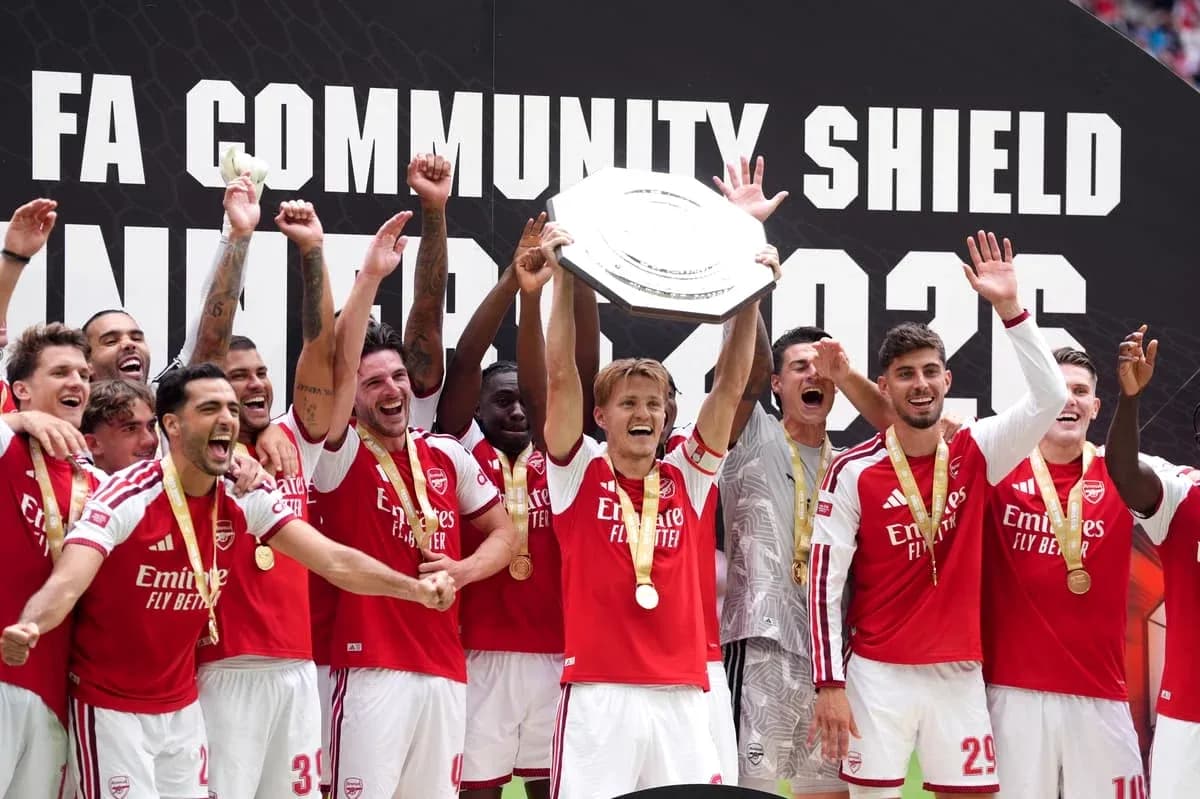
Martin Odegaard's Impact in Arsenal's Community Shield Victory
Martin Odegaard did not so much score Arsenal’s third as bring the whole afternoon to a calm, inevitable conclusion.
He slipped into space, froze Gianluigi Donnarumma with a feint, and rolled the ball home with the kind of composure that makes a stadium fall briefly silent before it roars. Barely two minutes into the second half of the Community Shield in Cardiff, the captain had made it 3-0. The contest with Manchester City was over. The silverware, once again, was his to lift.
Yes, it is “only” the Community Shield. Superstition merchants will point out no team have paraded it in August and then the Premier League trophy in May since 2018/19. But this felt less like a curtain-raiser and more like a reminder. Arsenal blew away City without the marquee forward they have chased all summer — and did it with Odegaard at the heart of a retooled attack.
Captain back at the centre of it all
Odegaard’s place in Arsenal history is already secure. He is the captain who finally hoisted the Premier League trophy in May, ending 22 years of waiting and anxiety at Emirates Stadium.
Yet last season, on a personal level, nagged at him. Knee and shoulder problems chopped his campaign into awkward fragments. He started only 16 league matches. Across 36 appearances in all competitions, he scored once. For a player of his influence, those numbers jarred.
Debate followed. Some argued Eberechi Eze should take his spot. Others wondered if Declan Rice should take the armband.
Mikel Arteta never wavered. “He missed five or six months for different things and it was extremely difficult for him to get any momentum,” the manager said after Sunday’s win. “I’m sure this year if we can maintain him fit, available with the players around him, we’re going to see a very different Martin.”
The Community Shield offered an early glimpse of that “different” version.
His clipped cross created Arsenal’s second goal. His movement constantly unhinged City’s back line. And when the chance came to finish the job, he did it with a swagger that suggested last season’s hesitancy has been firmly left behind.
Transfer frustration, internal solution
Arsenal’s recruitment plan this summer was clear: add a top-tier attacker, ideally an elite left winger, to sharpen a title-winning squad. They missed out on Morgan Rogers. Vinicius Jr stayed out of reach. As the window has dragged on, the list of realistic, game-changing options has shrunk.
Right now, there is no obvious “statement” signing waiting to walk through the door.
So Arteta has turned to something far more valuable than any new arrival: a fully fit, fully confident Odegaard.
The 27-year-old has entered the final two years of his contract. This is the stretch of his career that will likely define his next major deal and his long-term legacy. He knows it. He has used the frustration of last season as fuel.
“Last year was really a big struggle with a lot of difficult moments,” Odegaard admitted. “That’s the worst thing for a footballer, to not be on the pitch. I had quite a lot of weird injuries and bad luck.
“It was good to end it with the title here and then a good World Cup. Then I had my break. Now I feel good.
“After last season, to miss so many games is really frustrating. What I’ve done is use that as motivation for this year and come back stronger.”
He took three weeks off after the World Cup, spending time with his wife and young son before reporting back. The reset has been obvious to those around him.
“I sense from the first day that he joined that he has something else in the belly that he wants to prove and show because the team needs it as well,” Arteta said.
Numbers, edge and that missing yard
Last season, Odegaard often looked a yard short. He went into challenges half a beat late, sometimes pulling out, understandably wary after repeated setbacks. The rhythm that defined his best football deserted him.
Against City, that edge returned.
He won five of his seven duels. No player on the pitch made more recoveries. He pressed, snapped into tackles and still had the clarity to pick passes between the lines. The silk came with steel.
This isn’t a sudden surge from nowhere. He carried strong form out of the World Cup, where only Michael Olise registered more assists than the Norwegian. The difference now is fitness and continuity. For the first time in a long time, Odegaard looks like he trusts his body again.
He only made his first pre-season appearance just over a week ago, playing 30 minutes against Borussia Dortmund and twice slicing them open with through balls. The sharpness is arriving quickly.
And he should be even more dangerous with Bruno Guimaraes now added to the squad. The Brazilian’s ability to fire passes through the lines gives Arsenal a different kind of technical platform. If Guimaraes can find Odegaard between the lines regularly, defences will be dragged into areas they do not want to visit.
Attack rebuilt from within
Arsenal’s title win last season was forged on defensive granite. They did it without an elite striker and with wingers who, for long stretches, fought for rhythm.
It was still enough.
In the absence of a blockbuster forward signing this summer, the path to improvement is clear: squeeze more out of what is already there. That is not blind optimism; it is a realistic demand.
Bukayo Saka, Arteta insists, has finally shaken off his Achilles issue. Christos Tzolis already looks like an upgrade on the left, offering directness and variety. Around them, the patterns are familiar, but the execution can go up a level.
That is where Odegaard comes in.
At his peak, he is not just another creative midfielder. He is the system’s accelerator. In the 2022/23 Premier League season, he scored 15 goals and laid on seven assists. The following year, he posted eight goals and 11 assists. Those are elite output levels for a player who also sets the press, dictates tempo and leads the dressing room.
An ankle problem then stalled him. Injuries kept breaking his stride. Rhythm, that precious ingredient for any playmaker, vanished.
Cardiff suggested it is back.
The finish past Donnarumma, the vision for Arsenal’s second, the constant scanning and movement between City’s lines — this was the Odegaard who once dragged Arsenal’s attack up a tier almost on his own.
Arsenal already know he can captain them to a league title. The question now is different, and more ambitious: with this version of Odegaard orchestrating again, how far can this attack stretch the ceiling of a team that has already climbed to the summit?