Newcastle vs Liverpool: Tactical Insights from the 2-2 Draw
St James’ Park had the feel of a reset button for both clubs. Opening day, late-summer light, and two sides who finished locked together on the scoreboard and in the table. Following this result, Newcastle sit 11th and Liverpool 10th in the Premier League, each with 1 point, each with a goal difference of 0 after a 2–2 draw that said as much about their evolving identities as it did about the scoreline.
I. The Big Picture – Two 4-2-3-1s, two different stories
Both coaches declared their intentions with matching 4-2-3-1 shapes, but the personalities inside those structures were strikingly different.
For Newcastle, Matthias Jaissle leaned into energy and verticality. L. Hornicek in goal was shielded by a back four of A. Dedic, M. Thiaw, S. Botman and L. Hall – a blend of aerial security and ball progression. Ahead of them, the double pivot of S. Steur and L. Miley gave Newcastle a young, mobile core: Steur as the tidier recycler, Miley as the rhythm-setter who can step beyond the first line. The attacking band of three – A. Elanga right, Y. Wissa central, H. Barnes left – fed into the movement of W. Osula as the lone forward.
Liverpool, under Andoni Iraola, mirrored the 4-2-3-1 but with a more possession-heavy tilt. Alisson was backed by an adventurous back line: J. Frimpong and M. Kerkez as aggressive full-backs, J. Jacquet partnering V. van Dijk centrally. The double pivot of D. Szoboszlai and R. Gravenberch offered two press-resistant carriers rather than a classic holder-and-runner pairing. Ahead of them, R. Ngumoha and C. Gakpo flanked the central creator F. Wirtz, with A. Isak leading the line.
Statistically, both sides walk away with identical seasonal profiles after one game. Overall, Newcastle have scored 2 and conceded 2, averaging 2.0 goals for and 2.0 against at home. Liverpool mirror that on their travels: 2 goals scored and 2 conceded away, for an away average of 2.0 scored and 2.0 conceded. The symmetry underlines how finely balanced this contest was, and how small details will define their trajectories from here.
II. Tactical Voids – Who wasn’t there, and what that changed
The absences list quietly shaped the tactical landscape.
For Newcastle, Joelinton’s injury removed a powerful, all-phase midfielder who usually knits transitions and offers a direct target when building under pressure. Without him, Jaissle doubled down on technical youth in central areas, asking Miley and Steur to manage tempo and distance. V. Livramento’s hamstring injury also mattered: with him unavailable, Dedic’s role at right-back became conservative by necessity. Newcastle lost some of the overlapping chaos Livramento can provide, which in turn placed more responsibility on Elanga to stretch the pitch.
Liverpool’s missing quartet – C. Bradley, H. Ekitike, J. Gomez and G. Leoni – narrowed Iraola’s options both in rotation and in-game adaptation. Bradley’s knee injury meant Frimpong had to go the distance as the high, wide outlet on the right, with no like-for-like deputy. Gomez’s absence removed a flexible defensive piece who can shift between full-back and centre-back, making Iraola more committed to his starting back four. Up front, Ekitike’s Achilles problem limited Liverpool’s capacity to change the profile of their number nine late on, keeping the creative burden on Wirtz, Gakpo and Isak.
Discipline also told a story. Newcastle’s season card profile already shows a spread of yellow cards across the timeline: 20.00% of their yellows have come in each of the 16–30, 31–45, 61–75 and 76–90 minute ranges, with another 20.00% between 91–105. That pattern suggests a side that tackles aggressively in every phase, not just in desperation time. Liverpool’s yellows away from home have been more concentrated: 66.67% between 16–30 minutes and 33.33% between 76–90, hinting at a team that can be rattled early by tempo shifts and again in the closing stretch.
III. Key Matchups – Hunter vs Shield, and the battle for control
Hunter vs Shield
In the absence of a prolific, established Premier League scorer in this data set, the “Hunter vs Shield” duel is more about creative finishers than pure number nines.
For Newcastle, A. Elanga and J. Willock emerge as early-season threats. Elanga, starting from the right, has already scored 1 goal in total this campaign, hitting the target with both of his shots and completing 1 of 2 dribbles. His 9 duels and 3 fouls drawn underline his willingness to engage defenders repeatedly. Willock, coming from the bench, also has 1 goal overall and a 7.6 rating, with 1 shot on target from 1 attempt and 2 tackles made. Together, they offer different angles of penetration: Elanga attacking space from wide, Willock surging late from midfield.
The shield Liverpool rely on is still anchored by van Dijk’s presence and the protection of Gravenberch and Szoboszlai. Gravenberch’s numbers are revealing: 47 passes with 91% accuracy, 1 tackle and 2 interceptions overall. He is not just a passer; he is part of the first defensive line when possession is lost. Against Newcastle’s vertical runners, his ability to snuff out transitions before they reach the back four is vital.
On the other side, Liverpool’s offensive pulse is carried by F. Wirtz and the roaming Gakpo, with Isak finishing moves. The early creative fulcrum, though, is again Gravenberch: 1 assist in total this season, 1 key pass and 3 fouls drawn. His capacity to step forward from the pivot and combine with Wirtz between the lines will repeatedly test the positioning of Steur and Miley.
Engine Room – control vs chaos
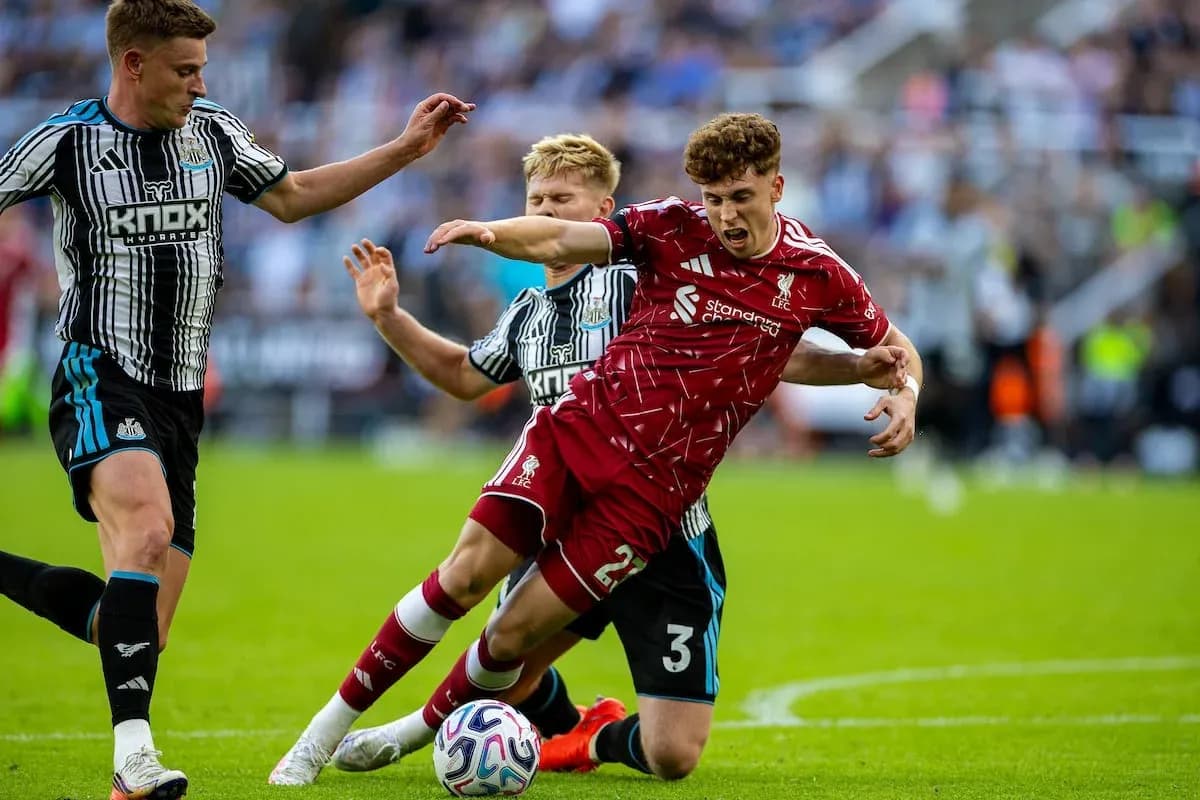
The midfield duel is where this fixture truly lived. Miley’s numbers encapsulate his importance to Newcastle’s structure: 36 passes at 83% accuracy, 2 key passes, 1 tackle, 1 block and 1 interception overall. He is both metronome and disruptor. Around him, Wissa and Ramsey bring edge: Wissa has 4 tackles and 19 total duels (winning 11), while Ramsey adds 2 tackles, 1 block and 1 interception from the bench, each with a yellow card to their name. This is a midfield that embraces controlled chaos – it will foul, press and break lines.
Liverpool’s engine is more about control. Szoboszlai and Gravenberch are both comfortable receiving under pressure and driving forward, but their defensive responsibility is heavy. If Newcastle’s front four press aggressively in those 16–30 and 31–45 minute windows – when Newcastle historically pick up 40.00% of their yellows combined – they can force turnovers high, but they also risk exposing the back four if Liverpool play through.
IV. Statistical Prognosis – Margins, xG hints and what comes next
With only one match played for each side, the statistical sample is thin but suggestive. Overall, Newcastle’s attack at home has produced 2 goals from what feels like a high-energy, transition-heavy approach. They have not yet kept a clean sheet, and their overall average of 2.0 goals conceded at home points to a defence still calibrating its distances, especially with a new goalkeeper and a young double pivot.
Liverpool’s away profile is almost a mirror: 2 goals scored, 2 conceded, 0 clean sheets, but with a more structured attacking pattern. Their single penalty this season has been converted, giving them a 100.00% record from the spot so far, an important psychological edge in tight games.
Defensively, neither side has yet shown the solidity to grind out low-scoring wins. Newcastle’s disciplinary spread – yellows appearing from 16 minutes all the way beyond 90 – suggests sustained physical commitment but also the risk of late-game fatigue and cheap fouls around the box. Liverpool’s concentration of early yellows hints that the first half-hour is the window in which opponents can most easily disrupt their rhythm and provoke mistakes.
Taken together, the numbers point toward a season in which both Newcastle and Liverpool are more likely to be involved in open, high-event games than in sterile, low-xG stalemates. The shared 2–2 opening, the identical goal averages, and the prominence of creative midfielders like Elanga, Willock and Gravenberch all suggest that, tactically, the story of their campaigns will be written in the spaces between the lines rather than in the penalty areas alone.
For Jaissle, the challenge is to harness the chaos without losing control – to turn the dueling energy of Wissa, Miley and Ramsey into a platform rather than a firefight. For Iraola, it is about hardening a possession side that can be rattled in those 16–30 and 76–90 minute bands, ensuring that the elegance of Wirtz and the craft of Gravenberch are not undermined by defensive lapses.
Following this result, both clubs leave St James’ Park knowing they can hurt anyone – and that, statistically and tactically, they can still be hurt just as easily.