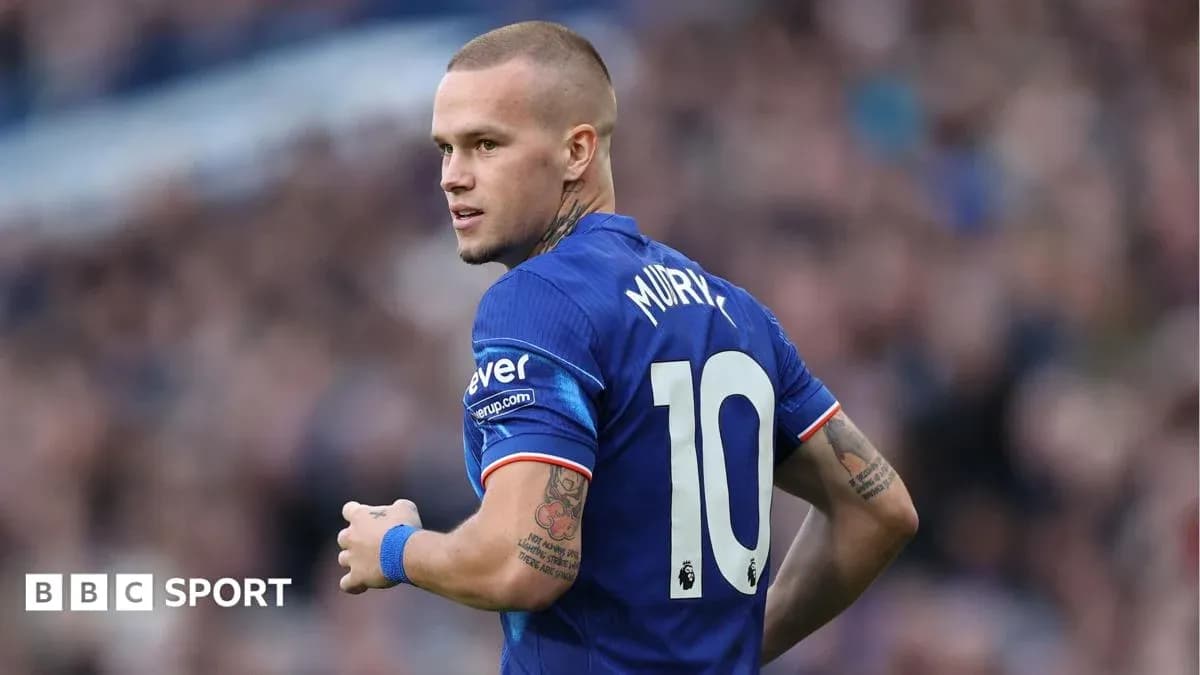
Mudryk’s Return to Chelsea: What to Expect from the Winger
Mykhailo Mudryk is finally on his way back into Chelsea blue. What he looks like when he gets there is anyone’s guess.
Cleared to resume his career after serving a one-year, eight-month suspension for an anti-doping breach, the 25-year-old winger will rejoin Chelsea’s pre-season tour in Hong Kong. For a player who has not kicked a competitive ball since November 2024, simply boarding that flight is a significant step.
Xabi Alonso, speaking after a 2-1 defeat to 10-man Tottenham in a friendly in Sydney, did not try to dress it up as anything more than that.
“Yes, he is coming to Hong Kong, but I haven't spoken to him yet,” the Chelsea manager said, before quickly applying the brakes on any rush to judgement. It is, he stressed, “too early” to know what version of Mudryk Chelsea are getting back – physically, mentally, or tactically.
A Case Closed, A Career Reopened
Mudryk’s absence stemmed from an “adverse finding” for meldonium, a banned substance, which led to a provisional suspension and a long, uncertain spell in limbo. The Football Association has now closed its anti-doping proceedings after the Ukraine international accepted a breach of the rules and agreed to a ban equal to the time already served.
No fanfare. No grand unveiling. Just a quiet line on a team-sheet in pre-season, somewhere far from home.
Alonso, though, cut through the procedural language and spoke to the human cost.
“We are happy for him, especially for him,” he said. “We are probably not able to understand what he has been through during this time and how he feels at the moment with the things he has had to cope with.”
Mudryk has not been allowed to train at Chelsea’s Cobham base or work with club staff during his suspension. While his team-mates worked under club conditioning coaches and analysts, he built a makeshift career-in-exile: a private coach, hired goalkeepers, and sessions at non-league Uxbridge just to keep a ball at his feet.
That kind of isolation leaves a mark. Alonso knows it.
Fitness Questions, Emotional Unknowns
From a purely football perspective, Mudryk returns as a riddle. His match sharpness is an obvious concern. So is his rhythm, his confidence, his ability to reconnect with a dressing room that has moved on without him.
“It’s too early to tell how he is in terms of fitness, in terms of the game time you need to be involved again,” Alonso admitted. “We expect that it will take time.”
He did not dress up the challenge.
“He trained on his own every day, and I think it had to be really, really hard because he wanted to play football, he wanted to be part of a team, and he was not allowed to do that for such a long time.
“Afterwards we will see if it's quicker or slower, but we need to be aware of that. We want him to feel part of the team. Once he is with us, we will see how things develop.”
That last line matters. Chelsea do not yet have a plan for Mudryk carved in stone. They have a player returning from the wilderness and a manager willing to watch, wait and judge with his own eyes.
A Surprise Return to a Crowded Wing
The other complication is the squad he is walking back into. When Mudryk disappeared from the picture, Chelsea did what big clubs do: they bought, they planned, they moved on.
Alonso now has a wing department that barely has room to breathe. Pedro Neto, Estevao Willian, Jamie Gittens and Geovany Quenda are already jostling for minutes. Cole Palmer can step wide. So can Morgan Rogers, a £117m signing who did not arrive to sit politely on the bench.
In that context, Mudryk’s return is not just emotional; it is strategic. It changes the puzzle.
“Yeah, to be honest, we were not expecting to have this great news at this moment,” Alonso said.
Great news, yes. But also a surprise variable in an area of the pitch where Chelsea had already stocked up heavily.
A Second Chance, On Different Terms
For Mudryk, this is not simply a continuation of a Chelsea career paused by a ban. It feels more like a restart. The club has evolved, the competition is fiercer, and his margin for error is slimmer.
He will arrive in Hong Kong as the story, but not as the guaranteed starter. The work he did in the shadows with private coaches and at Uxbridge kept him alive as a professional, but it cannot replicate the pace, pressure and scrutiny of elite football.
Chelsea, and Alonso, sound prepared for that reality. They are not promising miracles. They are promising patience.
The winger who once arrived at Stamford Bridge as a symbol of a new era now returns as something more fragile and more intriguing: a talent with scars, a career that has already stared into the void.
What he does with this second chance will say as much about Chelsea’s future on the flanks as it will about his own.